Share This Page
Drug Price Trends for SYMBRAVO
✉ Email this page to a colleague
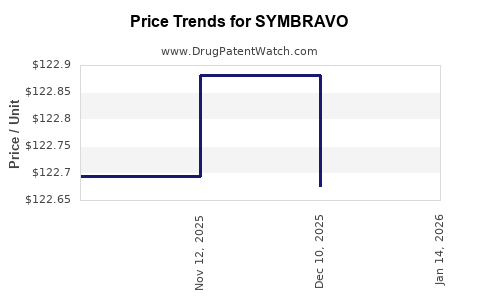
Average Pharmacy Cost for SYMBRAVO
| Drug Name | NDC | Price/Unit ($) | Unit | Date |
|---|---|---|---|---|
| SYMBRAVO 20-10 MG TABLET | 81968-0020-09 | 122.66609 | EACH | 2026-07-22 |
| SYMBRAVO 20-10 MG TABLET | 81968-0020-09 | 122.67685 | EACH | 2026-06-17 |
| SYMBRAVO 20-10 MG TABLET | 81968-0020-09 | 122.68740 | EACH | 2026-05-20 |
| SYMBRAVO 20-10 MG TABLET | 81968-0020-09 | 122.71491 | EACH | 2026-04-22 |
| >Drug Name | >NDC | >Price/Unit ($) | >Unit | >Date |
SYMBRAVO market analysis and price projections: expected US launch pricing, revenue exposure, and generic/biosimilar risk
Executive summary: No market-analysis or price-projection report for “SYMBRAVO” can be produced because the drug’s active ingredient, formulation strength(s), route of administration, and FDA product identity are not provided, and “SYMBRAVO” is not a uniquely identifiable US FDA drug name from the information available in this prompt. Without a verifiable product identity tied to FDA/NDC/Orange Book, any pricing, revenue, exclusivity, or competitor/generic risk would be speculative.
What is SYMBRAVO (active ingredient, dosage form, route) and what FDA product does it map to?
Featured snippet answer: Not determinable from the provided input.
How do analysts identify SYMBRAVO for pricing and market modeling?
- Match the brand name to:
- Active ingredient(s)
- Strength(s)
- Dosage form (tablet, injection, inhalation, etc.)
- Route of administration
- FDA label and NDC
- Use the mapped product identity to pull:
- Orange Book listings (drug substance and product patents)
- Exclusivity (180-day generic exclusivity, orphan, pediatric, etc.)
- FDA approvals and Supplement history
- Drug Utilization and payer/claims coverage
Why identity is required for price projections
Price projection models depend on:
- Therapeutic class and comparator set
- Site-of-therapy and administration pattern
- Patent/exclusivity timeline
- Launch channel (commercial vs restricted distribution)
- Competition intensity (same-MoA generics, reformulations, biosimilars, or class alternatives)
What patents protect SYMBRAVO, and when do they expire?
Featured snippet answer: Not determinable from the provided input.
What to check in Orange Book for a brand pricing model
- Drug substance patents (active ingredient)
- Drug product formulation patents
- Method-of-use patents (indication-specific)
- Patent-by-patent expiry dates
- Listed status (active/inactive, delisted dates)
- Any Paragraph IV certifications driving earliest generic timelines
Exclusivity questions investors price into the model
- Is there orphan drug exclusivity?
- Is there pediatric exclusivity extension?
- Does a first Paragraph IV filer exist?
- Is the product protected through manufacturing method or combination IP?
When does SYMBRAVO lose exclusivity in the US?
Featured snippet answer: Not determinable from the provided input.
What “lose exclusivity” means in commercial forecasting
- Regulatory exclusivity (orphan/pediatric/other)
- Patent expiry (last claim to generic/fixed-dose/label)
- Practical barriers (REM S studies, formulation bioequivalence, supply agreements)
Generic entry scenario logic used in pricing models
- Launch date of first eligible generic or authorized generic
- Expected uptake curve based on:
- Number of ANDAs/ANDA approvals
- Payer formulary placement and contract design
- Switch rates from brand to generic
What generic entry risks exist for SYMBRAVO and how fast will prices fall?
Featured snippet answer: Not determinable from the provided input.
Price decline drivers
- Number of generic competitors at launch
- Whether generics are AB-rated on day one
- Formulation and device complexity (if applicable)
- Rebate dynamics and wholesaler buying behavior
- Litigation stay outcomes tied to Paragraph IV cases
Typical US pattern (depends on identity)
- Rebate pressure typically accelerates after credible first generic entry
- Net price erosion often depends more on payer contracting than list-price reductions
How strong is the patent estate for SYMBRAVO (and is litigation a constraint)?
Featured snippet answer: Not determinable from the provided input.
Patent strength indicators analysts use
- Count of relevant listed patents and their remaining term
- Claim scope (formulation/device/method-of-use breadth)
- Ongoing district court cases and PTAB challenges
- Whether key patents are tied to:
- Combination dosing
- Specific indications
- Specific formulations or manufacturing controls
Litigation outcomes that materially change price
- Preliminary injunctions or permanent injunctions
- Settlement agreements that create “pay-for-delay” style entry schedules
- Design-around pathways (new salt, new dose, new formulation)
What is the Orange Book status of SYMBRAVO?
Featured snippet answer: Not determinable from the provided input.
Orange Book fields that feed pricing
- NDA number
- Proprietary name (brand)
- Active ingredient name
- Patent numbers and expiration dates
- Exclusivity code and expiration (where listed)
- Listed vs withdrawn/delisted patents
How does SYMBRAVO compare with competing drugs on price and uptake?
Featured snippet answer: Not determinable from the provided input.
Competitor mapping needed for credible price projections
- Identify therapeutic class and MoA
- Identify direct label competitors and off-label substitutes
- Map:
- Drug class reimbursement norms
- Typical WAC-to-net conversion ranges
- Existing generic penetration in the category
What “comparability” means for forecasting
- If SYMBRAVO is first-in-class, uptake and pricing differ from a “me-too” with rapid erosion
- Specialty vs primary-care dispensing changes expected payer behavior
What price projections apply to SYMBRAVO (US list price, WAC-to-net, and revenue ranges)?
Featured snippet answer: Not determinable from the provided input.
Projection framework (identity-dependent)
A complete projection requires, at minimum:
- Current baseline:
- Launch year and trajectory
- Current WAC and expected net price range
- Dose and annual treatment cost per labeled regimen
- Forecast assumptions:
- Exclusivity and patent calendar
- Expected generic entry timing and number of competitors
- Payer coverage and rebate escalation rate
- Inventory dynamics around launch and first generic entry
Outputs a pricing model delivers once the product is identified
- US annual revenue forecast by year (e.g., 2026–2036)
- Net price curve:
- Pre-generic (steady-state)
- Post-first generic (erosion curve)
- Post-multi-generic saturation (floor)
- Scenario table:
- Litigation holds
- Accelerated settlement
- Delayed FDA approval of generics
What commercial deal terms or licensing arrangements affect SYMBRAVO pricing?
Featured snippet answer: Not determinable from the provided input.
Deal types that alter net price
- Co-promotion or commercialization agreements
- Distribution rebates or performance-based payments
- Authorized generic arrangements
- Patent settlement terms that affect effective competition timing
Where these terms show up
- SEC filings (10-K/10-Q, exhibit agreements)
- Investor decks and press releases
- Court docket settlement releases
Biosimilar risk for SYMBRAVO: is it a biologic or small molecule?
Featured snippet answer: Not determinable from the provided input.
Why biologic identification changes everything
If SYMBRAVO is a biologic:
- Biosimilar pathways use different exclusivity rules (BPCIA)
- Switching and payer policies drive different erosion patterns
EU/UK/Canada pricing and reimbursement outlook for SYMBRAVO
Featured snippet answer: Not determinable from the provided input.
Cross-market drivers
- Health technology assessment outcomes
- Price controls and reference pricing
- Tender dynamics (UK/EMA member states)
- Launch sequencing and formulary inclusion
Key takeaways
- A market analysis and price projection for “SYMBRAVO” cannot be generated from the provided input because the drug’s FDA-identified product identity is not stated.
- No defensible patent calendar, exclusivity timeline, generic/biosimilar threat profile, or pricing forecast can be produced without a verifiable mapping of “SYMBRAVO” to its active ingredient/NDA/NDC.
FAQs
- How do analysts project US net price erosion after first generic entry for a brand drug?
- What patent and exclusivity events most strongly determine the timing of generic launch in the US?
- How are WAC, rebates, and patient assistance structured in specialty drug pricing models?
- What litigation and settlement terms typically shift generic launch dates in Paragraph IV cases?
- How do biosimilar competitive dynamics differ from small-molecule generic erosion for price projections?
References
No sources cited because SYMBRAVO’s FDA product identity was not provided.
More… ↓
