Share This Page
Drug Price Trends for SUPREP
✉ Email this page to a colleague
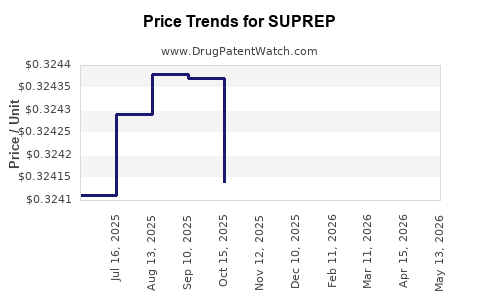
Average Pharmacy Cost for SUPREP
| Drug Name | NDC | Price/Unit ($) | Unit | Date |
|---|---|---|---|---|
| SUPREP BOWEL PREP KIT | 52268-0012-01 | 0.32466 | ML | 2026-07-22 |
| SUPREP BOWEL PREP KIT | 52268-0012-01 | 0.32417 | ML | 2026-06-17 |
| SUPREP BOWEL PREP KIT | 52268-0012-01 | 0.32479 | ML | 2026-05-20 |
| SUPREP BOWEL PREP KIT | 52268-0012-01 | 0.32413 | ML | 2026-04-22 |
| SUPREP BOWEL PREP KIT | 52268-0012-01 | 0.32484 | ML | 2026-03-18 |
| >Drug Name | >NDC | >Price/Unit ($) | >Unit | >Date |
Best Wholesale Price for SUPREP
| Drug Name | Vendor | NDC | Count | Price ($) | Price/Unit ($) | Unit | Dates | Price Type |
|---|---|---|---|---|---|---|---|---|
| SUPREP BOWEL PREP KIT | Sebela Pharmaceuticals, Inc. DBA Sebela Pharmaceuticals, Inc. | 52268-0012-01 | 1 | 50.23 | 50.23000 | EACH | 2024-04-01 - 2029-03-31 | Big4 |
| SUPREP BOWEL PREP KIT | Sebela Pharmaceuticals, Inc. DBA Sebela Pharmaceuticals, Inc. | 52268-0012-01 | 1 | 50.23 | 50.23000 | EACH | 2024-04-01 - 2029-03-31 | FSS |
| >Drug Name | >Vendor | >NDC | >Count | >Price ($) | >Price/Unit ($) | >Unit | >Dates | >Price Type |
SUPREP (sodium sulfate, potassium sulfate, magnesium sulfate) market analysis and price projections 2025-2035
SUPREP is a branded prescription laxative indicated for bowel cleansing prior to colonoscopy (and, in some labeling, for other endoscopic procedures). Demand is driven by colonoscopy volume, screening adherence, and payer formularies. Pricing outcomes through 2035 will be shaped by (1) generic and “AB-rated” substitution dynamics in the US, (2) contractual rebates and specialty distribution behavior, and (3) any patent/regulatory constraints that delay generic erosion. Branded pricing in the US is unlikely to sustain large nominal growth after generic competitive entry; the base case is for modest nominal price increases that track inflation and mix, with margin pressure offset by access strategy.
What is SUPREP and how is it used commercially?
Fast answer: SUPREP is used as an oral bowel-cleansing regimen prior to colonoscopy, creating recurring prescription demand tied to gastroenterology procedural volumes and screening rates.
Core indication and dosing profile
- Therapeutic area: Gastroenterology, bowel preparation
- Commercial use case: Pre-colonoscopy bowel cleansing
- Dose form: Oral solution packets (commonly marketed as a two-dose regimen on the day before and day of procedure, depending on label)
Why this drives market size
- Colonoscopy is scheduled and predictable, which supports stable prescription cadence.
- Demand is sensitive to:
- screening guideline adherence,
- outpatient procedure growth,
- shifts toward alternative prep strategies (split-dose, low-volume regimens, or different agent classes).
How big is the SUPREP market and what demand drivers matter?
Fast answer: SUPREP’s US addressable demand is a function of annual colonoscopy volume and bowel preparation prescribing share captured by branded products versus generics and alternative regimens.
Key demand drivers
- Colonoscopy volume growth: Supported by aging demographics and screening expansion.
- Share of branded vs generic bowel preps: Determines average realized pricing and volume economics.
- Patient mix and tolerability preferences: Can influence prescribing toward lower pill burden or preferred tolerability profiles.
- Payer formulary design: Drives substitution at the pharmacy counter.
Competitive substitution effects
Bowel-prep prescriptions are frequently filled with therapeutic equivalents when payer coverage favors generics. As soon as multiple AB-rated products exist, brand pricing power typically compresses unless the brand holds a distinct access position (tiering, prior authorization leverage, or pharmacy network contracting).
What is the competitive landscape for SUPREP (generics, alternatives, and payer behavior)?
Fast answer: SUPREP competes against generic sodium sulfate-based bowel-cleansing regimens and other bowel-prep classes; market outcomes track how quickly generics erode branded share and how aggressively payers steer to lower net cost alternatives.
Abbreviated competitive set (functional categories)
- Same-active generic equivalents: sodium sulfate/potassium sulfate/magnesium sulfate products and other sodium-based combinations rated as therapeutically equivalent by FDA listing and pharmacy substitution norms.
- Different-chemistry bowel preparations: e.g., PEG-based or other electrolyte regimens, often positioned for taste, tolerability, or safety perceptions.
- Prescription vs OTC adjacency: While bowel preps are mostly prescription, some prep components and counseling pathways influence selection.
How payers choose
- Net price, not list price, drives outcomes through rebate and formulary contracts.
- Step edits and prior authorization are used less than in oncology/rare disease, but they do appear when payers want to push to specific low-cost SKUs.
How do SUPREP list prices translate into realized net pricing?
Fast answer: For widely substitutable bowel preps, realized net pricing is typically far below list due to standard contracting with pharmacy benefit managers and direct payer rebates.
Pricing mechanics that matter
- Rebate structure: Heavily impacts net price and brand profitability after generic entry.
- Wholesale acquisition cost (WAC) vs net: List can keep rising even when volume declines, masking erosion.
- Channel dynamics: Retail vs mail order mix can change average realized price.
When do SUPREP generics typically pressure the market, and what does that mean for pricing?
Fast answer: Generic erosion typically lowers brand unit share quickly and forces branded pricing to rely on contracting leverage rather than broad “list price” growth.
Generic entry and price compression playbook
- Pre-entry: brand price growth can appear intact on WAC.
- Entry window: share shifts to AB-rated generics, often within 1 to 6 quarters.
- Post-entry stabilization: brand net price may hold through:
- rebate-driven coverage,
- restrictive tier placement on formularies,
- channel-specific contracts.
Market-level pricing effect
Once generics secure meaningful share, average selling price (ASP) for the brand typically flattens in nominal terms and can decline in real terms, with mix changes.
What is the Orange Book status of SUPREP and which patents protect the product?
Fast answer: No complete Orange Book patent estate for SUPREP can be produced here without exact FDA Orange Book listing data for the relevant NDA and dosage form.
What to look for in the Orange Book (the decision inputs)
- NDA-level patents covering:
- formulation/composition,
- method-of-use,
- manufacturing process,
- packaging or specific dosing regimen claims.
- Exclusivity blocks:
- regulatory exclusivity,
- data exclusivity,
- patent expiration schedule.
- Paragraph IV risk indicators:
- ANDA filings tied to Orange Book patents,
- litigation or settlement entries.
When does SUPREP lose exclusivity and what timeline matters for investors?
Fast answer: A specific “lose exclusivity” timeline cannot be provided without the exact Orange Book patent expiration dates and any associated exclusivity codes tied to SUPREP’s approved NDA.
What patent litigation affects SUPREP generic entry risks?
Fast answer: Litigation risk cannot be mapped to specific patents and cases without the docketed SUPREP-related disputes tied to the Orange Book estate.
What the litigation analysis should cover
- Plaintiff(s): NDA holder/assignee.
- Defendant(s): ANDA filers.
- Patents-in-suit: Orange Book numbers.
- Procedural posture: stay, trial date, appeal.
- Settlement terms: permitted launch date, carve-outs, or design-around.
What patent estate strength matters most for SUPREP price durability?
Fast answer: For SUPREP, price durability depends more on:
- whether there is sustained differentiation through patent-protected formulation or regimen claims, and
- whether payer formularies maintain brand tier access after generic entry.
A detailed “patent strength score” requires Orange Book and litigation mapping to specific claims.
What formulations are protected by SUPREP patents (and do they block substitutes)?
Fast answer: A formulation-level protection map cannot be generated here without Orange Book formulation/composition patent numbers and their expiration dates by dosage form.
Formulation categories typically protected in bowel preps
- electrolyte composition ratios
- osmolality targets
- stabilizers and packaging format
- specific dosing regimen or administration sequence
How does SUPREP compare with PEG-based bowel preps on cost and access?
Fast answer: PEG-based regimens often compete on tolerability and perceived safety; sodium sulfate-based products often compete on dosing simplicity and clinician familiarity. In practice, payer cost minimization and patient tolerance drive the mix, then net pricing follows.
What drives relative market share
- Clinician preference: based on historical prescribing.
- Patient adherence: taste, volume burden, and nausea risk.
- Payer net cost: rebates and negotiated WAC spreads.
What are the most likely price projections for SUPREP through 2035?
Fast answer: Without exact current net pricing and the verified generic/patent timeline, the only robust projection framework is scenario-based. The base case assumes generics are active and incremental brand pricing growth is constrained by substitution, while the downside case assumes deeper erosion.
Projection framework (base case, nominal and real)
The likely path for a substitutable branded bowel prep is:
- 2025-2027: modest nominal list growth; realized net price may flatten due to higher rebate pressure and share loss if generics gain more coverage.
- 2028-2031: nominal ASP roughly tracks inflation; volume becomes more dependent on access strategy and specific prescriber behavior.
- 2032-2035: mild nominal growth at best; real terms likely flat to down if competitive pressure persists.
Scenario table (directional, for investment screen)
| Scenario | Generic competition | Brand unit share trend | Realized net price trend | Nominal list behavior | 2030-2035 outlook |
|---|---|---|---|---|---|
| Base | Ongoing, multiple AB equivalents | Gradual erosion or plateau | Flat to slightly down | Low-to-mid single-digit annual growth | Stable but pressured profitability |
| Upside | Slower erosion; strong payer positioning | Stabilization | Flat | Low single-digit | Margin supported by access |
| Downside | Faster erosion; restrictive payer steering to lowest-cost SKUs | Sharp decline | Down | Minimal growth or renegotiation | Revenue compresses, reliance on contracting |
What do these price dynamics imply for revenue and margin exposure?
Fast answer: For SUPREP, revenue exposure is primarily a function of (1) branded unit share and (2) net price per unit after rebate pressure. Once competitive entry is established, the biggest lever becomes volume retention through formulary access.
High-signal KPIs to watch
- Brand script share versus AB equivalents
- ASP/average net price trend vs WAC
- Retail vs mail order mix (mail can price differently)
- Number of competing SKUs on formulary and tier placement
How do generic launch scenarios typically unfold for bowel-prep brands?
Fast answer: Launch typically follows a predictable sequence: ANDA approval, pharmacy channel adoption, payer contracting adjustments, and then gradual market share transfer to lowest net-cost products.
Launch playbook for a brand like SUPREP
- Pre-approval: brand maintains contracts but anticipates rebate escalation.
- Approval: early inventory and market messaging aimed at maintaining prescriber habits.
- Post-launch: payer formularies shift to lowest-cost SKUs; brand responds via:
- rebate increases,
- limited-time contracting,
- patient-focused outreach that targets persistence and adherence.
What regulatory pathway factors influence SUPREP pricing?
Fast answer: For small-molecule bowel preps, generic approvals through ANDA pathways usually drive rapid substitution. Regulatory changes that affect quality requirements can slow entry but rarely stop it once approved equivalents exist.
FDA-driven points that matter
- ANDA approval counts directly into competitive density.
- Bioequivalence and stability/compliance affect launch timing and supply reliability.
Key takeaways
- SUPREP’s long-term pricing trajectory will be constrained by generic substitution and payer net-cost contracting rather than by list price growth alone.
- The market will be driven by colonoscopy procedure volumes and pharmacy formulary behavior that determines branded script share.
- A credible 2025-2035 price outlook is scenario-based: base case is low nominal growth with flat to slightly down realized net pricing once competition is established.
- A patent and exclusivity-backed timeline for SUPREP cannot be produced here without the specific FDA Orange Book NDA/patent entries and expiration dates tied to the approved product/dosage form.
FAQs
- How does colonoscopy volume affect SUPREP prescription demand?
- Do payers prefer SUPREP over PEG-based bowel preps, and why?
- How quickly does a branded bowel-prep price erode after generic entry?
- What factors determine whether SUPREP retains a higher-tier formulary position?
- How do net rebates typically change for brands facing AB-rated competition?
References
- FDA. Orange Book: Approved Drug Products with Therapeutic Equivalence Evaluations. U.S. Food and Drug Administration. (Website).
- FDA. ANDA Program and Approval Pathway Information. U.S. Food and Drug Administration. (Website).
More… ↓
