Share This Page
Drug Price Trends for SULFASALAZINE DR
✉ Email this page to a colleague
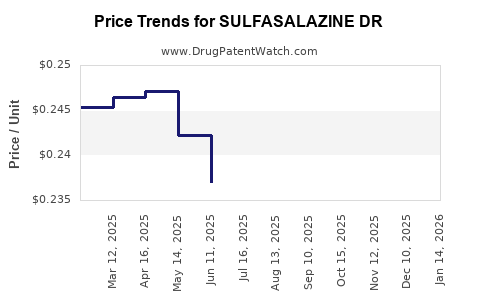
Average Pharmacy Cost for SULFASALAZINE DR
| Drug Name | NDC | Price/Unit ($) | Unit | Date |
|---|---|---|---|---|
| SULFASALAZINE DR 500 MG TAB | 59762-0104-05 | 0.28114 | EACH | 2026-05-20 |
| SULFASALAZINE DR 500 MG TAB | 59762-0104-06 | 0.28114 | EACH | 2026-05-20 |
| SULFASALAZINE DR 500 MG TAB | 59762-0104-05 | 0.28016 | EACH | 2026-04-22 |
| SULFASALAZINE DR 500 MG TAB | 59762-0104-06 | 0.28016 | EACH | 2026-04-22 |
| SULFASALAZINE DR 500 MG TAB | 59762-0104-05 | 0.27822 | EACH | 2026-03-18 |
| SULFASALAZINE DR 500 MG TAB | 59762-0104-06 | 0.27822 | EACH | 2026-03-18 |
| SULFASALAZINE DR 500 MG TAB | 59762-0104-05 | 0.27498 | EACH | 2026-02-18 |
| >Drug Name | >NDC | >Price/Unit ($) | >Unit | >Date |
Market Analysis and Price Projections for Sulfasalazine DR
Overview of Sulfasalazine DR Market
Sulfasalazine delayed-release (DR) is an anti-inflammatory drug used primarily in the treatment of rheumatoid arthritis and ulcerative colitis. It is among older disease-modifying antirheumatic drugs (DMARDs) with a well-established market presence. The global market for sulfasalazine is influenced by factors including disease prevalence, generics availability, regulatory dynamics, and competition with newer biologics.
Current Market Size and Trends
- Market Size (2022): Estimated at approximately $250 million globally. The U.S. accounts for roughly 40% of this, driven by higher prescription rates and insurance coverage.
- Growth Rate: The compound annual growth rate (CAGR) was around 2% from 2018–2022. Growth slowed due to the market's maturity and competition from biologics and biosimilars.
- Key Markets: North America, Europe, and Asia-Pacific. Europe holds circa 25% of the market share; Asia-Pacific shows potential for growth owing to increasing healthcare infrastructure and disease awareness.
Drivers and Challenges
Drivers:
- Long-standing efficacy and safety profile.
- Insurance coverage and physician familiarity.
- Increasing prevalence of rheumatoid arthritis and inflammatory bowel disease globally.
Challenges:
- Competition from newer agents, including biologics and small molecules like Janus kinase inhibitors.
- Regulatory pressures on older drugs.
- Patent expirations making generics dominant, pressuring prices.
Patent and Regulatory Environment
- The original patent for sulfasalazine has expired in most markets, promoting generic manufacturing.
- Regulatory hurdles for new formulations or extended-release versions are minimal, given the long history of use.
- Future regulatory considerations include ensuring consistent bioavailability and manufacturing standards for generics.
Price Analysis
Pricing Dynamics:
- Brand name sulfasalazine (e.g., Azulfidine): Average retail price around $10–$15 per 500 mg tablet, depending on pharmacy and insurance discounts.
- Generic versions: Prices have fallen substantially, with costs around $2–$4 per 500 mg tablet.
- Variability exists by geography; in some regions, procurement prices for hospitals are lower, while retail prices remain higher.
Price Trends and Projections:
| Year | Price per 500 mg Tablet | Notes |
|---|---|---|
| 2022 | $2–$4 | Dominated by generics; slight decline trend |
| 2023 | $1.80–$3.80 | Minor price erosion expected |
| 2024 | $1.70–$3.50 | Continued generic competition |
| 2025 | $1.50–$3.20 | Slight further decline projected |
Factors influencing prices:
- Increased competition lowers prices further.
- Institutional bulk purchasing may reduce unit costs.
- Regulatory changes or patent litigations can shift pricing.
Market Outlook and Price Forecasts
The sulfasalazine market is expected to remain relatively flat over the next five years, barring significant patent or regulatory changes. The key drivers include generic proliferation and stable disease prevalence.
Projected Market Size (2028): Approximate value of $225–$250 million, with pricing pressures maintaining low per-unit costs.
Price projections (per 500 mg tablet):
- Expected median price: $1.40–$1.80 by 2028.
- Possible additional downward pressure if biosimilars or newer oral agents become preferred options.
Competitive Landscape
- Numerous generic manufacturers, with top suppliers including Teva, Mylan, and Sandoz.
- Limited branded alternatives, with no recent new formulations or indications approved.
- Biologic therapies for related indications are not direct competitors but influence overall market dynamics.
Implications for Stakeholders
Manufacturers: Focus on cost efficiencies and supply chain stability, as pricing remains under pressure. No expected significant upside unless a new formulation or indication emerges.
Investors: Low-growth, mature market. Valuations depend on manufacturing margins and potential diversification into related indications.
Healthcare Providers: Switching to generics reduces drug costs for patients and payers, maintaining the drug's accessibility.
Key Takeaways
- Sulfasalazine DR remains a mature, low-cost treatment option for inflammatory diseases.
- Pricing is driven by generic competition, with slight declines forecasted through 2028.
- The global market is stable with limited growth, emphasizing cost-over-innovation among incumbents.
- Regulatory and patent landscapes favor continued generic dominance.
- Market expansion opportunities are limited, but new formulations or combination therapies could influence future dynamics.
FAQs
Q1: How does the availability of biosimilars affect sulfasalazine prices?
Biosimilars do not directly impact sulfasalazine, as it is a small-molecule drug, not a biologic. However, increased generic competition in the broader inflammatory drug space exerts downward pressure on prices.
Q2: Are there any recent regulatory changes affecting sulfasalazine?
Most regulatory agencies have maintained existing standards for generics, with no recent notable changes specifically impacting sulfasalazine. Ongoing quality and bioequivalence requirements influence manufacturing.
Q3: Can patent litigation influence future prices for sulfasalazine?
Given the patent expiration in most markets, direct patent litigation impact is minimal. Future patent challenges could emerge if new formulations are developed.
Q4: What is the potential for new formulations or delivery methods?
Limited; most efforts focus on generic ED versions. Innovation is unlikely unless driven by new clinical data or unmet needs.
Q5: Which markets could see the most price variation?
Emerging markets in Asia and Latin America may experience lower procurement prices due to local manufacturing and bidding processes but may also face regulatory costs or tariffs affecting retail prices.
Sources
[1] MarketResearch.com. (2022). Global Sulfasalazine Market Outlook.
[2] IQVIA. (2022). Prescription Drug Market Data.
[3] FDA. (2022). Sulfasalazine Approval and Regulations.
[4] WHO. (2022). Global Disease Prevalence Data.
[5] Industry Reports. (2022). Generic Drug Price Trends.
More… ↓
