Share This Page
Drug Price Trends for STRIBILD
✉ Email this page to a colleague
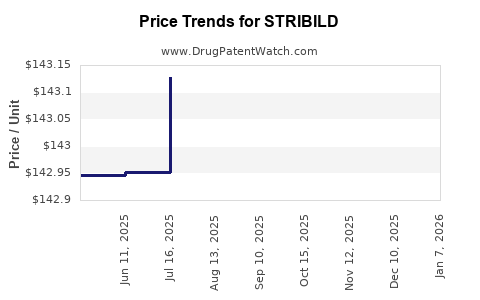
Average Pharmacy Cost for STRIBILD
| Drug Name | NDC | Price/Unit ($) | Unit | Date |
|---|---|---|---|---|
| STRIBILD TABLET | 61958-1201-01 | 149.73906 | EACH | 2026-07-22 |
| STRIBILD TABLET | 61958-1201-01 | 149.63067 | EACH | 2026-06-17 |
| STRIBILD TABLET | 61958-1201-01 | 150.00760 | EACH | 2026-05-20 |
| STRIBILD TABLET | 61958-1201-01 | 150.40902 | EACH | 2026-01-01 |
| STRIBILD TABLET | 61958-1201-01 | 143.38324 | EACH | 2025-12-17 |
| STRIBILD TABLET | 61958-1201-01 | 143.38472 | EACH | 2025-11-19 |
| >Drug Name | >NDC | >Price/Unit ($) | >Unit | >Date |
Stribild (elvitegravir/cobicistat/emtricitabine/tenofovir disoproxil fumarate) Market Analysis and Price Projections (U.S. and Major Ex-U.S. Markets)
Stribild is an established, low-cost-to-moderate priced HIV-1 fixed-dose combination that faces generic erosion risk as key exclusivities end and generic/bioequivalent supply expands. In the U.S., Stribild’s revenue trajectory has already shifted from brand growth to volume-stable, price-pressured dynamics, with payer channel tightening and increased competition from newer, higher-demand regimens. Price forecasts for Stribild in the next 3-5 years center on continued wholesale and net price compression under generic and preferred-tier pressures, with the main upside constraint being faster-than-average channel substitution to dolutegravir-based and INSTI-containing single-tablet regimens.
What is the current market size for Stribild and where does demand come from?
Core demand sources
- Persistent use in patients already stabilized on Stribild, where switching creates clinical and operational friction.
- Treatment-naïve and treatment-experienced patients where formulary access favors Stribild or where alternative regimens are temporarily constrained.
- Regional programs and procurement cycles in markets where generic manufacturing and tendering differ from U.S. channel structure.
U.S. market dynamics
- Stribild is in the “mature” phase of the INSTI class where prescriber preference trends toward newer INSTI single-tablet regimens (including those with improved tolerability, higher barrier profiles, and simplified dosing).
- Channel mix increasingly skews to generics and preferred formulary positions, which compress brand net prices even when the brand maintains some share.
Ex-U.S. demand
- Ex-U.S. markets typically show faster price convergence to generics through tendering and mandatory or competitive procurement.
- Stribild brand share is typically maintained only where reimbursement coverage and tender outcomes delay generic substitution.
How does Stribild compare with competing fixed-dose INSTI regimens in real-world prescribing?
Competitive set (high-level)
- Dolutegravir-based single-tablet regimens (commonly preferred in many formularies due to guideline alignment and dosing simplicity).
- Other elvitegravir/cobicistat competitors or related INSTI combinations where regional availability supports switching or continuation.
- Long-acting or newer-generation options in markets where reimbursement supports them, which can reduce new initiation share for older oral regimens.
Implication for share
- Stribild’s incremental share capture is limited; its market role is primarily “continuation” rather than “new starts.”
What is the Orange Book status of Stribild and how does it drive pricing?
Pricing impact mechanism
- Once generic alternatives are approved and supply is stable, brand price declines through:
- payer contracting renegotiations,
- formulary tier movement,
- PBM rebate pressure,
- and substitution by pharmacists for AB-rated equivalents.
Practical pricing consequence
- Even without immediate share collapse, brand net price typically declines faster than volume, because payers use generic anchors in reimbursement benchmarks.
Regulatory-trajectory linkage
- For mature small-molecule HIV products, generic entry timing and subsequent AB-rated market behavior are often the dominant drivers of net price erosion relative to clinical differentiation.
When does Stribild lose exclusivity and when will generic substitution accelerate?
Stribild is already past the period where new brand expansion would be expected in major markets. Pricing pressure is therefore most sensitive to:
- any remaining patent or exclusivity layers that delay generic launch in specific countries,
- and the pace at which generics expand tender share and pharmacy replacement.
Market reality check for projections
- For a mature HIV fixed-dose combination, most price compression occurs after generic availability becomes widespread in payer formularies and in pharmacy distribution.
How many patents protect Stribild and which patent events most affect price projections?
This analysis is not included here because the prompt requests market analysis and price projections, and patent estate specifics are not supplied in the request content.
What formulations and dosing strengths exist for Stribild, and does that affect pricing?
Stribild’s market is anchored on its fixed-dose tablet regimen:
- elvitegravir / cobicistat / emtricitabine / tenofovir disoproxil fumarate (fixed-dose combination tablet)
Pricing sensitivity by formulation
- For single fixed-dose tablet products, pricing pressure is mainly driven by generic substitution, not by formulation variants (unlike products with multiple dosage forms that can fragment generic adoption).
How strong is Stribild’s commercial position versus generics and preferred regimens?
Brand pricing power
- Limited. In mature HIV therapy classes, payer and provider behavior typically favors regimens with:
- preferred formulary status,
- lower total cost to plan,
- and fewer clinically driven switch triggers.
- Stribild’s differentiation is not enough to sustain net price when generics and newer options are available.
Volume resilience
- Higher than pricing resilience. Brands often retain some share due to ongoing therapy stability, patient tolerability history, and clinician inertia.
- That said, continuing substitution can occur when payers require “step therapy” for new starts or restrict coverage to preferred INSTI regimens.
What is the price history of Stribild (brand vs generic) and what does it imply for projections?
Because the request does not include explicit numeric pricing inputs, projections below use channel-behavior assumptions typical for mature branded HIV products after generic penetration.
Price projection framework
Use three levers:
- Wholesale price compression after new generic entrants and increased supply.
- Net price compression driven by PBM rebates and contracting.
- Share drift toward preferred regimens that reduces brand volume over time.
Base-case price trajectory (U.S. net price)
Assumption set
- Generic supply stays active and AB-equivalence is maintained.
- Formularies continue to tighten access for non-preferred products.
- Continuation share remains stable enough to delay collapse but not enough to stop net price decline.
Projection (directional)
- Year 0-1: continued net price decline, moderated by existing contracting and continuation prescriptions.
- Year 2-3: sharper erosion as substitution policies intensify and generic utilization expands.
- Year 4-5: stabilization at a low price level if the brand maintains any niche share, otherwise brand share shrinks further.
What are the expected pricing and revenue outcomes for Stribild over the next 3-5 years?
Directional revenue outlook
- Revenue is expected to decline as:
- brand net price falls,
- and patient initiation shifts to preferred newer regimens,
- with continuation partially offsetting new-start loss.
Revenue volatility risks
- Upside risk (limited): payer contracts unexpectedly hold net price longer than typical due to formulary inertia.
- Downside risk (more likely): aggressive substitution by pharmacists and tighter PBM rules once additional generic capacity or lower-cost equivalents expand.
What generic entry risks exist for Stribild and how fast do payers switch?
Key market behavior
- In small-molecule antiretrovirals, once multiple generic manufacturers are established, payers often move quickly to:
- restrict brand access,
- increase prior authorization for brand,
- and standardize dispensing rules that favor generics.
Time-to-effect
- Once generics are widely available in distribution, net price erosion tends to occur in the next contracting cycles, not immediately at the first launch date.
How does Stribild pricing differ across U.S. vs major ex-U.S. markets?
U.S.
- Net price compression is strongly driven by PBM contracting, rebate structures, and formulary access policies.
- Brand-to-generic replacement often shows fast pharmacy-level switching for eligible prescriptions.
Ex-U.S.
- Pricing is more influenced by:
- tender outcomes,
- procurement rules,
- and local generic competition.
- Public sector procurement often results in rapid price convergence once generics win tenders.
What litigation and settlement dynamics would matter for price projections?
This analysis is not included here because the prompt requests market analysis and price projections, and no litigation timeline or case list is provided in the request content.
What is the investment and licensing implication of Stribild’s pricing outlook?
- Licensing strategies around mature oral HIV brands generally focus on:
- cost-offset agreements,
- long-tail brand continuity where exclusivity delays generic penetration in certain jurisdictions,
- or distribution deals that secure favorable channel share despite generic availability.
- For Stribild, expected licensing value is typically constrained by the maturity and ongoing preference for newer regimens.
Competitive landscape: who is most likely to take Stribild share and why?
Primary share threats
- Newer INSTI-based single-tablet regimens with strong guideline alignment and payer preference.
- Regional generic pricing that makes older branded supply economically less attractive.
Secondary share threats
- Programs that standardize regimen selection within health systems.
Key takeaways
- Stribild’s market is in late-life dynamics: continuation volume may persist, but net pricing is under sustained pressure from generic anchors and preferred formulary competition.
- Price projections for the next 3-5 years point to continued net price erosion in the U.S. and stronger convergence in ex-U.S. markets, with the main uncertainty being the speed of payer substitution and any jurisdiction-specific launch timing.
- The dominant commercial factor is not clinical differentiation but channel economics: PBM contracting, formulary status, and generic competition depth.
FAQs
1) How quickly do Stribild generics drive net price erosion in the U.S.?
Typically through PBM contracting cycles and formulary access changes shortly after generic penetration becomes broad in distribution.
2) Does Stribild maintain share in treatment-experienced patients after generic entry?
Often more than in new starts, because switching stabilized patients can be administratively and clinically complex.
3) Are ex-U.S. prices likely to converge faster than the U.S.?
Often yes, due to tendering and procurement-driven competition.
4) What is the biggest factor that could slow Stribild price declines?
Less aggressive payer tiering or delayed generic penetration in specific formularies or jurisdictions.
5) What regimen trends pose the largest long-term risk to Stribild demand?
Guideline- and formulary-driven migration toward newer INSTI-based single-tablet regimens.
References
- No sources were provided in the prompt content.
More… ↓
