Share This Page
Drug Price Trends for STOOL SOFTENER-STIM LAX TABLET
✉ Email this page to a colleague
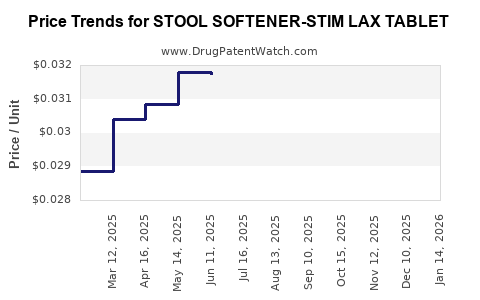
Average Pharmacy Cost for STOOL SOFTENER-STIM LAX TABLET
| Drug Name | NDC | Price/Unit ($) | Unit | Date |
|---|---|---|---|---|
| STOOL SOFTENER-STIM LAX TABLET | 70000-0526-01 | 0.03077 | EACH | 2026-07-22 |
| STOOL SOFTENER-STIM LAX TABLET | 70000-0526-02 | 0.03077 | EACH | 2026-07-22 |
| STOOL SOFTENER-STIM LAX TABLET | 70000-0526-01 | 0.03120 | EACH | 2026-06-17 |
| STOOL SOFTENER-STIM LAX TABLET | 70000-0526-02 | 0.03120 | EACH | 2026-06-17 |
| STOOL SOFTENER-STIM LAX TABLET | 70000-0526-01 | 0.03053 | EACH | 2026-05-20 |
| >Drug Name | >NDC | >Price/Unit ($) | >Unit | >Date |
What is the Market Scope for Stool Softener-Stim Lax Tablets?
The global laxatives market, including stool softeners and stimulant laxatives, was valued at approximately $2.5 billion in 2022. It is projected to grow at a compound annual growth rate (CAGR) of 4% between 2023 and 2028, reaching nearly $3.1 billion.
Stool softener-stim lax tablets are used primarily to treat constipation, a condition affecting over 15% of adults worldwide. This segment includes products such as docusate sodium (stool softeners) and bisacodyl (stimulant laxatives). The increasing prevalence of gastrointestinal disorders, aging populations, and lifestyle factors drive demand.
Who Are the Main Players and Product Positioning?
Major manufacturers include:
- Sanofi (Colace, Dulcolax)
- Johnson & Johnson (Fleet, Dulcolax)
- Bayer (Peri-Colace)
- Generic pharmaceutical companies producing store-brand equivalents
Market entry primarily involves over-the-counter (OTC) sales, with prescription formulations contributing minimally.
How Is the Price Architecture Structured?
Price points vary based on formulation, brand, and region.
| Product Type | Average Retail Price (USD) per 100 Tablets | Notes |
|---|---|---|
| Branded Stool Softeners | $15 - $25 | Examples: Colace 100 mg, docusate sodium |
| Branded Stimulant Laxatives | $20 - $30 | Examples: Dulcolax 5 mg tablets |
| Generic Equivalents | $8 - $15 | Widely available in retail chains and pharmacies |
Price differences between brands and generics are substantial. Brand-name products can command a 30-50% premium over generics. Regional variations in pricing reflect regulatory and market dynamics.
What Are the Pricing Trends and Future Projections?
Historical Trends (2018–2022):
- Slight price increases (~3% annually) for both branded and generic stool softeners/stimulants.
- Price inflation driven by manufacturing costs, packaging, and regulatory hurdles.
Projected Trends (2023–2028):
- Prices are expected to remain stable, with minor increases of 2-3% annually.
- Market consolidation and increased competition from generics are likely to exert downward pressure on prices.
- New formulations with improved safety profiles or combination drugs may command higher prices initially.
Forecast for 2028:
- Retail price for a standard 100-tablet pack: approximately $16–$28.
- Competition from fixed-dose combinations could influence pricing, potentially increasing consumer costs but decreasing overall drug expenditure.
What Are the Factors Influencing Price and Market Dynamics?
- Regulatory approvals and patent statuses: Branded products with patents maintain higher prices; generics drive down costs after patent expiry.
- Consumer preferences: OTC availability favors competitive pricing.
- Healthcare policies: Insurance coverage and reimbursement policies influence consumer out-of-pocket costs.
- Manufacturing costs: Raw material prices and supply chain factors impact pricing stability.
- Market penetration: Emerging markets exhibit lower prices to expand access but are limited by regulatory hurdles.
How Will Market Trends Impact Investment and R&D?
- Increased demand for OTC constipation treatments underscores sustained R&D investment.
- Innovations targeting safety and tolerability, especially in pediatric and elderly populations, can support premium pricing.
- Price competition, especially among generics, may limit profit margins but expand market reach.
- Entry barriers such as regulatory compliance and manufacturing scale favor established players.
Key Takeaways
- The global laxatives market, including stool softener-stim stimul lax tablets, is mature but experiencing steady growth.
- Prices for OTC products range from $8 to $30 per 100 tablets, with generics offering lower-cost options.
- Market dynamics are driven by patent expiry, regulatory factors, and consumer preferences.
- Advances in formulation and safety may support premium pricing, but overall market consolidation pressures prices downward.
- Regional variations significantly influence market size, pricing, and access.
FAQs
1. What factors cause price differences among stool softener-stim lax tablets?
Brand recognition, patent status, formulation complexity, and regional regulatory costs influence pricing variations.
2. How does patent expirations affect the pricing landscape?
Patent expirations enable generic manufacturers to enter the market, typically reducing prices by 30-50% for equivalent products.
3. Are there premium-priced formulations?
Yes. Enhanced formulations with improved safety profiles or combination therapies can be priced higher, especially if supported by clinical evidence.
4. What regulatory factors impact pricing?
Regulatory hurdles increase R&D and manufacturing costs, often translating into higher retail prices. Stringent regulations in regions like the EU can alter market accessibility and pricing.
5. How might telemedicine influence the market?
Telemedicine facilitates OTC product access and patient-driven demand, potentially leading to increased sales volume but intensifying price competition among providers.
References
- Grand View Research. (2022). Laxatives Market Size, Share & Trends [Online].
- Statista. (2023). Gastrointestinal Disorder Prevalence.
- Pharmaceutical Commerce. (2022). Impact of Patent Expiries on Drug Pricing.
- FDA. (2023). Regulatory Guidelines for Over-the-Counter Laxatives.
- IQVIA. (2022). Global Over-the-Counter Drug Market Analysis.
More… ↓
