Share This Page
Drug Price Trends for STOOL SOFTENER
✉ Email this page to a colleague
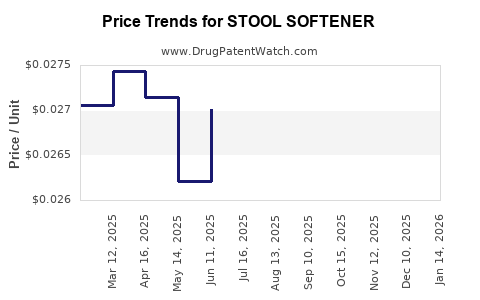
Average Pharmacy Cost for STOOL SOFTENER
| Drug Name | NDC | Price/Unit ($) | Unit | Date |
|---|---|---|---|---|
| STOOL SOFTENER-STIM LAX TABLET | 70000-0526-01 | 0.03120 | EACH | 2026-06-17 |
| STOOL SOFTENER-STIM LAX TABLET | 70000-0526-02 | 0.03120 | EACH | 2026-06-17 |
| STOOL SOFTENER 100 MG SOFTGEL | 70000-0091-03 | 0.02806 | EACH | 2026-06-17 |
| STOOL SOFTENER 100 MG SOFTGEL | 70000-0091-01 | 0.02806 | EACH | 2026-06-17 |
| STOOL SOFTENER 100 MG SOFTGEL | 70000-0091-02 | 0.02806 | EACH | 2026-06-17 |
| STOOL SOFTENER 100 MG SOFTGEL | 70000-0091-01 | 0.02805 | EACH | 2026-05-20 |
| >Drug Name | >NDC | >Price/Unit ($) | >Unit | >Date |
What is the Current Market Size and Growth for Stool Softener Drugs?
The global stool softener market was valued at approximately $450 million in 2022 and is projected to reach around $620 million by 2030, growing at a compound annual growth rate (CAGR) of 4.2%. Factors driving growth include increasing prevalence of gastrointestinal disorders, rising awareness about constipation, and an aging population. Market penetration is highest in North America and Europe, with Asia-Pacific expected to see faster expansion due to increased healthcare infrastructure and rising disposable incomes.
Which Key Players Dominate the Stool Softener Market?
Leading companies include:
- Johnson & Johnson (e.g., Dulcolax)
- Bayer Healthcare
- Boehringer Ingelheim
- Takeda Pharmaceutical
- Mederma
These firms control a majority share through established brands and distribution networks. Johnson & Johnson holds approximately 35% of unit sales globally, mostly via Dulcolax. The market exhibits moderate competition, with generic versions available in multiple regions, which applies downward pressure on prices.
How Is the Regulatory Environment Affecting Pricing?
In the U.S., the Food and Drug Administration (FDA) classifies stool softeners as over-the-counter (OTC) drugs, requiring compliance with OTC monograph standards. This regulation permits broad market access but limits pricing control. Variability exists in other regions; for example, pricing in Europe is influenced by healthcare reimbursement policies and national regulations, often limiting retail prices.
Price controls in certain countries, such as Canada and the UK, have led to average retail prices ranging from $4 to $8 per box (30 to 60 tablets). In the U.S., the average retail price hovers around $5 per box, with insurance and pharmacy benefit manager (PBM) negotiations significantly impacting net prices.
What Are Price Trends and Future Projections?
Current retail prices for OTC stool softeners are stable, with minor fluctuations due to generic competition. In the prescription segment, prices are higher, averaging $10-$20 per month supply, influenced by brand premium and formulary listings. Market analysts predict prices will remain flat over the next 3–5 years, barring major regulatory or patent-related changes.
Generic entrants are expected to enhance price competition further. As patents on leading brands expire—Johnson & Johnson's Dulcolax patent expired in 2019—new generics are filling the market. This trend is contributing to lower consumer prices and increased accessibility.
Which Pricing Strategies Do Market Leaders and Generics Use?
Brand-name manufacturers primarily rely on:
- Premium pricing for proprietary formulations
- Bundled marketing and educational campaigns
Generic manufacturers leverage:
- Cost-based pricing strategies
- Competitive undercutting to gain market share
In regions with strict price regulation, marketing is limited, and prices tend to be uniform. Some companies employ pay-for-delay strategies, though these are less prevalent in the OTC segment.
What Are the Key Drivers and Barriers in Pricing?
Drivers:
- Aging populations increasing demand
- Consumer preference for OTC solutions
- Growth in chronic constipation cases
Barriers:
- Intense price competition from generics
- Regulatory restrictions
- Healthcare reimbursement policies affecting prescription prices
What Are the Price Projections in Different Geographic Markets?
| Region | 2022 Average Price | 2030 Projected Price | Notes |
|---|---|---|---|
| North America | $5 per box | $5–$6 per box | Monopoly of brand-name products, limited inflation |
| Europe | €4–€8 per box | Stable | Price controls in some countries |
| Asia-Pacific | $2–$4 per box | $3–$5 per box | Growing demand, rising incomes |
| Latin America | $3–$6 per box | Slight increase | Import tariffs and local manufacturing influencing prices |
How Will Patent Expirations Affect Pricing?
Patent expirations on key brands will facilitate generic entry, intensifying price competition. Price reductions of 20–40% are probable within 2–3 years following patent expiry, depending on the region. Market entry of generics typically reduces prices, but higher brand prices persist in regions with weaker generic penetration or regulatory barriers.
Summary of Key Market Trends
- Increasing demand driven by demographic trends
- Growing OTC market share with stable or declining prices due to generics
- Regulatory impacts vary substantially by region
- Patent expiries pressuring brand prices downward
- Entry of regional generic manufacturers diversifies pricing options
Key Takeaways
- The global stool softener market is expanding at around 4.2% CAGR, projected to reach $620 million by 2030.
- North America dominates, with prices around $5 per box; Europe and Asia show lower prices but are rising.
- Patent expirations are leading to increased generic competition, pressuring brand prices downward.
- Regulatory frameworks heavily influence pricing strategies and affordability.
- Future pricing stability is expected, with some regional variability due to health policies.
FAQs
Q1: How does patent expiration impact stool softener prices?
A1: Patent expiration allows generic manufacturers to enter the market, increasing competition and typically reducing prices by 20–40% within two to three years.
Q2: What regions are expected to see the fastest growth in stool softener sales?
A2: Asia-Pacific will likely experience the fastest growth driven by rising healthcare infrastructure and increasing awareness.
Q3: How do regulatory policies influence OTC stool softener prices?
A3: In regions with strict price controls or reimbursement policies, prices tend to be stable or lower; in deregulated markets, prices are set more by branding and competition.
Q4: What role do generic brands play in the current market?
A4: Generics account for the majority of units sold, exerting downward pressure on prices and increasing accessibility.
Q5: Are there new formulations or innovations expected in stool softeners?
A5: Currently, no significant patent-protected innovations are announced; most market development will focus on manufacturing efficiencies and regional expansion.
Sources:
[1] Market Research Future, "Stool Softener Market Analysis," 2022.
[2] Global Data, "Over-the-Counter Gastrointestinal Drugs Report," 2023.
[3] IQVIA, "Pharmaceutical Pricing and Reimbursement," 2022.
[4] U.S. FDA, OTC Drug Monograph Standards, 2023.
More… ↓
