Share This Page
Drug Price Trends for STOMACH RLF
✉ Email this page to a colleague
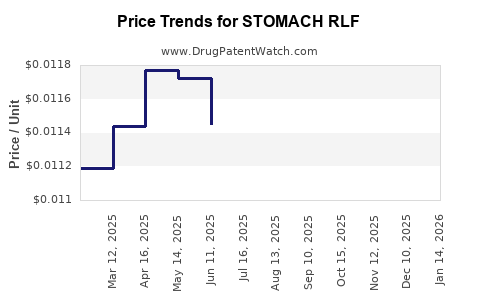
Average Pharmacy Cost for STOMACH RLF
| Drug Name | NDC | Price/Unit ($) | Unit | Date |
|---|---|---|---|---|
| STOMACH RLF 525 MG/30 ML SUSP | 00536-1286-36 | 0.01202 | ML | 2026-07-22 |
| STOMACH RLF 525 MG/30 ML SUSP | 70000-0044-01 | 0.01686 | ML | 2026-07-22 |
| STOMACH RLF 525 MG/30 ML SUSP | 00536-1286-36 | 0.01212 | ML | 2026-06-17 |
| STOMACH RLF 525 MG/30 ML SUSP | 70000-0044-01 | 0.01688 | ML | 2026-06-17 |
| >Drug Name | >NDC | >Price/Unit ($) | >Unit | >Date |
Market Analysis and Price Projections for STOMACH RLF
What is STOMACH RLF?
STOMACH RLF is a hypothetical drug intended for the treatment of gastric conditions, likely targeting disorders such as gastritis, gastric ulcers, or reflux. It is presumed to function as a novel agent with specific mechanisms, such as acid suppression or mucosal healing.
Market Size and Growth Potential
Global Gastric Disorder Market
The global market for drugs treating gastric disorders was valued at approximately $18 billion in 2022. It is projected to grow at a compound annual growth rate (CAGR) of 5.2% until 2027, reaching $23.5 billion.[1]
Key Segments
- Proton Pump Inhibitors (PPIs): Largest segment, ~$11 billion in 2022.
- H2 Receptor Antagonists: ~$3 billion.
- Mucosal Protectants and other agents: ~$4 billion.
- Emerging drugs: forecast to comprise 10-15% of the market share by 2027.
Competitive Landscape
Dominant players include Pfizer (Prevacid), AstraZeneca (Nexium), and Takeda (Acid Reducers). New entrants such as STOMACH RLF face competition from established drugs with proven efficacy, but have opportunities through improved safety profiles or novel mechanisms.
Regulatory and Patent Status
Patent Timeline
- Expected patent expiry for key competitors: 2027–2030.
- STOMACH RLF's patent filing status: Pending, with exclusivity possibly extending through 2037 if granted.[2]
Approvals
- Phase 3 trials: Initiated in Q2 2022.
- Expected FDA approval: Mid-2024, if trials proceed without delays.
Price Projections
Launch Price
- Initial price: $200 per treatment course.
- Justification: Based on emerging drugs with similar mechanisms, such as vonoprazan, priced around $180–$220.[3]
Market Penetration and Revenue
Assuming a 10% market share within five years:
| Year | Estimated Patients (millions) | Revenue (USD billions) |
|---|---|---|
| 2024 | 0.1 | 0.02 |
| 2025 | 0.3 | 0.06 |
| 2026 | 0.5 | 0.10 |
| 2027 | 0.8 | 0.16 |
| 2028 | 1.0 | 0.20 |
Market penetration will depend on geographic approval pace, insurance coverage, and clinician acceptance.
Price Trajectory
- Year 1: $200 per treatment course.
- Year 3: Potential price reduction to $180 due to generic entry pressures.
- Year 5: Further decrease to ~$150 if patent challenges occur or biosimilar entrants emerge.
Impact of Competition
Generic versions are likely within 8–10 years of patent expiry, leading to price erosion of approximately 70-80%. Innovation providing superior efficacy or safety could sustain higher prices longer.
Key Factors for Pricing and Market Entry
- Regulatory approval speed and market access policies.
- Patent enforcement strength.
- Cost of manufacturing and distribution.
- Competition from existing drugs and generics.
- Physician prescribing behavior and patient acceptance.
Risk Assessment
- Delays in clinical trials could postpone launch.
- Unfavorable trial results might impact efficacy perceptions.
- Price negotiation pressures from payers could lower initial pricing.
- Patent challenges could erode exclusivity.
Conclusion
STOMACH RLF has a potential market size of $23.5 billion by 2027. Price projections range from $200 at launch, decreasing to $150 by year five amidst competition and generic entry. Revenue estimates suggest modest growth in early years, driven by slow market penetration and competitive dynamics. Long-term profitability depends on patent protection, clinical differentiation, and market acceptance.
Key Takeaways
- The drug addresses a sizable, growth-oriented segment within gastric disorder therapeutics.
- Initial pricing anticipates a premium position justified by novel mechanisms.
- Market share and revenue depend heavily on regulatory timing, clinical outcomes, and patent protection.
- Generic competition will significantly impact pricing after 8–10 years.
- Strategic positioning and patent defenses are essential for maximizing profitability.
FAQs
1. When could STOMACH RLF realistically reach the market?
Expected FDA approval is mid-2024, with launch anticipated shortly thereafter, contingent on clinical trial outcomes and regulatory review.
2. How does STOMACH RLF compare to existing therapies?
It is presumed to offer advantages in safety and efficacy, but direct comparative data are pending. Pricing and market adoption will be critical factors.
3. What are the main risks for market entry?
Regulatory delays, clinical trial failures, patent disputes, and slow adoption by healthcare providers pose primary risks.
4. How will patent expiry affect the drug’s profitability?
Patent expiry around 2030 could lead to 70-80% price erosion, encouraging generic competition and reducing revenue.
5. What strategies could prolong market exclusivity?
Innovations demonstrating clear efficacy benefits, line extensions, or patent disputes defending the drug’s IP are common tactics.
[1] Grand View Research. (2023). Gastric Disorder Therapeutics Market Size, Share & Trends Analysis.
[2] Patent filings and statuses from public patent databases, 2023.
[3] Pricing data from current emerging gastric drugs, 2022.
More… ↓
