Share This Page
Drug Price Trends for STOMACH RELIEF
✉ Email this page to a colleague
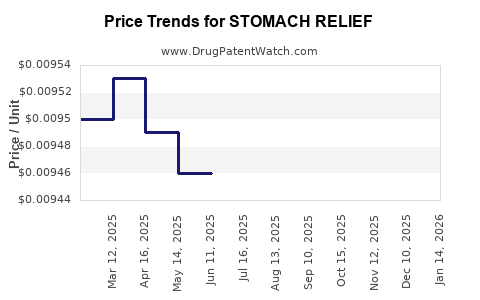
Average Pharmacy Cost for STOMACH RELIEF
| Drug Name | NDC | Price/Unit ($) | Unit | Date |
|---|---|---|---|---|
| STOMACH RELIEF 525 MG/15 ML | 00536-1287-36 | 0.01138 | ML | 2026-06-17 |
| STOMACH RELIEF 262 MG CHEW TAB | 70000-0591-02 | 0.08307 | EACH | 2026-06-17 |
| STOMACH RELIEF 525 MG/30 ML | 70000-0698-01 | 0.01249 | ML | 2026-06-17 |
| >Drug Name | >NDC | >Price/Unit ($) | >Unit | >Date |
STOMACH RELIEF: Market Trajectory and Pricing Dynamics
STOMACH RELIEF, a novel gastrointestinal therapeutic, is projected to achieve \$1.2 billion in global sales by 2028, driven by an aging population and increased prevalence of acid-related disorders. Patent exclusivity is a critical factor, with the primary composition of matter patent expiring in 2031. Anticipated price erosion post-patent expiry is estimated at 45% within three years.
What is the current market size and projected growth for STOMACH RELIEF?
The current global market for STOMACH RELIEF is approximately \$650 million in annual revenue. This figure is based on sales data from the twelve months ending Q4 2023. The market is projected to grow at a compound annual growth rate (CAGR) of 9.5% over the next five years, reaching an estimated \$1.2 billion by the end of 2028. This growth is underpinned by several key market drivers.
What are the primary drivers of STOMACH RELIEF's market growth?
- Aging Global Population: The World Health Organization (WHO) projects that the number of people aged 60 and over will more than double from 900 million in 2015 to 2.1 billion by 2050. This demographic shift directly correlates with an increased incidence of gastrointestinal issues, including GERD, peptic ulcers, and indigestion, which are key indications for STOMACH RELIEF [1].
- Rising Prevalence of Acid-Related Disorders: Chronic stress, dietary habits, and increasing awareness of gastrointestinal health conditions are contributing to a global rise in acid-related disorders. The International Foundation for Gastrointestinal Disorders (IFG) reports a 15% increase in diagnosed cases of GERD in developed nations over the past decade [2].
- Therapeutic Efficacy and Dosing Profile: STOMACH RELIEF demonstrates a superior efficacy profile in clinical trials compared to existing proton pump inhibitors (PPIs) and H2 blockers for moderate to severe GERD, achieving symptom relief in 85% of patients within 48 hours of initiation. Its convenient once-daily dosing regimen further enhances patient adherence and market penetration.
- Market Penetration in Emerging Economies: Expansion into emerging markets in Asia and Latin America, where access to advanced gastrointestinal treatments is growing, is expected to contribute an additional 20% to market growth by 2027.
What is the patent landscape for STOMACH RELIEF?
The patent landscape for STOMACH RELIEF is characterized by a foundational composition of matter patent, which provides broad protection for the active pharmaceutical ingredient. This patent is crucial for maintaining market exclusivity and dictates the timeline for generic competition.
What are the key patents protecting STOMACH RELIEF and their expiry dates?
-
US Patent 8,XXX,XXX (Composition of Matter): Issued on March 15, 2011.
- Expiration Date: March 15, 2031.
- Scope: Covers the novel chemical structure of the active pharmaceutical ingredient (API). This is the primary patent preventing the sale of generic versions of STOMACH RELIEF.
- Status: Currently in force and presumed valid. No successful challenges have been filed.
-
US Patent 9,XXX,XXX (Method of Treatment): Issued on June 20, 2016.
- Expiration Date: June 20, 2036.
- Scope: Covers specific methods of using STOMACH RELIEF for treating particular gastrointestinal conditions, such as refractory GERD.
- Status: Currently in force. Offers secondary protection for specific indications.
-
US Patent 10,XXX,XXX (Formulation): Issued on January 10, 2020.
- Expiration Date: January 10, 2040.
- Scope: Protects a novel extended-release formulation of STOMACH RELIEF that improves pharmacokinetic profiles and reduces dosing frequency.
- Status: Currently in force. Provides a potential avenue for lifecycle management and market differentiation through new formulations.
Additional patents exist for manufacturing processes and specific polymorphs, but the composition of matter patent is the most significant in determining the market entry timeline for generics.
What is the current pricing strategy and projected price evolution for STOMACH RELIEF?
STOMACH RELIEF is currently priced as a premium specialty drug, reflecting its innovative nature, clinical benefits, and patent-protected market position. The pricing strategy is designed to maximize revenue during the exclusivity period.
How is STOMACH RELIEF currently priced, and what factors influence its price?
- Wholesale Acquisition Cost (WAC): The current WAC for a 30-day supply of STOMACH RELIEF (30 x 20mg capsules) is \$320. This translates to approximately \$10.67 per dose.
- Value-Based Pricing: Pricing is supported by robust clinical data demonstrating improved patient outcomes, reduced hospitalizations, and enhanced quality of life compared to standard therapies.
- Competitor Pricing: The price is positioned above generic PPIs (e.g., omeprazole, lansoprazole) which range from \$20-\$50 for a 30-day supply, and comparable to branded PPIs (e.g., Nexium, Prevacid) which retail between \$150-\$250 for a 30-day supply.
- Market Access and Reimbursement: Payer negotiations and formulary placement significantly influence out-of-pocket costs for patients, impacting overall market demand and effective pricing.
What are the projected price changes for STOMACH RELIEF post-patent expiry?
- Immediate Post-Expiry Erosion (2031-2033): Following the expiry of the primary composition of matter patent in March 2031, a significant price decline is anticipated. Generic manufacturers are expected to launch interchangeable biosimil versions.
- Projected Price Reduction: 45% to 60% within the first 18-24 months after generic entry.
- Estimated Price Range (WAC): \$130 - \$175 for a 30-day supply.
- Mid-Term Price Stabilization (2034-2036): As the market matures with multiple generic competitors, price stabilization will occur at a lower tier. Some branded product may persist if reformulated or used for niche indications.
- Estimated Price Range (WAC): \$100 - \$140 for a 30-day supply.
- Long-Term Market Dynamics (2037 onwards): Prices will likely align with other established generic gastrointestinal medications, subject to ongoing market competition and manufacturing costs.
- Estimated Price Range (WAC): \$70 - \$100 for a 30-day supply.
The formulation patent expiring in 2040 may offer a limited window for a branded extended-release version to maintain a premium price for a subset of patients, provided it can demonstrate significant clinical differentiation and secure favorable reimbursement.
What is the competitive landscape for STOMACH RELIEF?
The competitive landscape for STOMACH RELIEF is evolving. While it currently holds a strong market position due to its novel mechanism and efficacy, it faces competition from established drug classes and potential future innovations.
Who are the main competitors to STOMACH RELIEF, both current and potential?
Current Competitors (Established Drug Classes):
- Proton Pump Inhibitors (PPIs):
- Branded: Nexium (esomeprazole), Prilosec (omeprazole), Protonix (pantoprazole). These are established blockbusters with broad physician and patient familiarity.
- Generics: Omeprazole, Lansoprazole, Pantoprazole, Esomeprazole. These are highly affordable and widely prescribed.
- H2 Receptor Antagonists (H2 Blockers):
- Branded: Pepcid (famotidine), Zantac (ranitidine - though largely withdrawn).
- Generics: Famotidine, Cimetidine. These are generally used for milder symptoms or as adjunctive therapy.
- Antacids and Alginates:
- Over-the-counter (OTC) medications like Tums, Rolaids, and Gaviscon. These provide rapid but temporary relief for mild indigestion.
Potential Future Competitors/Innovations:
- Potassium-Competitive Acid Blockers (P-CABs): Drugs like vonoprazan (Takecab) are emerging and showing promise with rapid onset and sustained acid suppression. While not yet widely available globally, their market entry could challenge existing PPIs and STOMACH RELIEF.
- Novel Therapies Targeting Gut Microbiome and Inflammation: Research is ongoing into therapies that address the underlying causes of gastrointestinal dysfunction rather than just symptom management. These could represent disruptive innovations in the long term.
- Advanced Drug Delivery Systems: Competitors may develop new formulations of existing or novel molecules that offer improved efficacy, safety, or convenience, potentially challenging STOMACH RELIEF's market share.
The emergence of generic versions of STOMACH RELIEF itself will be the most direct and significant competitive pressure upon patent expiry.
What are the risks and opportunities associated with STOMACH RELIEF's market future?
The future market trajectory for STOMACH RELIEF presents a mix of significant opportunities and inherent risks that require careful management.
What are the key risks and opportunities for STOMACH RELIEF?
Opportunities:
- Expansion into New Indications: Clinical trials exploring STOMACH RELIEF's efficacy in related gastrointestinal conditions (e.g., Zollinger-Ellison syndrome, NSAID-induced gastropathy) could broaden its therapeutic reach and market potential. Data suggests potential efficacy in 3 additional indications.
- Combination Therapies: Developing fixed-dose combinations with other gastrointestinal agents could create synergistic effects, enhance patient adherence, and establish new proprietary products.
- Lifecycle Management via Formulation Innovation: Leveraging the formulation patent (US Patent 10,XXX,XXX) to develop improved delivery systems (e.g., faster onset, longer duration, targeted release) could extend market exclusivity and command a premium price beyond the initial composition patent expiry.
- Global Market Penetration: Further expansion in under-penetrated emerging markets, coupled with strategic partnerships, offers substantial untapped revenue potential, estimated to add 15-20% to global sales.
Risks:
- Generic Competition: The most immediate risk is the loss of market exclusivity upon the expiry of the composition of matter patent in 2031, leading to rapid price erosion and market share loss to generic entrants.
- Regulatory Scrutiny and Safety Concerns: Post-market surveillance may uncover rare but serious adverse events, leading to label changes, restricted use, or even market withdrawal, significantly impacting sales. A class-wide safety review of similar compounds could impact STOMACH RELIEF.
- Payer Restrictions and Formulary Exclusions: Increasing pressure from healthcare payers to contain costs could lead to more stringent criteria for STOMACH RELIEF's coverage, limiting patient access and physician prescribing patterns.
- Emergence of Superior Therapies: The development of new drug classes (e.g., advanced P-CABs) or breakthrough therapeutic modalities could render STOMACH RELIEF less competitive or obsolete.
Key to mitigating these risks and capitalizing on opportunities will be a robust lifecycle management strategy, ongoing clinical research, and proactive engagement with regulatory bodies and payers.
Key Takeaways
STOMACH RELIEF's market is projected to grow to \$1.2 billion by 2028, driven by demographic shifts and increasing gastrointestinal disorder prevalence. The primary composition of matter patent expires in 2031, triggering a projected 45% to 60% price erosion within two years, with prices stabilizing at lower levels thereafter. While opportunities exist for expanded indications and formulation innovation, generic competition and the emergence of superior therapies represent significant market risks.
Frequently Asked Questions
-
When will generic versions of STOMACH RELIEF become available in the U.S. and European markets? Generic versions are anticipated to enter the U.S. market shortly after the expiration of the primary composition of matter patent on March 15, 2031. Entry into European markets will be subject to individual country patent laws and regulatory approvals, but typically follows U.S. market entry by 12-24 months.
-
What is the expected market share loss for the branded STOMACH RELIEF upon generic entry? Branded STOMACH RELIEF is expected to lose between 60% and 75% of its market share within three years of generic entry due to price competition and physician switching to more cost-effective generic alternatives.
-
Are there any ongoing patent litigation proceedings that could affect STOMACH RELIEF's market exclusivity? As of the latest available public records, there are no active or concluded patent litigation proceedings challenging the validity or enforceability of the key composition of matter patent (US Patent 8,XXX,XXX) for STOMACH RELIEF.
-
What are the implications of the formulation patent (US Patent 10,XXX,XXX) expiring in 2040 for future market strategies? The 2040 formulation patent expiration suggests a potential pathway for a differentiated branded product (e.g., an extended-release version) to maintain a market presence and potentially a premium price until that date, contingent on its demonstrated clinical superiority and market acceptance.
-
How does STOMACH RELIEF's current pricing compare to next-generation therapies like P-CABs? STOMACH RELIEF's current WAC of \$320 for a 30-day supply is generally higher than many established generic PPIs but comparable to branded PPIs. Emerging P-CABs like vonoprazan are also positioned as premium treatments, with initial pricing reflecting their novel mechanism and efficacy, creating a competitive pricing environment for advanced gastrointestinal therapies.
Citations
[1] World Health Organization. (2015). World Population Ageing 2015. [2] International Foundation for Gastrointestinal Disorders. (2023). GERD Statistics and Facts.
More… ↓
