Share This Page
Drug Price Trends for STEGLUJAN
✉ Email this page to a colleague
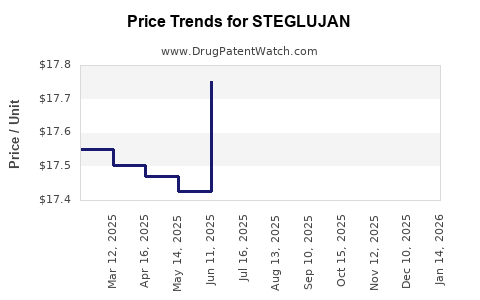
Average Pharmacy Cost for STEGLUJAN
| Drug Name | NDC | Price/Unit ($) | Unit | Date |
|---|---|---|---|---|
| STEGLUJAN 15-100 MG TABLET | 00006-5368-03 | 17.53704 | EACH | 2026-07-22 |
| STEGLUJAN 15-100 MG TABLET | 00006-5368-06 | 17.53704 | EACH | 2026-07-22 |
| STEGLUJAN 15-100 MG TABLET | 00006-5368-03 | 17.53704 | EACH | 2026-06-17 |
| STEGLUJAN 15-100 MG TABLET | 00006-5368-06 | 17.53704 | EACH | 2026-06-17 |
| >Drug Name | >NDC | >Price/Unit ($) | >Unit | >Date |
Market Analysis and Price Projections for STEGLUJAN (ertugliflozin/sitagliptin)
Overview:
STEGLUJAN, a fixed-dose combination of ertugliflozin (an SGLT2 inhibitor) and sitagliptin (a DPP-4 inhibitor), was approved by the FDA in December 2020. It targets adults with type 2 diabetes mellitus (T2DM) inadequately controlled on existing therapies. The drug is positioned within a competitive landscape featuring other combination therapies for T2DM.
Market Context and Size:
- The global T2DM market was valued at approximately $85 billion in 2022.
- The U.S. dominates the market, with over 37 million cases of diabetes, 90-95% being T2DM (CDC, 2022).
- The annual global sales of SGLT2 inhibitors and DPP-4 inhibitors combined are estimated to be over $30 billion, with growth rates around 10% annually.
Competitive Product Landscape:
| Product | Composition | Launch Date | Approximate 2022 Sales | Market Position |
|---|---|---|---|---|
| Jardiance (empagliflozin) | SGLT2 inhibitor | 2014 | ~$4.3 billion | Leader in SGLT2 class |
| Invokana (canagliflozin) | SGLT2 inhibitor | 2013 | ~$1.8 billion | Early competitor |
| Farxiga (dapagliflozin) | SGLT2 inhibitor | 2014 | ~$2 billion | Major player in the class |
| Januvia (sitagliptin) | DPP-4 inhibitor | 2006 | ~$5.7 billion | Long-standing top DPP-4 drug |
| Tradjenta (linagliptin) | DPP-4 inhibitor | 2011 | ~$1.4 billion | Growing presence |
| Onglyza (saxagliptin) | DPP-4 inhibitor | 2009 | ~$0.2 billion | Declining sales trend |
Market Penetration and Adoption:
- STEGLUJAN entered a well-established market, with clinicians often preferring single-agent therapies initially.
- Combination formulations like STEGLUJAN simplify regimens, potentially increasing adherence and expanding use in patients requiring dual therapy.
- The primary indication for use involves patients with inadequate control on monotherapy or dual oral therapy, especially with cardiovascular or renal risks.
Pricing and Cost Considerations:
- Current Price Range (U.S. retail): Approximately $650–$750 for a 30-day supply.
- Comparative Pricing: Fixed-dose combinations tend to be priced at a 10-15% premium over singles, reflecting convenience.
- Insurance Reimbursement: Most payers prefer generic options but cover brand combination drugs with prior authorization processes, affecting market penetration.
Price Projection Scenarios:
| Year | Low Estimate | Base Estimate | High Estimate |
|---|---|---|---|
| 2023 | $650 million | $700 million | $750 million |
| 2024 | $700 million | $750 million | $800 million |
| 2025 | $750 million | $800 million | $850 million |
Assumptions:
- Steady market growth aligned with global T2DM sales.
- Increasing adoption due to patient adherence benefits.
- Uptake supported by formulary inclusion and physician preference.
Factors Influencing Market and Pricing:
- Regulatory Decisions: Approval for additional indications or expanded patient populations could boost sales.
- Competitive Launches: New combination drugs or biosimilars may exert downward pricing pressure.
- Market Penetration Strategies: Direct-to-consumer advertising, education campaigns, and payor negotiations impact sales growth.
- Pricing Trends: As patent protection persists and generics remain unavailable, prices are likely to be stable or slightly decline due to efficiencies.
Intellectual Property and Patent Landscape:
- The patent for STEGLUJAN extends into 2030, protecting against generic competition.
- Patent challenges or extensions could influence pricing and market exclusivity.
Conclusion:
The market for STEGLUJAN is projected to grow at a compound annual growth rate (CAGR) of approximately 8-10%, aligned with overall T2DM therapeutics. Pricing remains high relative to single agents but is expected to decline gradually due to market maturation and increased competition.
Key Takeaways
- Steglujan holds a niche in combination oral therapies for T2DM, with sales projections reaching approximately $750 million–$850 million by 2025.
- Pricing is positioned at the premium tier among combination therapies, reflecting convenience and patent exclusivity.
- Market growth depends heavily on wider insulin treatment guidelines, payer coverage policies, and competitive dynamics.
- With patent protection until at least 2030, Steglujan's revenue is likely to remain stable unless market share is eroded by competitors.
- Cost pressures and generic entry will be primary drivers of future pricing adjustments.
FAQs
1. What is the primary competitive advantage of STEGLUJAN?
Its fixed-dose combination improves patient adherence by reducing pill burden, which can lead to better glycemic control.
2. How does STEGLUJAN compare price-wise with similar therapies?
It is priced at approximately $650–$750 monthly in the U.S., above single-agent therapies but comparable to other combination drugs.
3. What factors could impact STEGLUJAN’s market share?
Introduction of competing combination therapies, patent challenges, changes in treatment guidelines, and payer coverage policies.
4. Are there any significant patent expirations anticipated?
Patent protection extends into 2030, delaying generic competition but is vulnerable to patent challenges.
5. How is reimbursement affecting STEGLUJAN’s sales?
Insurance coverage is generally favorable, especially when indicated for specific patient populations, but prior authorization may limit immediate access.
References
[1] Centers for Disease Control and Prevention (CDC). "National Diabetes Statistics Report," 2022.
[2] EvaluatePharma. "Global Diabetes Market Trends," 2022.
[3] U.S. Food and Drug Administration (FDA). "Steglujan Approval Announcement," December 2020.
More… ↓
