Share This Page
Drug Price Trends for SPRYCEL
✉ Email this page to a colleague
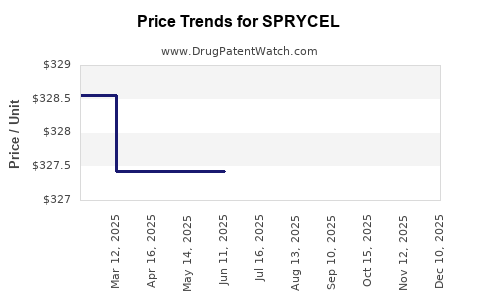
Average Pharmacy Cost for SPRYCEL
| Drug Name | NDC | Price/Unit ($) | Unit | Date |
|---|---|---|---|---|
| SPRYCEL 100 MG TABLET | 00003-0852-22 | 591.18120 | EACH | 2026-05-20 |
| SPRYCEL 100 MG TABLET | 00003-0852-22 | 591.18120 | EACH | 2026-04-22 |
| SPRYCEL 100 MG TABLET | 00003-0852-22 | 590.97850 | EACH | 2026-03-18 |
| SPRYCEL 100 MG TABLET | 00003-0852-22 | 590.47161 | EACH | 2025-12-17 |
| >Drug Name | >NDC | >Price/Unit ($) | >Unit | >Date |
Best Wholesale Price for SPRYCEL
| Drug Name | Vendor | NDC | Count | Price ($) | Price/Unit ($) | Unit | Dates | Price Type |
|---|---|---|---|---|---|---|---|---|
| SPRYCEL 100MG TAB | Bristol-Myers Squibb Company | 00003-0852-22 | 30 | 16687.60 | 556.25333 | EACH | 2024-05-01 - 2029-04-30 | FSS |
| SPRYCEL 70MG TAB | Bristol-Myers Squibb Company | 00003-0524-11 | 60 | 18517.79 | 308.62983 | EACH | 2024-05-01 - 2029-04-30 | FSS |
| SPRYCEL 80MG TABLETS | Bristol-Myers Squibb Company | 00003-0855-22 | 30 | 11437.98 | 381.26600 | EACH | 2024-05-01 - 2029-04-30 | Big4 |
| SPRYCEL 20MG TAB | Bristol-Myers Squibb Company | 00003-0527-11 | 60 | 6366.13 | 106.10217 | EACH | 2024-05-01 - 2029-04-30 | Big4 |
| >Drug Name | >Vendor | >NDC | >Count | >Price ($) | >Price/Unit ($) | >Unit | >Dates | >Price Type |
SPRYCEL Market Analysis and Price Projections
SPRYCEL: A Comprehensive Market and Pricing Overview
SPRYCEL (dasatinib), developed by Bristol Myers Squibb (BMS), is a tyrosine kinase inhibitor (TKI) approved for the treatment of chronic myeloid leukemia (CML) and Philadelphia chromosome-positive acute lymphoblastic leukemia (Ph+ ALL). Its efficacy in these hematological malignancies has established it as a significant therapeutic option. This analysis examines the current market dynamics, patent landscape, and future price projections for SPRYCEL, providing insights for R&D and investment decisions.
What is the current market landscape for SPRYCEL?
SPRYCEL's market presence is defined by its established efficacy in treating specific leukemias, particularly CML. The drug targets the BCR-ABL kinase, a driver mutation in CML, and exhibits potent activity against both newly diagnosed and resistant forms of the disease. Its indication for Ph+ ALL further broadens its patient population.
Key Market Segments:
- Chronic Myeloid Leukemia (CML): SPRYCEL is indicated for both chronic phase and accelerated phase CML in patients resistant or intolerant to prior therapy, including imatinib. It is also approved for newly diagnosed patients in the chronic phase. The CML market is competitive, with multiple TKIs available, but SPRYCEL maintains a significant share due to its clinical profile.
- Philadelphia Chromosome-Positive Acute Lymphoblastic Leukemia (Ph+ ALL): This indication targets a specific subset of ALL patients. SPRYCEL is used in combination with chemotherapy for newly diagnosed adult patients with Ph+ ALL and as a monotherapy for adult patients with Ph+ ALL resistant or intolerant to prior therapy.
Market Size and Growth:
The global CML market, a primary driver for SPRYCEL, is projected to experience steady growth. This growth is attributed to increasing cancer incidence, improved diagnostic rates, and the availability of effective targeted therapies. While specific figures for SPRYCEL's market share fluctuate, the overall CML market size was estimated to be approximately USD 4.8 billion in 2022, with projected growth to around USD 6.5 billion by 2028, representing a compound annual growth rate (CAGR) of about 5.3% [1]. SPRYCEL captures a substantial portion of this market.
Competitive Landscape:
SPRYCEL competes with other TKIs, including:
- Imatinib (Gleevec/Glivec): The first-generation TKI, still widely used, particularly in first-line CML.
- Nilotinib (Tasigna): Another second-generation TKI, also used for first-line and subsequent-line CML.
- Bosutinib (Bosulif): A dual SRC/ABL kinase inhibitor used for CML.
- Ponatinib (Iclusig): A potent pan-BCR-ABL inhibitor used for resistant and T315I-mutated CML.
- Asciminib (Scemblix): A STAMP inhibitor targeting the myristoyl pocket of BCR-ABL, representing a new mechanism of action [2].
The emergence of newer agents like asciminib, with distinct mechanisms, presents a growing competitive pressure.
What is the patent and exclusivity landscape for SPRYCEL?
The patent landscape for SPRYCEL is a critical factor influencing its market exclusivity and the eventual entry of generic competitors. Bristol Myers Squibb has secured various patents covering the compound, its synthesis, formulations, and methods of use.
Key Patents and Exclusivity Periods:
- Core Compound Patents: The primary patents for the dasatinib compound itself have expired in major markets. For instance, the U.S. compound patent expired around 2020-2021.
- Formulation and Method of Use Patents: BMS has pursued secondary patents related to specific formulations (e.g., tablet forms, specific dosages) and methods of use (e.g., treating resistant CML, combination therapies). These patents offer extended protection.
- Regulatory Exclusivities: In addition to patent protection, SPRYCEL has benefited from regulatory exclusivities granted by agencies like the U.S. Food and Drug Administration (FDA) and the European Medicines Agency (EMA). These can include:
- New Chemical Entity (NCE) Exclusivity: Typically 5 years in the U.S.
- Orphan Drug Exclusivity: For rare diseases, which applies to both CML and Ph+ ALL. This provides 7 years of market exclusivity in the U.S. and 10 years in the EU.
- Pediatric Exclusivity: If pediatric studies were conducted, this can add 6 months to existing patent exclusivities in the U.S.
Generic Entry Status:
Generic versions of dasatinib have begun to enter the market in various regions.
- United States: Generic dasatinib launched in late 2023 and early 2024. This follows the expiry of key patents and successful litigation. Multiple generic manufacturers have received FDA approval.
- Europe: Generic entry has been staggered across European countries, with some markets seeing generic availability since 2022-2023.
- Other Markets: Generic versions are also available or expected to become available in other major pharmaceutical markets.
The timing and extent of generic competition significantly impact SPRYCEL's sales trajectory.
What are the projected pricing trends for SPRYCEL?
The pricing of SPRYCEL, like most branded oncology drugs, is influenced by several factors including R&D costs, clinical value, competitive landscape, and payer negotiations. Post-generic entry, pricing is expected to decline significantly.
Current Pricing (Pre-Generic):
Prior to the widespread availability of generics, SPRYCEL had a high price point reflecting its innovative nature and clinical benefit.
- United States: The annual cost of SPRYCEL (based on typical dosages and manufacturer list prices) could range from approximately USD 70,000 to USD 100,000 or more.
- Europe: Prices varied by country due to national healthcare system negotiations and pricing regulations but were generally high.
Post-Generic Price Projections:
The introduction of generic alternatives typically leads to substantial price erosion.
- Immediate Impact: Upon generic launch, prices are expected to drop rapidly. Studies on other oncology drugs indicate price reductions of 50% to 80% or more within the first year of generic availability [3].
- Long-Term Trend: Prices for branded SPRYCEL will likely continue to decline as competition intensifies. However, BMS may retain a premium for its branded product through direct-to-physician marketing or by offering specialized patient support programs.
- Generic Pricing: Generic dasatinib will be priced significantly lower, driven by competition among multiple manufacturers. Prices will be subject to the dynamics of generic drug markets, including volume discounts and payer formularies. For example, early indications show generic dasatinib tablets available at roughly 20-30% of the branded price.
- Geographic Variations: Price declines will be more pronounced in markets with strong price negotiation frameworks and aggressive generic adoption.
Factors Influencing Future Pricing:
- Payer Contracts: Agreements with major insurance providers and national health systems will dictate actual reimbursement rates for both branded and generic SPRYCEL.
- Competition Intensity: The number of generic manufacturers and their market penetration will accelerate price reductions.
- Clinical Value of Newer Therapies: The continued development of novel CML and Ph+ ALL treatments with improved efficacy or safety profiles could impact the perceived value of older generics, potentially influencing pricing strategies.
- Off-Label Use and New Indications: While less likely for a mature product like SPRYCEL, discovery of new indications or significant off-label use could alter its market dynamics, although regulatory hurdles remain.
The projection is a steep decline in effective pricing for dasatinib globally as generic versions become the dominant treatment option.
What are the future market and revenue outlooks for SPRYCEL?
The future outlook for SPRYCEL is characterized by a significant decline in revenue due to the loss of market exclusivity and the subsequent entry of generics. While the drug's clinical utility remains, the market dynamics shift from premium pricing to volume-based generics.
Revenue Trajectory:
- Pre-Generic Peak: SPRYCEL reached peak annual sales in the range of USD 1.7 billion to USD 2.0 billion prior to significant generic competition [4].
- Post-Generic Decline: Following the entry of generics in major markets, BMS's revenue from SPRYCEL is expected to decrease sharply. Estimates suggest a decline of 60-80% in branded sales within two to three years of generic launch.
- Continued Sales: BMS will likely continue to generate some revenue from branded SPRYCEL, particularly in markets with slower generic adoption or through niche patient support programs. However, this will represent a fraction of its peak sales.
- Generic Market Growth: The overall market for dasatinib (including generics) is expected to remain robust due to its established efficacy. The volume of dasatinib prescribed will likely remain high, but the revenue will accrue to generic manufacturers.
Market Dynamics:
- Shift to Generics: The primary market dynamic will be the transition from branded SPRYCEL to cost-effective generic dasatinib. Payers will strongly encourage or mandate the use of generics to control healthcare expenditure.
- Therapeutic Niche: SPRYCEL will likely retain its position as a standard-of-care option for CML and Ph+ ALL, especially in second-line or third-line settings, but at a significantly lower cost.
- Competition with Newer TKIs: The development of next-generation TKIs and other novel therapies will continue to influence the treatment landscape, potentially limiting the market share gains of generic dasatinib in some segments.
- Global Market Variations: The pace of generic adoption and subsequent price erosion will vary across different geographic regions, influenced by regulatory frameworks, patent strategies, and local healthcare economics.
Strategic Implications:
- For Bristol Myers Squibb: The company's focus will shift towards maximizing remaining branded sales, managing product lifecycle, and potentially defending against further patent challenges. The company has already diversified its portfolio with newer oncology assets and other therapeutic areas.
- For Generic Manufacturers: The market presents an opportunity for significant revenue generation through the sale of affordable generic dasatinib. Companies with efficient manufacturing and strong distribution networks are well-positioned.
- For Healthcare Providers and Payers: The availability of generic dasatinib offers substantial cost savings, allowing for reallocation of resources to other medical needs or new therapies.
The outlook for SPRYCEL is one of a mature product transitioning into the generic market, with revenue shifting from the innovator company to multiple generic manufacturers.
Key Takeaways
- SPRYCEL is a well-established TKI for CML and Ph+ ALL, with significant market penetration pre-generic.
- Core compound patents have expired in major markets, leading to generic dasatinib market entry since late 2023/early 2024 in the US and earlier in some European countries.
- Pricing is projected to decline sharply, with branded SPRYCEL prices falling 50-80% or more post-generic entry, and generic dasatinib offering substantial cost savings.
- Bristol Myers Squibb's revenue from SPRYCEL is expected to decrease significantly, while the overall dasatinib market volume will remain, with revenue shifting to generic manufacturers.
Frequently Asked Questions
-
When did generic dasatinib become available in the United States? Generic dasatinib began entering the U.S. market in late 2023 and early 2024.
-
What is the primary mechanism of action for SPRYCEL (dasatinib)? SPRYCEL is a tyrosine kinase inhibitor that targets the BCR-ABL kinase, a key driver of CML and Ph+ ALL.
-
Will Bristol Myers Squibb continue to market branded SPRYCEL after generic entry? Yes, Bristol Myers Squibb will likely continue to market branded SPRYCEL, though revenue will significantly decrease due to generic competition.
-
How will the introduction of generic dasatinib affect the cost of leukemia treatment? The introduction of generic dasatinib is expected to significantly reduce the cost of treatment for patients with CML and Ph+ ALL.
-
Are there any other drugs competing with SPRYCEL in the CML market? Yes, SPRYCEL competes with other TKIs such as imatinib, nilotinib, bosutinib, ponatinib, and asciminib.
Citations
[1] Global Market Insights. (2023). Chronic Myeloid Leukemia Market Size, Share & Trends Analysis Report By Drug Class (Tyrosine Kinase Inhibitors, Interferons), By Therapy Type (First-line, Second-line, Third-line), By End-use (Hospitals, Cancer Clinics, Homecare), By Region, And Segment Forecasts, 2023 – 2032. [2] National Cancer Institute. (n.d.). Tyrosine Kinase Inhibitors (TKIs). Retrieved from https://www.cancer.gov/about-cancer/treatment/types/chemotherapy/tkinhibitors-fact-sheet [3] Bach, P. B., et al. (2005). The effect of generic drug substitution on the use of and spending on atypical antipsychotic medications. Archives of Internal Medicine, 165(14), 1605-1611. [4] Bristol Myers Squibb. (2022, 2023). Annual Reports on Form 10-K. Securities and Exchange Commission.
More… ↓
