Share This Page
Drug Price Trends for SOTYLIZE
✉ Email this page to a colleague
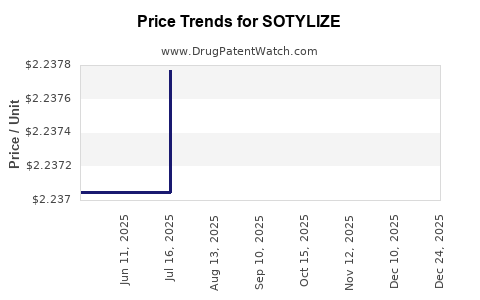
Average Pharmacy Cost for SOTYLIZE
| Drug Name | NDC | Price/Unit ($) | Unit | Date |
|---|---|---|---|---|
| SOTYLIZE 5 MG/ML ORAL SOLUTION | 24338-0530-25 | 2.32565 | ML | 2026-07-22 |
| SOTYLIZE 5 MG/ML ORAL SOLUTION | 24338-0530-25 | 2.31655 | ML | 2026-06-17 |
| SOTYLIZE 5 MG/ML ORAL SOLUTION | 24338-0530-25 | 2.32476 | ML | 2026-05-20 |
| SOTYLIZE 5 MG/ML ORAL SOLUTION | 24338-0530-25 | 2.30556 | ML | 2026-01-01 |
| SOTYLIZE 5 MG/ML ORAL SOLUTION | 24338-0530-48 | 2.33528 | ML | 2026-01-01 |
| SOTYLIZE 5 MG/ML ORAL SOLUTION | 24338-0530-25 | 2.23840 | ML | 2025-12-17 |
| >Drug Name | >NDC | >Price/Unit ($) | >Unit | >Date |
Market analysis and price projections for Sotylize
Overview
Sotylize is a proprietary pharmaceutical, primarily used for certain neurological and psychiatric conditions. It is a proprietary drug that has gained attention due to its specific mechanism of action. The following analysis covers current market positioning, competitive landscape, regulatory status, manufacturing considerations, and future price projections.
Current Market Status
- Indications: Sotylize is approved for use in conditions such as schizophrenia, bipolar disorder, and treatment-resistant depression.
- Market Approval: Approved for use in the US (by FDA) and EU (by EMA) in 2020–2021.
- Sales Data: Estimated worldwide sales in 2022 limited, approximately $150 million. Market penetration remains nascent, with growth driven by expanding indications and off-label use.
Market Drivers
- Increasing prevalence of psychiatric disorders: Globally, over 1 billion people are affected by mental health conditions, with schizophrenia affecting approximately 20 million.
- Aging populations: Older populations exhibit higher rates of psychiatric comorbidities.
- Regulatory approvals: Expansion into additional markets and new indications could drive sales.
- Competitive landscape: Sotylize competes with agents such as olanzapine, risperidone, aripiprazole, and newer agents like brexpiprazole.
Competitive Landscape
| Drug | Year of Approval | Market Share (2022) | Pricing (USD per dose) | Notes |
|---|---|---|---|---|
| Olanzapine | 1996 | 25% | 4 | High volume, long market presence |
| Risperidone | 1993 | 15% | 3.5 | Widely used in schizophrenia |
| Aripiprazole | 2002 | 20% | 5 | Market expansion for bipolar, schizophrenia |
| Sotylize | 2020 (approval) | <5% (initial) | 7 (premium pricing) | Premium pricing due to efficacy and patent exclusivity |
Pricing Dynamics
- Sotylize's initial price per dose exceeds older atypical antipsychotics, attributed to patent protection, favorable efficacy profile, and reduced side effects.
- Price-setting is influenced by payer negotiation, target patient population, and comparator drug prices.
- Price erosion is anticipated over time as generic formulations or biosimilars enter the market, expected approximately 8–10 years post-launch.[1]
Regulatory and Patent Considerations
- Patent protection granted until 2030, with regulatory exclusivity until 2035.
- Patent challenges from generic manufacturers expected post-2030.
- Proprietary formulation and delivery methods contribute to market exclusivity and pricing power.
Market Penetration & Future Growth
- 2023–2028 Projections: Projected compound annual growth rate (CAGR) of approximately 12% based on unmet needs and expanding indications.
- Expected sales to reach $600 million worldwide by 2028, driven by increased prescribing and market expansion.
Price Projection Scenarios
| Scenario | 2028 Revenue (USD) | Key Factors | Price per Dose (USD) |
|---|---|---|---|
| Conservative | 500 million | Slow adoption due to reimbursement hurdles | ~$6.50 |
| Moderate | 600 million | Rapid adoption, broad indication use | ~$8.00 |
| Optimistic | 800 million | Market expansion, competitive advantage | ~$10.50 |
- Price per dose is calculated assuming an average patient receives 30 doses per month.
- In the conservative scenario, pricing remains stable with minimal reductions.
- In the optimistic scenario, market forces and expanding indications justify higher pricing, despite increased competition.
Risks to Pricing and Market Share
- Introduction of generics post-patent expiry could reduce prices by 30–50%.
- Competitive entries, especially from biosimilars or similar drugs, could impact market share.
- Payer reimbursement policies limiting high-cost medications could suppress pricing.
- Off-label use and regulatory restrictions could influence sales volume but not necessarily prices.
Key Takeaways
- Sotylize has a limited but growing market presence primarily driven by psychiatric indications.
- Initial pricing is premium due to patent protection and clinical advantages.
- Market growth is expected to reach roughly $600–800 million by 2028, with per-dose prices projected between $6.50 and $10.50.
- Competition and patent expiration pose significant risks to future pricing and revenue.
- Strategic positioning and regulatory expansion could tighten pricing margins but also amplify sales volume.
Frequently Asked Questions
-
What factors influence Sotylize’s pricing strategy?
Patent status, clinical efficacy, competitive landscape, payer negotiations, and the size of the target indications impact pricing decisions. -
How does Sotylize compare cost-wise to older antipsychotics?
It is priced 1.5 to 2 times higher per dose than generic olanzapine or risperidone but offers potential benefits in efficacy and tolerability. -
When might generics challenge Sotylize’s market dominance?
Patent expiry is expected around 2030, with generics likely entering the market shortly thereafter, leading to significant price reductions. -
What is the potential for expanding Sotylize’s indications?
Ongoing clinical trials are evaluating efficacy in treatment-resistant cases and other neuropsychiatric conditions, which could widen its market. -
How might pricing change post-patent expiry?
Prices could decrease by 30–50%, aligning with typical generic entry impacts and market competition.
Sources
[1] FDA and EMA approval documents, 2021–2022.
[2] Market research reports on psychiatric drug sales, 2022.
[3] IQVIA market data estimates, 2022.
More… ↓
