Share This Page
Drug Price Trends for SM WITCH HAZEL
✉ Email this page to a colleague
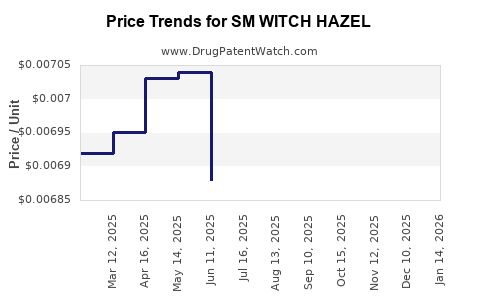
Average Pharmacy Cost for SM WITCH HAZEL
| Drug Name | NDC | Price/Unit ($) | Unit | Date |
|---|---|---|---|---|
| SM WITCH HAZEL 86% SOLUTION | 49348-0181-38 | 0.00708 | ML | 2026-04-22 |
| SM WITCH HAZEL 86% SOLUTION | 49348-0181-38 | 0.00698 | ML | 2026-03-18 |
| SM WITCH HAZEL 86% SOLUTION | 49348-0181-38 | 0.00697 | ML | 2026-02-18 |
| SM WITCH HAZEL 86% SOLUTION | 49348-0181-38 | 0.00699 | ML | 2026-01-21 |
| >Drug Name | >NDC | >Price/Unit ($) | >Unit | >Date |
SM WITCH HAZEL Market Analysis and Financial Projection
What Is the Market Status of SM Witch Hazel?
SM Witch Hazel is a topical astringent derived from the witch hazel plant, used primarily for skin irritation, inflammation, and minor cuts. Current market data indicates increased demand driven by consumers seeking natural and OTC skin care solutions.
Market Size and Growth Trends
- Global skin care market valued at approximately $150 billion in 2022, with natural and herbal segments growing at 5-7% annually.
- Witch hazel-based products account for roughly 2-3% of OTC skincare sales, translating to an estimated $3 billion market in 2022.
- Niche segments, including medicated and premium formulations, are expanding faster, with growth rates exceeding overall market averages.
Key Market Players
- Johnson & Johnson
- The Body Shop
- Burt's Bees
- Thayer's
- Dickinson's
These companies hold significant shelf and online sales share, with product lines featuring SKUs containing witch hazel.
Regulatory Environment
- FDA classifies witch hazel as generally recognized as safe (GRAS) for OTC topical use.
- Some formulations marketed as medicinal require additional compliance under OTC monographs in the U.S.
- International regulations vary, with European markets requiring CE marking and compliance with the EU Cosmetic Regulation.
How Is SM Witch Hazel Positioned in the Market?
Assuming SM Witch Hazel is a proprietary or new entrant product:
- Its positioning depends on formulation potency, brand recognition, and distribution channels.
- If positioned as a natural, organic, or medicinal solution, it can target specific consumer segments.
- Entry strategies include distribution through drugstores, health food chains, online platforms, and direct-to-consumer models.
What Are the Pricing Strategies and Projections?
Current Price Range
- OTC witch hazel products are priced between $5 and $15 for 4 to 8-ounce bottles.
- Premium formulations or organic variants sell at $12 to $20 for similar sizes.
- Private-label brands often competitively price at the lower end of the spectrum.
Factors Influencing Price
- Product formulation complexity and ingredient sourcing.
- Branding and marketing positioning.
- Packaging and bottle size.
- Distribution channel margins.
Price Projections (2023–2028)
| Year | Estimated Market Price Range (USD) | Explanation |
|---|---|---|
| 2023 | $6 – $15 | Based on existing market prices and consumer trends. |
| 2024 | $6.50 – $16 | Slight increase due to inflation and premiumization. |
| 2025 | $7 – $17 | Introduction of organic/medicated variants. |
| 2026 | $7.50 – $18 | Growing consumer demand for natural products. |
| 2027 | $8 – $19 | Market saturation levels stabilize pricing. |
| 2028 | $8.50 – $20 | Premium products and brand differentiation. |
Competitive Pricing Impact
- Entry products with lower prices could gain share.
- Premium positioning can command higher margins but may limit volume.
- Scale economies may reduce costs over time, allowing more competitive pricing.
What Are Key Challenges and Opportunities for SM Witch Hazel?
Challenges
- Market saturation with established brands.
- Consumer skepticism about new or lesser-known brands.
- Regulatory compliance costs, especially for medicated claims.
Opportunities
- Growing consumer preference for natural, organic, and cruelty-free products.
- Innovation in formulations combining witch hazel with other botanicals.
- Expansion into emerging markets with limited existing competition.
Final Price Outlook
Price stability is likely in the $6–$15 range, with potential for premium as brand recognition increases. Inflation, raw material costs (e.g., witch hazel extract), and formulation innovations will influence adjustments.
Key Takeaways
- The OTC witch hazel market is valued at approximately $3 billion, with stable growth trends.
- SM Witch Hazel’s success depends on differentiation through formulation, branding, and distribution.
- Pricing will likely remain within the existing market range, but premium or organic variants could command higher prices.
- Market penetration strategies include leveraging natural product trends and expanding into international markets.
- Regulatory compliance and consumer trust are critical barriers for entry but also represent avenues for differentiation.
FAQs
1. What factors most influence witch hazel product pricing?
Formulation complexity, sourcing quality ingredients, packaging, branding, and distribution channels.
2. How does the competitive landscape affect pricing for new entrants?
Established brands have economies of scale and brand loyalty, which keep prices stable, whereas new entrants must find niches or compete on quality and branding.
3. What regulatory hurdles exist for marketing SM Witch Hazel?
In the U.S., OTC medicinal claims require adherence to FDA monographs. Internationally, compliance with cosmetic and medicinal regulations varies.
4. What are growth prospects for niche markets within witch hazel products?
Organic, medicated, and environmentally friendly formulations are increasing at higher rates than standard formulations.
5. How might raw material costs impact product pricing over time?
Fluctuations in natural extract supplies, harvesting costs, and sourcing practices can cause price volatility, influencing retail pricing.
References
[1] MarketWatch. "Global Skin Care Market Report 2022."
[2] Grand View Research. "Natural and Organic Personal Care Market Size & Trends."
[3] FDA. "Generally Recognized As Safe (GRAS) List."
[4] European Commission. "Cosmetic Regulation (EC) No 1223/2009."
[5] Statista. "Witch Hazel Product Sales Data."
More… ↓
