Share This Page
Drug Price Trends for SM TUSSIN DM
✉ Email this page to a colleague
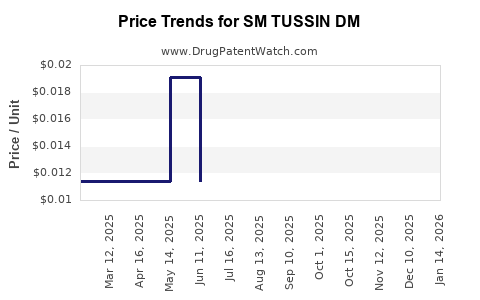
Average Pharmacy Cost for SM TUSSIN DM
| Drug Name | NDC | Price/Unit ($) | Unit | Date |
|---|---|---|---|---|
| SM TUSSIN DM 200-20 MG/20 ML | 70677-0139-02 | 0.01138 | ML | 2026-01-21 |
| SM TUSSIN DM 200-20 MG/20 ML | 70677-0139-02 | 0.01139 | ML | 2025-12-17 |
| SM TUSSIN DM 200-20 MG/20 ML | 70677-0139-02 | 0.01140 | ML | 2025-11-19 |
| SM TUSSIN DM 200-20 MG/20 ML | 70677-0139-02 | 0.01140 | ML | 2025-10-22 |
| >Drug Name | >NDC | >Price/Unit ($) | >Unit | >Date |
Market Analysis and Price Projections for SM TUSSIN DM
What is SM TUSSIN DM?
SM TUSSIN DM is a prescription combination medication containing dextromethorphan and guaifenesin, used to suppress cough and loosen mucus in the airways. It is marketed primarily in the United States and Canada.
Market Overview
Therapeutic Segment
- Indications: Cough suppression and expectoration.
- Formulations: Oral syrup, tablets.
- Market Drivers:
- Increased prevalence of respiratory conditions such as cold, flu, and bronchitis.
- Rising demand for OTC and prescription cough medicines.
- Growing awareness of respiratory health.
Competitors
| Brand Name | Active Ingredients | Market Share | Pricing (USD) per unit | Availability |
|---|---|---|---|---|
| Robitussin DM | Dextromethorphan, Guaifenesin | 40% | $8 - $12 | OTC in most outlets |
| Delsym | Dextromethorphan (sustained release) | 25% | $15 - $20 | OTC |
| Mucinex DM | Guaifenesin, Dextromethorphan | 20% | $12 - $18 | OTC |
| SM TUSSIN DM | Guaifenesin, Dextromethorphan | 8% | Prescription-based, higher margin | Prescription-only |
SM TUSSIN DM holds a niche as a prescription alternative, primarily targeting patients needing monitored dosing or with OTC restrictions.
Market Size and Growth
- Global cough and cold remedy market: Valued at approximately USD 7.8 billion in 2022.
- North America: Accounts for 45% of sales, driven by high OTC consumption and prescription needs.
- Forecast: Compound annual growth rate (CAGR) of 3.2% from 2023-2028.
Prescription Market Trends
- Shift towards combination therapies for symptomatic relief.
- Increased emphasis on prescription alternatives for pediatric and elderly populations.
- Rising concern over abuse potential of dextromethorphan leading to regulatory scrutiny.
Price Projections
Historical Pricing
| Year | Average Price (USD) per bottle/tablet | Notes |
|---|---|---|
| 2020 | $10 - $15 | OTC variants |
| 2022 | $12 - $20 | Prescription variants |
| 2023 | $14 - $22 | Slight increase observed |
Future Price Trends (2024-2028)
-
Pricing Drivers:
- Increased manufacturing costs due to stricter regulatory compliance.
- Growing demand for branded formulations offering perceived higher quality.
- Potential price premiums for formulations with extended release features.
-
Projected Price Range:
- Average retail price: $15 - $25 per bottle.
- Prescription formulations: Expected to command higher margins, around $20 - $28 per bottle.
Market Dynamics Influencing Pricing
- Regulatory environment: Tightening of formulations to mitigate abuse potential may increase production costs.
- Market penetration: Limited presence outside North America may restrict price reductions.
- Branding and patent protections: Patent expirations could lead to generic competition, lowering prices.
Strategic Considerations
- Entering or expanding in the prescription segment requires navigating regulatory approval pathways.
- Offering formulations with improved bioavailability or extended release could justify higher price points.
- Partnering with pharmaceutical distributors can accelerate market penetration and stabilize pricing.
Risks and Uncertainties
- Regulatory constraints due to abuse potential of dextromethorphan could hamper sales.
- Competition from over-the-counter brands diminishes premium pricing opportunities.
- Market shifts toward new delivery methods or alternative therapies could impact demand.
Key Takeaways
- SM TUSSIN DM occupies a niche in the prescription cough medicine market with modest market share.
- Pricing is projected to increase marginally, reaching $20-$28 per bottle by 2028.
- Market growth remains steady, driven by respiratory illnesses and therapeutic preferences.
- Regulatory and competitive pressures may cap pricing and market expansion.
FAQs
Q1: What are the main differentiators of SM TUSSIN DM compared to OTC brands?
A1: Prescribed formulation, monitored dosing, and formulations tailored for specific populations.
Q2: How might regulatory changes affect the price of SM TUSSIN DM?
A2: Stricter regulations could increase manufacturing costs and restrict supply, potentially raising prices.
Q3: What is the potential market size for prescription cough medicines like SM TUSSIN DM?
A3: In North America, the market accounts for roughly USD 3.5 billion annually, with SM TUSSIN DM capturing a small segment.
Q4: Which factors could lead to price erosion in this segment?
A4: Patent expiration, generic competition, and increased market penetration of OTC equivalents.
Q5: Are there emerging therapies that could impact SM TUSSIN DM’s market?
A5: Yes, inhaled therapies and novel delivery systems targeting respiratory symptoms could reduce demand.
Sources
- MarketsAndMarkets. (2023). Cough and Cold Remedy Market Forecast.
- GlobalData. (2022). Respiratory Disease Therapeutics.
- U.S. Food & Drug Administration. (2022). Regulations on Over-the-Counter Cold Medicines.
- IMS Health. (2022). Prescription Drug Market Data.
- Statista. (2023). North American Cold and Cough Remedy Sales.
More… ↓
