Share This Page
Drug Price Trends for SM TRIPLE ANTIBIOTIC OINTMENT
✉ Email this page to a colleague
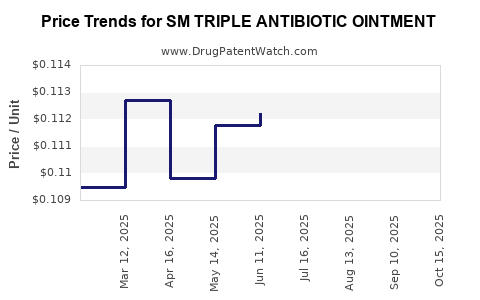
Average Pharmacy Cost for SM TRIPLE ANTIBIOTIC OINTMENT
| Drug Name | NDC | Price/Unit ($) | Unit | Date |
|---|---|---|---|---|
| SM TRIPLE ANTIBIOTIC OINTMENT | 70677-0013-01 | 0.10389 | GM | 2025-10-22 |
| SM TRIPLE ANTIBIOTIC OINTMENT | 70677-0013-01 | 0.10607 | GM | 2025-09-17 |
| SM TRIPLE ANTIBIOTIC OINTMENT | 70677-0013-01 | 0.11085 | GM | 2025-08-20 |
| >Drug Name | >NDC | >Price/Unit ($) | >Unit | >Date |
Market Analysis and Price Projections for SM Triple Antibiotic Ointment
What is SM Triple Antibiotic Ointment?
SM Triple Antibiotic Ointment combines bacitracin, neomycin, and polymyxin B. It is used for topical infections, preventing minor skin infections in cuts, scrapes, and burns. Its existing formulations are over-the-counter (OTC) products available globally, with market penetration primarily in North America, Europe, and parts of Asia.
Market Size and Growth Dynamics
Current Market Size
The global topical antibiotics market was valued at approximately USD 5.6 billion in 2022[1]. SM Triple Antibiotic Ointment accounts for a sizable share owing to its widespread OTC use, particularly in the wound care segment.
Growth Drivers
- Rising prevalence of skin injuries and wounds.
- Increasing OTC availability and consumer preference for topical over systemic antibiotics.
- Expanding healthcare infrastructure in emerging markets.
Market Trends
- Shift toward combination topical antibiotics.
- Growing consumer awareness and self-medication.
- Regulation tightening on prescription-only status for certain topical antibiotics.
Regional Insights
| Region | Market Share (2022) | Growth Rate (CAGR 2022-2028) |
|---|---|---|
| North America | 45% | 3.2% |
| Europe | 25% | 2.8% |
| Asia-Pacific | 20% | 6.4% |
| Rest of World | 10% | 4.5% |
Asia-Pacific exhibits higher growth due to increasing disposable incomes, expanding pharmacy chains, and a rising number of wound management cases.
Competitive Landscape
Major players include:
- Pfizer (Neosporin)
- Johnson & Johnson (Neosporin, other formulations)
- GlaxoSmithKline
- Local generic manufacturers in emerging markets
Entry barriers involve regulatory approval, manufacturing scale, and patent protections.
Regulatory Environment
In the US, OTC status persists for most broad-spectrum topical antibiotics[2]. The EU classifies such products as pharmacy medicines requiring supervision. Patent expirations, regulatory approvals, and safety concerns influence market access and pricing strategies.
Price Trends and Projections
Current Pricing
- United States: USD 4.50 – USD 7.00 for a 15g tube[3].
- Europe: EUR 3.00 – EUR 6.50 per tube.
- Asia-Pacific: USD 2.00 – USD 4.50, influenced by local manufacturing costs.
Price Drivers
- Patent expirations and generic competition decrease prices.
- Regulatory changes impacting OTC status can influence pricing.
- Brand dominance sustains higher prices in mature markets.
Future Price Trends (2023–2028)
| Year | Price Range (USD) per 15g tube | Influencing Factors |
|---|---|---|
| 2023 | USD 4.50 – USD 7.00 | Patent expiries, supply chain stability |
| 2024 | USD 4.00 – USD 6.50 | Increased generic entries, price competition |
| 2025 | USD 3.50 – USD 6.00 | Market saturation, regulatory changes |
| 2026 | USD 3.00 – USD 5.50 | Heightened generic competition, manufacturing efficiencies |
| 2027 | USD 2.50 – USD 5.00 | Further price compression, OTC transitions in some markets |
| 2028 | USD 2.00 – USD 4.50 | Mature generic market, regional cost factors |
Potential Impact of New Entrants
- Entry of biosimilars or novel formulations could lower prices.
- Price declines may accelerate if regulatory hurdles are eased or patents expire earlier than anticipated.
Market Entry and Investment Opportunities
- Regions with high growth potential include Southeast Asia and Latin America.
- Differentiation via improved formulations, packaging, or addressing resistance concerns is vital.
- Strategic licensing and partnerships with local manufacturers can accelerate market penetration.
Key Considerations for Stakeholders
- Patent landscapes may limit immediate generics or biosimilars entry.
- Regulatory pathways differ markedly; a product approved in one region may face hurdles elsewhere.
- Consumer preferences for OTC products favor affordable pricing and robust safety profiles.
Key Takeaways
- The global topical antibiotics market, including SM Triple Antibiotic Ointment, is robust with steady growth.
- Price points are declining due to generic competition but remain stable in branded segments.
- Asia-Pacific offers the highest growth prospects.
- Regulatory policies heavily influence market dynamics and pricing.
- Continuous innovation and strategic regional expansion are critical for sustained profitability.
FAQs
Q1: How will patent expirations impact the price of SM Triple Antibiotic Ointment?
A: Patent expirations typically lead to increased generic competition, causing prices to decline gradually over 1–3 years.
Q2: What regions offer the most attractive opportunities for new entrants?
A: Southeast Asia and Latin America present high growth potential due to expanding healthcare infrastructure and rising wound care needs.
Q3: Are there regulatory barriers for OTC topical antibiotics?
A: Yes. Regulatory requirements vary; the US maintains OTC status for many formulations, whereas the EU often requires pharmacy supervision.
Q4: Could new formulations or delivery methods influence the market?
A: Yes. Innovations like sustained-release formulations or combined therapies could command premium pricing and expand market share.
Q5: How does consumer preference affect pricing strategies?
A: Preference for affordable, easily accessible OTC products pressures manufacturers to keep prices competitive, especially in emerging markets.
References
[1] MarketandMarkets. (2022). Topical Antibiotics Market Size, Share & Trends.
[2] U.S. Food and Drug Administration. (2023). Over-the-Counter (OTC) Drug Review.
[3] GoodRx. (2023). Neosporin prices.
More… ↓
