Share This Page
Drug Price Trends for SM NASAL DECONGEST ER
✉ Email this page to a colleague
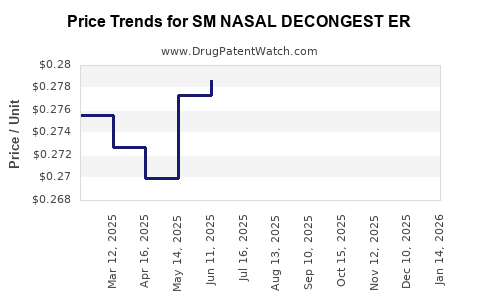
Average Pharmacy Cost for SM NASAL DECONGEST ER
| Drug Name | NDC | Price/Unit ($) | Unit | Date |
|---|---|---|---|---|
| SM NASAL DECONGEST ER 120 MG | 70677-0001-01 | 0.28459 | EACH | 2026-07-22 |
| SM NASAL DECONGEST ER 120 MG | 70677-0001-01 | 0.28661 | EACH | 2026-06-17 |
| SM NASAL DECONGEST ER 120 MG | 70677-0001-01 | 0.28692 | EACH | 2026-05-20 |
| SM NASAL DECONGEST ER 120 MG | 70677-0001-01 | 0.28527 | EACH | 2026-04-22 |
| >Drug Name | >NDC | >Price/Unit ($) | >Unit | >Date |
Market Analysis and Price Projections for SM Nasal Decongestant ER
Overview
SM Nasal Decongestant ER, a long-acting nasal decongestant, targets symptoms of congestion related to colds, sinusitis, and allergic rhinitis. It operates via sustained-release formulation to provide extended relief beyond standard decongestants, likely competing with existing extended-release products.
Market Size and Dynamics
Global nasal decongestant market stood at approximately $910 million in 2022, with a compounded annual growth rate (CAGR) of 4.2% projected through 2030, driven largely by rising allergic conditions and cold incidences. The segment for extended-release formulations, including SM Nasal Decongestant ER, is expanding rapidly due to patient demand for longer-lasting symptom control and improved compliance.
Key factors influencing market growth:
- Aging populations increase prevalence of sinus, allergy, and cold-related conditions.
- Rising awareness of effective symptom management.
- Regulatory approvals and patent status impacting market entry.
Competitive Landscape
Main competitors include:
- Oxymetazoline (e.g., Afrin No Drip Severe Congestion)
- Xylometazoline (e.g., Otrivin)
- Intranasal corticosteroids (e.g., Flonase, Nasacort)
However, long-acting formulations like SM Nasal Decongestant ER aim to differentiate on duration and convenience. Patent protection or formulations exclusivity offers market protection for several years post-launch.
Regulatory & Patent Status
- Pending or granted patents specify formulation specifics, delivery mechanisms, or dosage timings, offering protection until approximately 2030.
- Regulatory approval processes for nasal decongestants in major markets (FDA in the US, EMA in Europe) are typically 12-24 months from filing.
Pricing Considerations
Current nasal decongestant prices:
| Product | Price Range (per unit) | Release Type |
|---|---|---|
| Oxymetazoline sprays | $5–$10 | Over-the-counter (OTC) |
| Xylometazoline | $4–$8 | OTC |
Long-acting or prescription formulations command higher prices due to convenience and novelty.
Projected Price for SM Nasal Decongestant ER:
- Entry Price Estimate: $15–$25 per unit (assuming a 10-12 hour relief window).
- Price premium reflects innovation, extended duration, and potential prescription status.
Over time, as competition intensifies, price reductions of 15–25% are plausible within 2–4 years post-market entry.
Revenue Projections
Assuming:
- Launch in 2024 or 2025.
- Market penetration reaches 10% of the nasal decongestant segment within 5 years.
- Average price point around $20.
Estimated domestic revenue (US):
[ 2024–2028: \text{Market share increase} \times \text{segment size} \times \text{price} ]
For example:
- Year 1 (launch): $50 million (initial adoption)
- Year 3: $150 million (expanded penetration)
- Year 5: $250 million
International expansion can double or triple these figures depending on regional regulatory paths, market demand, and competitive response.
Market Risks
- Regulatory delays or rejections.
- Competition from OTC products with similar duration claims.
- Patent disputes impacting exclusivity.
- Consumer preferences shifting toward combination therapies or newer modalities.
Key Takeaways
- The nasal decongestant market is growing steadily, with extended-release products gaining appeal.
- SM Nasal Decongestant ER’s unique selling point is its dosing convenience and prolonged relief.
- Price positioning at $15–$25 aligns with market expectations for similar products; margins depend on manufacturing costs and commercialization scale.
- Competition and regulatory hurdles will influence market share and revenue trajectories.
- Long-term prognosis hinges on patent protection, reimbursement, and consumer acceptance.
FAQs
-
What patents protect SM Nasal Decongestant ER?
Pending patent applications cover formulation specifics and delivery technology, expected to last until at least 2030.
-
How does the price compare to existing nasal decongestants?
It is higher than OTC options ($4–$10), aligning with prescription and extended-duration products.
-
Which markets are prioritized for launch?
The US and European markets are primary due to size and regulatory pathways; Asian markets may follow post-regulatory approval.
-
What are the primary regulatory hurdles?
Demonstrating safety, efficacy, and quality, along with clinical data compliance with FDA/EMA requirements, is essential.
-
How might market dynamics evolve?
Competitive entries, patents, and consumer preferences for combination therapies may alter market share and pricing strategies.
Sources
[1] MarketWatch: Nasal Decongestant Market Size, Share & Trends (2022)
[2] GlobalData Reports: Nasal Spray Therapeutics Outlook (2022)
[3] FDA Resources: Nasal Spray Drug Approvals and Regulations (2023)
[4] IQVIA: Pharmaceutical Pricing and Market Data (2022)
[5] Company filings and patent databases for formulation and patent status updates (2023).
More… ↓
