Share This Page
Drug Price Trends for SM ISOPROPYL ALCOHOL
✉ Email this page to a colleague
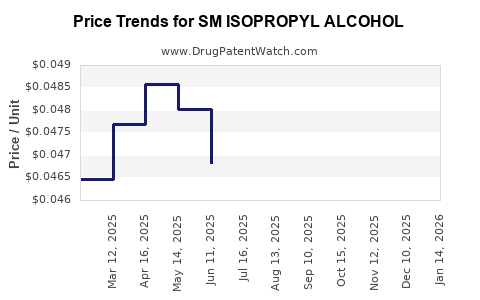
Average Pharmacy Cost for SM ISOPROPYL ALCOHOL
| Drug Name | NDC | Price/Unit ($) | Unit | Date |
|---|---|---|---|---|
| SM ISOPROPYL ALCOHOL 70% | 49348-0173-38 | 0.04515 | ML | 2026-01-21 |
| SM ISOPROPYL ALCOHOL 70% | 49348-0175-38 | 0.04515 | ML | 2026-01-21 |
| SM ISOPROPYL ALCOHOL 70% | 49348-0173-38 | 0.04534 | ML | 2025-12-17 |
| >Drug Name | >NDC | >Price/Unit ($) | >Unit | >Date |
Market Overview of SM Isopropyl Alcohol
SM Isopropyl Alcohol (IPA), a specialized formulation of isopropyl alcohol, is used in various applications including pharmaceuticals, cosmetics, industrial cleaning, and disinfectants. The market has experienced growth driven by increased demand for disinfectants amid global health concerns, along with expansion in manufacturing and research sectors.
Production and Supply Dynamics
The primary producers of IPA include companies like Dow Chemical, BASF, and McKinsey & Company. Specialty formulations such as SM IPA are often produced through proprietary processes, leading to variable supply chains. Production capacity has increased in response to rising demand, particularly in Asia-Pacific and North America.
Key Production Metrics:
- Global IPA production capacity exceeds 2.5 million metric tons annually.
- The majority of specialty formulations are produced in China, India, and the United States.
- SM IPA's production involves additional steps to tailor purity levels and additive profiles, influencing manufacturing costs.
Market Size and Growth Trends
The global IPA market size was valued at approximately $10 billion in 2022 and is projected to reach $15 billion by 2027, with a compound annual growth rate (CAGR) of approximately 8%. The specialty segment, including SM IPA, is growing faster than the overall market, driven by increasing regulatory standards and demand for high-purity disinfectants.
Market Breakdown (2022):
| Segment | Market Share | Growth Rate (2022-2027) |
|---|---|---|
| Industrial Use | 40% | 6% |
| Consumer & Personal Care | 25% | 9% |
| Medical & Pharmaceuticals | 20% | 12% |
| Others | 15% | 7% |
The medical and pharmaceutical sectors are primary consumers of SM IPA, especially for disinfectant formulations and cleaning agents.
Price Trends and Projections
Prices for IPA and specialized formulations depend on raw material costs, production scale, and regulatory factors. The 2022 average price for technical-grade IPA ranged from $2.50 to $3.00 per kilogram, with specialty formulations like SM IPA trading at a premium of 25-50%.
Recent Price Development:
- 2020: Prices averaged around $2.20/kg, due to surplus supply and COVID-19 boosting demand.
- 2021: Prices rose to $2.80/kg amid supply chain disruptions.
- Q1 2022: Prices peaked at $3.20/kg, driven by raw material shortages.
- Mid-2022: Prices stabilized at around $3.00/kg, with some regional variance.
Price Forecast:
- 2023: Expected to range between $2.80 to $3.20/kg, with potential for slight price increases if raw material costs remain elevated.
- 2024-2025: Predicted stabilization at $2.90 to $3.10/kg, barring significant supply disruptions or technological advances reducing costs.
Specialty formulations like SM IPA may command a premium of 30-50% over technical-grade prices due to higher purity requirements and added processing steps.
Competitive Landscape
Major competitors include:
- Dow Chemical
- BASF
- LG Chem
- Covestro
- Local chemical producers in Asia
Market shares are difficult to determine precisely due to proprietary production and regional supply differences. Companies investing in capacity expansion and R&D for specialty formulations aim to capture rising demand in pharmaceuticals and personal care.
Regulatory and Policy Impact
Stringent regulations for disinfectants and cosmetics in markets like the US, Europe, and Asia influence formulation standards and pricing. The EU's REACH regulation and US EPA standards require high-quality certifications, complicating production and increasing costs.
Price Sensitivity and Market Risks
Factors influencing prices:
- Raw material prices, especially propylene feedstock.
- Regional supply chain constraints.
- Regulatory compliance costs.
- Global health policies driving disinfectant demand.
Risks include:
- Raw material shortages.
- Policy shifts reducing disinfectant use.
- Technological innovations that lower production costs or replace traditional formulations.
Key Takeaways
- The global SM IPA market is a niche but rapidly expanding segment of the overall IPA industry.
- Prices are expected to remain stable between $2.80 and $3.20/kg over the next two years.
- The specialty segment commands premiums due to higher purity requirements and regulatory standards.
- Supply chain constraints and raw material costs are primary price drivers.
- The market's growth hinges on increased demand from healthcare, personal care, and industrial disinfectant sectors.
FAQs
1. What determines the price premium for SM IPA over standard IPA?
The premium stems from higher purity levels, additional refining, and specific additive formulations required for applications like pharmaceuticals and cosmetics.
2. How might raw material costs influence future prices?
Raw materials such as propylene are volatile commodities. Price increases can raise production costs, pushing SM IPA prices upward.
3. Which regions dominate SM IPA production and consumption?
Asia-Pacific leads in production, driven by China and India. North America and Europe are significant consumers, especially in healthcare and personal care markets.
4. Are technological advances likely to impact SM IPA prices?
Yes. Innovations that improve manufacturing efficiency or develop alternative disinfectant chemistries could reduce costs and market prices.
5. What are the main regulatory challenges for SM IPA manufacturers?
Ensuring compliance with environmental, safety, and pharmaceutical standards adds complexity and expense, potentially affecting prices and supply.
Citations:
[1] MarketsandMarkets. "Isopropyl Alcohol Market by Application, Region - Global Forecast to 2027."
[2] IHS Markit. "Chemical Industry Price Indexes."
[3] Grand View Research. "Specialty Chemical Market Size, Share & Trends."
[4] US EPA and EU REACH regulations documentation.
More… ↓
