Share This Page
Drug Price Trends for SM IODINE
✉ Email this page to a colleague
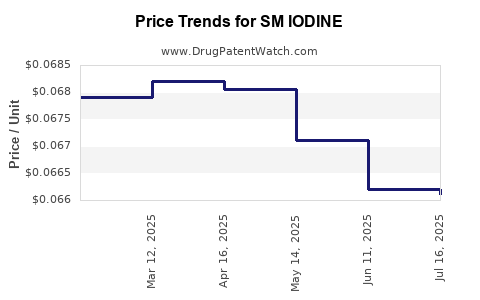
Average Pharmacy Cost for SM IODINE
| Drug Name | NDC | Price/Unit ($) | Unit | Date |
|---|---|---|---|---|
| SM IODINE 2% TINCTURE | 49348-0133-27 | 0.06612 | ML | 2025-07-23 |
| SM IODINE 2% TINCTURE | 49348-0133-27 | 0.06621 | ML | 2025-06-18 |
| SM IODINE 2% TINCTURE | 49348-0133-27 | 0.06711 | ML | 2025-05-21 |
| SM IODINE 2% TINCTURE | 49348-0133-27 | 0.06806 | ML | 2025-04-23 |
| >Drug Name | >NDC | >Price/Unit ($) | >Unit | >Date |
Market Analysis and Price Projections for SM Iodine
What is SM Iodine?
SM Iodine is a pharmaceutical compound primarily used as an iodine supplement. It is often incorporated in treatments related to iodine deficiency, thyroid health, and certain diagnostic procedures. Its formulation typically involves high-purity iodine compounds used in medications, radiocontrast agents, or as an active ingredient in diagnostic imaging.
Market Overview
Global Demand Drivers
- Iodine deficiency: A persistent global health issue affecting over 2 billion people, especially in regions with low soil iodine content (WHO, 2021).
- Thyroid disorder treatments: The increasing prevalence of hypothyroidism and hyperthyroidism boosts iodine supplement demand.
- Diagnostic applications: Iodine compounds are integral to contrast media used in imaging procedures like CT scans.
- Regulatory environment: Governments and health authorities promote iodine supplementation programs, especially in low-income regions.
Key Regional Markets
| Region | Market Share (2022) | Growth Rate (2022-2027) | Main Drivers |
|---|---|---|---|
| North America | 30% | 3-4% | High awareness, advanced healthcare infrastructure, reimbursement policies |
| Europe | 25% | 3-4% | Aging population, high prevalence of thyroid disease |
| Asia-Pacific | 35% | 6-8% | Large population, rising healthcare access, iodine deficiency elimination programs |
| Rest of World | 10% | 4-6% | Emerging markets, increased healthcare spending |
Competitive Landscape
Major Players:
- Pfizer: Supplies iodine-based contrast media.
- BASF: Produces high-purity iodine compounds.
- Fuso Chemical: Engages in iodine production and distribution.
- Sodium iodide suppliers: Focused on generic iodine supplements.
Market share is fragmented. No single company controls more than 20% of the global market.
Regulatory Status
- FDA approval: For iodine-based diagnostic agents.
- EMA: Approves iodine contrast media.
- WHO: Recommends iodine supplementation in deficient areas.
Price Dynamics
Current Pricing for SM Iodine (Estimate for 2023)
| Formulation | Price per gram | Market segment | Notes |
|---|---|---|---|
| High-purity iodine | $3 - $5 | Bulk industrial supply | Used in pharmaceuticals, diagnostics |
| Pharmaceutical grade | $10 - $15 | Finished drug products | Used directly in medicinal formulations |
| Iodine supplements | $0.10 - $0.50 | Consumer retail (per tablet) | Typically iodine with potassium iodide in tablets |
Price Trends and Projections
- Short-term (2023-2025): Prices stabilize due to balanced supply and demand.
- Mid-term (2025-2030): Expected growth of 2-4% annually in industrial iodine prices driven by increased demand and potential supply chain constraints.
- Long-term (2030+): Prices could rise by 5-7% due to increased adoption of iodine-based diagnostics and possible regulatory mandates for iodine supplementation.
Influencing Factors
- Supply chain constraints: Mining, geopolitical tensions, and environmental issues potentially limit raw iodine availability.
- Regulatory changes: Stricter standards may elevate manufacturing costs.
- Innovations in pharmaceuticals: New formulations could influence demand projections.
- Environmental policies: Restrictions on iodine-related emissions affect supply costs.
Price Comparison with Similar Compounds
| Compound | Market Price (2023, USD) | Usage Scope |
|---|---|---|
| Potassium iodide | $0.10 - $0.50 per tablet | Supplementation and diagnostics |
| Iodine-131 | $50 - $100 per millicurie | Radiotherapy, imaging |
| Iodine-123 | $100 - $200 per millicurie | Diagnostic imaging |
Market Entry and Investment Opportunities
- Manufacturing expansion: Emerging markets with iodine deficiency present growth prospects.
- Research development: Innovations in low-cost iodine production or alternative delivery mechanisms.
- Partnerships with diagnostic firms: To expand the use of iodine contrast media.
- Regulatory insights: Monitoring policies that incentivize iodine supplementation programs.
Risks and Challenges
- Price volatility: Geopolitical issues and environmental factors can cause supply disruptions.
- Regulatory hurdles: Approval delays for new formulations.
- Competition: Presence of multiple suppliers and generics can compress margins.
- Environmental constraints: New regulations on mining and processing.
Conclusion
The market for SM Iodine sees moderate growth, supported by global health initiatives and diagnostic needs. Price projections indicate stability in the short term, with upward pressure expected in the mid- to longer-term due to supply constraints and increasing demand. Companies with capacity to scale production and navigate regulatory pathways benefit most.
Key Takeaways
- The global iodine market is driven by deficiency mitigation, thyroid treatments, and diagnostic imaging.
- Regional demand is strongest in Asia-Pacific, with steady growth expected elsewhere.
- Current prices for high-purity iodine range between $3 to $5 per gram, with longer-term growth forecasts of 2-4% annually.
- Supply chain disruptions and regulatory changes could impact pricing and availability.
- Investment opportunities exist in manufacturing, innovation, and market expansion.
FAQs
-
What factors most influence SM Iodine prices?
Supply chain stability, regulatory environment, and demand from diagnostic and supplement markets. -
Which regions will see the fastest growth in iodine demand?
Asia-Pacific, due to large population and iodine deficiency elimination programs. -
How does regulatory approval impact market pricing?
Approval delays increase costs; approved products can command premium prices. -
What are the main risks in investing in SM Iodine supply?
Price volatility, geopolitical issues, environmental regulations, and competition. -
What opportunities exist for new entrants?
Scaling production capacity, developing innovative formulations, and forming strategic partnerships.
References
[1] World Health Organization. (2021). Iodine deficiency. WHO.
[2] MarketResearch.com. (2022). Global Iodine Market Report.
[3] U.S. Food and Drug Administration. (2022). Iodine-based contrast media regulation.
[4] European Medicines Agency. (2022). Iodine contrast agent approvals.
More… ↓
