Share This Page
Drug Price Trends for SM HYDROCORTISONE-ALOE
✉ Email this page to a colleague
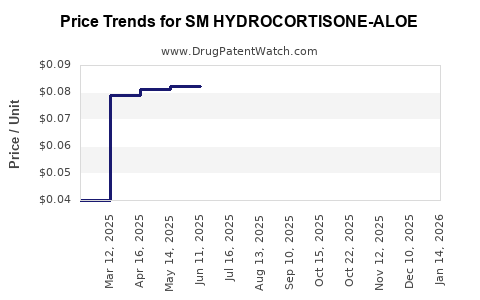
Average Pharmacy Cost for SM HYDROCORTISONE-ALOE
| Drug Name | NDC | Price/Unit ($) | Unit | Date |
|---|---|---|---|---|
| SM HYDROCORTISONE-ALOE 1% CRM | 49348-0521-78 | 0.04000 | GM | 2026-01-21 |
| SM HYDROCORTISONE-ALOE 1% CRM | 49348-0521-78 | 0.04000 | GM | 2025-12-17 |
| SM HYDROCORTISONE-ALOE 1% CRM | 49348-0521-78 | 0.04000 | GM | 2025-11-19 |
| SM HYDROCORTISONE-ALOE 1% CRM | 49348-0521-72 | 0.07231 | GM | 2025-10-22 |
| SM HYDROCORTISONE-ALOE 1% CRM | 49348-0521-78 | 0.04000 | GM | 2025-10-22 |
| >Drug Name | >NDC | >Price/Unit ($) | >Unit | >Date |
Market Analysis and Price Projections for SM Hydrocortisone-Aloe
What is SM Hydrocortisone-Aloe?
SM Hydrocortisone-Aloe is a topical dermatological product combining hydrocortisone, a corticosteroid used to reduce inflammation and itching, with aloe vera, a natural ingredient known for soothing skin. It targets inflammatory skin conditions such as eczema, dermatitis, and allergic reactions.
Market Overview
Global Market Size
The global topical corticosteroid market was valued at approximately $5 billion in 2021. Growth drivers include increasing prevalence of skin disorders, rising awareness, and an aging population. The segment that includes hydrocortisone and natural adjuncts like aloe is experiencing a compound annual growth rate (CAGR) between 4% and 6%.
Key Geographies
- North America: Largest market, driven by high healthcare expenditure, advanced healthcare infrastructure, and widespread awareness.
- Europe: Significant market with mature healthcare sectors and strong dermatological care focus.
- Asia-Pacific: Fastest-growing segment, with CAGR exceeding 7%. Lower manufacturing costs and rising disposable incomes contribute.
- Latin America and Middle East: Emerging markets with increasing access to dermatological treatments.
Competitive Landscape
Major players include:
- GlaxoSmithKline
- Teva Pharmaceuticals
- Mylan
- Sandoz (Novartis)
- Local manufacturers producing generic hydrocortisone creams with aloe optional formulations.
Innovative formulations with combined anti-inflammatory and soothing components, like SM Hydrocortisone-Aloe, target both prescription and over-the-counter (OTC) segments.
Product Status and Regulatory Pathways
Current Status
- Prescription Status: Hydrocortisone-ale formulations typically require prescription in developed regions. OTC availability varies depending on potency and local regulations.
- Patent Status: Patent protection for novel formulations may extend 10-20 years, but many hydrocortisone products are generic.
Regulatory Environment
- FDA (U.S.): OTC hydrocortisone products must contain ≤1% hydrocortisone; higher strengths are prescription-only.
- EMA (Europe): Similar regulations; aloe additives require safety and efficacy validation.
- Other markets: Regulations follow local standards, with many countries requiring clinical data for new combinations.
Market Entry Considerations
- Formulation: Compatibility of hydrocortisone and aloe in a stable cream or ointment.
- Regulatory Approval: Submission of safety, efficacy, and stability data.
- Manufacturing: Compliance with Good Manufacturing Practices (GMP).
- Distribution: OTC or prescription, based on potency and claims.
Price Projections
Current Pricing Trends
- Generic Hydrocortisone Cream 1% (30g): Average retail price ranges from $3 to $8 in the U.S.
- branded, combined formulations: Usually priced 30%-50% higher due to branding and added ingredients.
- Aloe-infused Variants: Generally cost 10%-20% more than standard hydrocortisone creams.
Projected Price Range
- Year 1-2: In mature markets, new SM Hydrocortisone-Aloe formulations are expected to retail at $8-$12 for a 30g tube.
- Year 3-5: As patent or exclusivity status expires, generic versions could push prices down to $4-$6 for similar formulations.
- Premium segments: Natural and combination products could command retail prices up to $15-$20 if positioned as therapeutic or cosmetic.
Factors Affecting Pricing
- Regulatory classification: Prescription versus OTC status impacts pricing.
- Market penetration: Higher volumes lead to economies of scale, reducing costs.
- Brand positioning: Branded products can command premium prices.
- Formulation differentiation: Efficacy, stability, and consumer perception of aloe benefits.
Pricing Compared to Competitors
| Product Type | Price Range (per 30g) | Notes |
|---|---|---|
| Generic Hydrocortisone 1% | $3 - $8 | Widely available, low cost |
| Brand-name Hydrocortisone creams | $10 - $15 | Established brands, trusted for efficacy |
| Aloe-infused Hydrocortisone | $9 - $12 | Natural reputation, added soothing properties |
| Premium Natural/Combination | $15 - $20 | Marketed as cosmetic or therapeutic enhancement |
Market Entry Risks and Opportunities
Risks
- Regulatory delays or reclassification.
- Competition from established brands.
- Consumer perception of aloe as a non-essential additive.
- Price sensitivity in emerging markets.
Opportunities
- Growing demand for natural and herbal products.
- Increasing prevalence of inflammatory skin disorders.
- Opportunities for combination products with skincare benefits.
- Expanding OTC availability in markets with relaxed regulations.
Key Takeaways
- The global hydrocortisone market is mature in developed regions but rapidly expanding in Asia-Pacific.
- SM Hydrocortisone-Aloe could target the OTC segment in emerging markets or prescription segment elsewhere.
- Launch price in mature markets is projected at $8-$12, with potential to reduce after patent expiry.
- Products with natural or dual-acting formulations command a premium.
- Competitive advantage hinges on formulation stability, regulatory approval, and consumer perception of aloe benefits.
FAQs
1. How does aloe addition impact regulatory approval?
Aloe is generally recognized as safe; however, formulations combining active pharmaceuticals with natural ingredients require specific safety and efficacy data, which may extend approval timelines.
2. Will the product be available OTC or prescription?
Dependent on hydrocortisone potency and local regulations. Typically, 1% hydrocortisone creams are OTC in many markets, but advanced formulations or higher strengths may require prescriptions.
3. How does the natural ingredient influence pricing?
Aloe adds to manufacturing costs but allows positioning as a natural or holistic option, enabling higher retail prices in targeted segments.
4. What are the key barriers to market entry?
Regulatory approval, formulation stability, and competing established brands. Costs associated with clinical trials and patent filings should also be considered.
5. How does the competition landscape look?
Price-sensitive generics dominate, while branded and natural products occupy premium segments. Innovation and positioning are critical for market share growth.
References
- MarketWatch. (2022). "Global topical corticosteroid market size."
- Grand View Research. (2022). "Dermatology drugs market analysis."
- U.S. Food and Drug Administration. (2021). "Title 21 CFR Part 357."
- European Medicines Agency. (2021). "Guidelines on dermatological products."
- IBISWorld. (2022). "Topical corticosteroid industry report."
More… ↓
