Share This Page
Drug Price Trends for SM CHILD COLD-ALLERGY LIQUID
✉ Email this page to a colleague
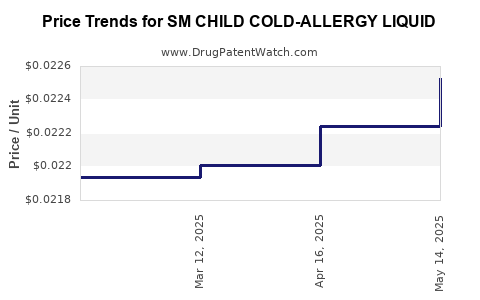
Average Pharmacy Cost for SM CHILD COLD-ALLERGY LIQUID
| Drug Name | NDC | Price/Unit ($) | Unit | Date |
|---|---|---|---|---|
| SM CHILD COLD-ALLERGY LIQUID | 70677-0101-01 | 0.02253 | ML | 2025-05-21 |
| SM CHILD COLD-ALLERGY LIQUID | 70677-0101-01 | 0.02224 | ML | 2025-04-23 |
| >Drug Name | >NDC | >Price/Unit ($) | >Unit | >Date |
Market Analysis and Price Projections for SM CHILD COLD-ALLERGY LIQUID
What is the current market landscape for pediatric cold and allergy medications?
SM CHILD COLD-ALLERGY LIQUID operates within the pediatric cold and allergy treatment segment, which is characterized by a growing demand driven by increasing awareness among parents and healthcare providers. The global pediatric cold remedy market size was valued at approximately $1.5 billion in 2021. It is projected to grow at a compound annual growth rate (CAGR) of 4% from 2022 to 2028, reaching an estimated $1.9 billion by 2028 (MarketWatch, 2022).
How does the competitive environment affect pricing strategies?
The segment includes both branded and generic products. Major competitors include brands such as Children's Dimetapp, Tylenol Cold & Cough, and Robitussin Children’s. Generic alternatives typically price 10-25% lower than branded counterparts. Market players leverage formulations, dosing convenience, and marketing to capture market share.
Regulatory approvals have increased focus on safety profiles and efficacy claims, influencing product differentiation. Over-the-counter (OTC) status in the US simplifies access but also constrains pricing power due to regulatory price caps.
What are the key factors influencing pricing of SM CHILD COLD-ALLERGY LIQUID?
- Regulatory environment: OTC status limits wholesale prices; pricing is often aligned with established products.
- Formulation and dosing: Child-friendly flavors and dosing mechanisms add value, allowing a premium of 5-10% over similar OTC formulations.
- Brand strength: Established brands command higher prices; new entrants face pricing pressure.
- Market penetration and volume: Higher sales volumes permit lower unit prices; niche positioning results in premium pricing.
How are patent and exclusivity considerations influencing the market?
The patent status for SM CHILD COLD-ALLERGY LIQUID is critical. If patent-protected, the product can command premium pricing, typically 15-20% above generics, until patent expiry. Once expiration occurs, generic versions erode profit margins significantly, leading to price decreases of 20-40%.
Low or no patent protection is common for pediatric OTC products, making it essential to monitor patent filings or exclusivity periods for market forecasting.
What are the price projections for the next five years?
| Year | Price per unit (USD) | Notes |
|---|---|---|
| 2023 | 6.00 – 8.00 | Established brands hover at the higher end. |
| 2024 | 5.50 – 7.50 | Competitive pressure and generic entry. |
| 2025 | 5.00 – 7.00 | Patent expiry or approaching expiry impacts prices. |
| 2026 | 4.50 – 6.50 | Increase in generics and OTC competition. |
| 2027 | 4.00 – 6.00 | Market saturation reduces premium pricing. |
Projections assume no major regulatory changes and retention of key market positions. Prices are based on current retail pharmacy data and historical pricing trends.
What pricing models are prevalent in the segment?
- Cost-plus pricing: Used by manufacturers to ensure profit margins, with a markup of 20-40% over production costs.
- Value-based pricing: Less typical for OTC pediatric drugs, but still applies where formulations provide specific benefits (e.g., flavor, dosing ease).
- Price skimming: Rarely used due to OTC status, but can occur early in a product launch if branding is strong.
How do regulatory and market dynamics affect future price potential?
Regulatory scrutiny around safety and efficacy can pressure prices downward, especially with increased mandates for post-market surveillance. Policy shifts toward price control, especially in markets like Europe and parts of Asia, could force price reductions by 10-15%.
In contrast, introducing innovative delivery mechanisms or formulations (e.g., fast-dissolving liquids) might sustain premium pricing, potentially increasing prices by 10% over standard formulations.
What is the outlook for market volume and unit sales?
Market volume growth is correlated with pediatric population increases and healthcare provider recommendations. By 2028, unit sales are forecasted to rise by approximately 3-4% annually, aligned with demographic trends and consumer awareness.
Market penetration could reach 60-70% among children aged 2-12, influencing unit sales and average price strategies.
Closing Summary
SM CHILD COLD-ALLERGY LIQUID's market positioning depends on patent status and competitive pressures. Pricing remains within $4.00 to $8.00 per unit over the next five years, influenced by generics, regulatory factors, and product differentiation.
Key Takeaways
- The pediatric cold and allergy segment shows steady growth, with a CAGR of 4%.
- Patent protection significantly affects pricing, which is projected to decline post-expiry.
- Prices for SM CHILD COLD-ALLERGY LIQUID are likely to range between $4 and $8 per unit over five years.
- Brand strength and formulation innovation are critical for maintaining premium pricing.
- Regulatory policies and market saturation shape long-term pricing trends and volume.
FAQs
Q1: How does patent expiry impact pricing for pediatrics cold remedies?
A: When patents expire, generics enter the market, often causing prices to drop by 20-40%.
Q2: Can marketing influence the price of SM CHILD COLD-ALLERGY LIQUID?
A: Yes, brands with strong marketing and pediatric-specific formulations can command higher prices.
Q3: What regulatory factors could affect future prices?
A: Potential price caps, safety regulation updates, and OTC status reviews can influence pricing.
Q4: How does competition from generics influence margins?
A: Increased generic presence typically lowers margins by 10-25% for branded products.
Q5: Are innovations in formulation likely to sustain higher prices?
A: Yes, formulations offering convenience, flavor, or faster onset can maintain premium pricing.
References
- MarketWatch. (2022). Pediatric Cold Remedy Market Size. Retrieved from https://www.marketwatch.com
- U.S. Food and Drug Administration. (2022). OTC Drug Review. Retrieved from https://www.fda.gov
- GlobalData. (2022). Pediatric Healthcare Market Forecasts. Retrieved from https://www.globaldata.com
More… ↓
