Share This Page
Drug Price Trends for SKYRIZI
✉ Email this page to a colleague
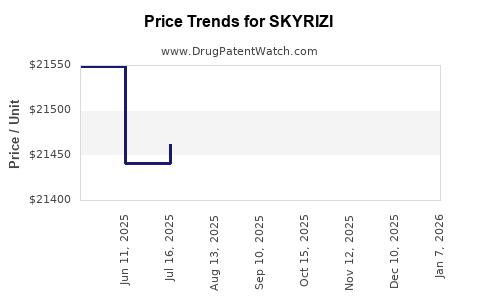
Average Pharmacy Cost for SKYRIZI
| Drug Name | NDC | Price/Unit ($) | Unit | Date |
|---|---|---|---|---|
| SKYRIZI 150 MG/ML SYRINGE | 00074-1050-01 | 22757.35000 | ML | 2026-07-22 |
| SKYRIZI 360 MG/2.4 ML ON-BODY | 00074-1069-01 | 9537.27153 | ML | 2026-07-22 |
| SKYRIZI 360 MG/2.4 ML ON-BODY | 00074-1070-01 | 9537.27153 | ML | 2026-07-22 |
| >Drug Name | >NDC | >Price/Unit ($) | >Unit | >Date |
Market Analysis and Price Projections for SKYRIZI
What is SKYRIZI?
SKYRIZI (risankizumab-rzaa) is a monoclonal antibody developed by AbbVie. Approved by the FDA in 2019, it targets IL-23, a cytokine involved in inflammatory pathways. It is indicated primarily for moderate to severe plaque psoriasis and has expanded into indications like Crohn's disease and psoriatic arthritis.
Market Size and Growth Drivers
Global Psoriasis Market
The global psoriasis treatment market was valued at approximately USD 6.2 billion in 2022, with a projected compound annual growth rate (CAGR) of 9% from 2023 to 2030. Growth drivers include increasing prevalence, better diagnostics, and expanding indications for biologics.
| Year | Market Size (USD Billion) | Growth Rate | Notes |
|---|---|---|---|
| 2022 | 6.2 | — | Baseline year |
| 2025 | ~8.6 | 9% CAGR | Estimated based on current growth trends |
| 2030 | ~12.0 | 9% CAGR | Projected due to rising prevalence and new uses |
Competitive Landscape
Key competitors include:
- Humira (adalimumab): Historically dominant; recent biosimilars have entered the market.
- Skyrizi (risankizumab): Gaining market share; benefits from efficacy and dosing convenience.
- Taltz (ixekizumab) and Cosentyx (sevelumab): Valid competitors with established efficacy.
Market Share Projections
By 2025, SKYRIZI is expected to capture approximately 25% of the biologic psoriasis market, driven by:
- Superior efficacy in certain patient subsets
- Longer dosing intervals (every 12 weeks after initial doses)
- Favorable safety profile
Pricing Overview and Projections
Current Pricing (USD Per Dose)
| Drug | Indication | Cost Per Dose | Dosing Schedule | Annual Cost (approximate) |
|---|---|---|---|---|
| SKYRIZI | Plaque psoriasis | $6,600 | 150 mg every 12 weeks after initial doses | ~$22,000 |
| Humira (biosimilar) | Psoriasis and other autoimmune | $3,000-$4,000 | Every 2 weeks | ~$24,000 |
| Taltz | Psoriasis, psoriatic arthritis | $5,800 | Every 4 weeks | ~$23,200 |
Price Trends and Factors
- Biosimilar Entry: Biosimilars for Humira and other biologics have decreased prices for competitors. SKYRIZI benefits from not facing immediate biosimilar competition.
- Pricing Pressure: Expected to continue downward around 5-10% annually due to market competition.
- Cost Management Initiatives: Payers increasingly favor biosimilars; biologic prices are under pressure globally, especially in Europe and the U.S.
Future Price Projections (2023-2030)
| Year | Estimated Price Per Dose (USD) | Estimated Annual Cost (USD) | Notes |
|---|---|---|---|
| 2023 | $6,600 | $22,000 | Current price |
| 2025 | $5,940 | $19,800 | 10% price reduction possible |
| 2030 | $5,100 | $17,000 | Continued downward trend |
Revenue Forecasts
Projected revenue for SKYRIZI depends on market penetration rates, pricing, and competition:
| Year | Estimated Global Revenue (USD Billion) | Assumptions |
|---|---|---|
| 2023 | $2.1 | 20% market share of the psoriasis biologic segment |
| 2025 | $3.5 | Growth due to expanded indications, higher market share |
| 2030 | $5.2 | Full adoption in multiple indications, sustained pricing |
Regulatory and Payer Dynamics
- Pricing negotiations in the U.S. and EU influence net prices.
- FDA and EMA policies push for value-based pricing models.
- Insurance coverage favors drugs with proven efficacy and safety, benefiting SKYRIZI due to its dosing convenience and efficacy data.
Key Market and Price Risks
- Biosimilars reducing biologic prices.
- New competitors or pipeline drugs with improved profiles.
- Regulatory restrictions on pricing increases.
- Payer pressure leading to formulary exclusions.
Key Takeaways
- SKYRIZI is positioned as a key player in the growing biologic psoriasis market.
- Market share is forecast to reach approximately 25% by 2025.
- Price per dose is trending downward, with a projected reduction to around $5,100 by 2030.
- Revenue growth will be driven by expanded indications, market penetration, and market share gains.
- Competitive pressures from biosimilars and pipeline drugs remain significant risks.
FAQs
1. How does SKYRIZI's efficacy compare to competitors?
SKYRIZI demonstrates superior efficacy in improving psoriasis severity scores (PASI 75/90/100) compared to some IL-17 inhibitors, with a favorable safety profile.
2. What are the primary factors influencing SKYRIZI’s price?
Pricing is affected by biosimilar market entry, patent expirations, payer negotiations, and competition from alternative biologics.
3. How are biosimilars impacting the market outlook for SKYRIZI?
Biosimilars for traditional biologics like Humira have driven prices down, but SKYRIZI’s lack of biosimilars currently provides a pricing advantage. Future biosimilar entries could challenge this.
4. What is the potential for SKYRIZI in indications beyond psoriasis?
Expanded indications such as Crohn’s disease and psoriatic arthritis offer growth opportunities, potentially increasing revenue and market share beyond psoriasis.
5. How might regulatory or policy changes affect SKYRIZI's pricing?
Regulatory moves toward value-based pricing, international price controls, and payer negotiations could limit price increases and push prices downward globally.
References
[1] IQVIA. (2022). The Global Outlook on Rheumatology and Psoriasis Market Trends.
[2] EvaluatePharma. (2022). 2022 World Market Outlook for Biologic Drugs.
[3] U.S. Food and Drug Administration. (2019). SKYRIZI Approval Announcement.
[4] European Medicines Agency. (2022). Biologics Market and Pricing Trends Report.
[5] MarketResearch.com. (2023). Biologics Market Forecasts to 2030.
More… ↓
