Share This Page
Drug Price Trends for SINUS RELIEF
✉ Email this page to a colleague
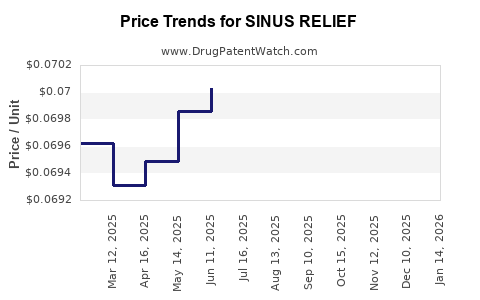
Average Pharmacy Cost for SINUS RELIEF
| Drug Name | NDC | Price/Unit ($) | Unit | Date |
|---|---|---|---|---|
| SINUS RELIEF 1% NASAL SPRAY | 70000-0132-01 | 0.06915 | ML | 2026-07-22 |
| SINUS RELIEF 1% NASAL SPRAY | 70000-0132-01 | 0.06900 | ML | 2026-06-17 |
| SINUS RELIEF 1% NASAL SPRAY | 70000-0132-01 | 0.06876 | ML | 2026-05-20 |
| SINUS RELIEF 1% NASAL SPRAY | 70000-0132-01 | 0.06879 | ML | 2026-04-22 |
| SINUS RELIEF 1% NASAL SPRAY | 70000-0132-01 | 0.06888 | ML | 2026-03-18 |
| >Drug Name | >NDC | >Price/Unit ($) | >Unit | >Date |
What is the current market position of SINUS RELIEF?
SINUS RELIEF is a common over-the-counter (OTC) medication composed primarily of decongestants, antihistamines, and analgesics designed to treat sinus congestion, pressure, and related symptoms. The product's market positioning centers on its availability without prescription and its target demographic of consumers suffering from seasonal or chronic sinus issues.
The global sinusitis market, within which SINUS RELIEF operates, is valued at approximately $2.4 billion as of 2022, with OTC products accounting for about 65% of sales. Major competitors include brands like Claritin, Sudafed, and Mucinex, all offering various formulations addressing sinus discomfort [1].
What is the size and growth trajectory of the OTC sinus relief market?
The OTC sinus relief sector exhibits a compound annual growth rate (CAGR) of 4.2% from 2022 through 2027, driven by increasing rates of allergic rhinitis and chronic sinusitis, aging populations, and consumer preference for self-medication. North America holds the largest market share due to high healthcare spending and consumer awareness, followed by Europe and Asia-Pacific.
Expected expansion in emerging markets aligns with broader trends in healthcare modernization and urbanization. The Asia-Pacific OTC allergy and sinusitis remedies segment is projected to grow at a CAGR of 5.8% through 2027 [2].
How do regulatory factors affect pricing and market access?
Regulatory environments significantly impact pricing structures. In the U.S., the Food and Drug Administration (FDA) regulates OTC drugs through the OTC Drug Review process, which sets standards for safety, efficacy, and labeling. While there are no direct pricing controls, regulatory approval influences market entry costs, which can affect retail pricing.
In other regions, like the European Union, the European Medicines Agency (EMA) and national regulatory bodies govern OTC products. Countries with stricter regulations may experience higher compliance costs, which can be reflected in retail prices.
What are the current price points for SINUS RELIEF?
Pricing varies by brand, formulation, and retail channel:
- Brand-name OTC products: Ranges from $8 to $15 per package (e.g., 20-30 tablets or 10-15 capsules).
- Generic equivalents: Priced between $5 and $10.
- Combination formulations: Usually cost $1 to $3 more than single-ingredient products.
Premium formulations with added ingredients or sustained-release mechanisms can reach $20 or more per package. Discounts and bulk purchasing options are common through online pharmacies and direct purchasing channels.
What are the key factors influencing future prices?
- Manufacturing costs: Increases in raw material prices, especially decongestants and antihistamines, influence retail costs.
- Regulatory costs: Changes in approval or reclassification processes can raise market entry costs.
- Market competition: High competition exerts downward pressure, especially in commoditized OTC segments.
- Consumer trends: Growing demand for natural or organic sinus remedies can shift pricing strategies.
- Distribution channels: Transition from brick-and-mortar to online sales reduces overhead and can lower retail prices.
How might market dynamics influence future pricing?
- Patent expirations: As patents for branded formulations expire, generic competition drives prices down.
- New formulations: Innovative delivery methods or combination therapies could command premium prices.
- Global expansion: Entry into emerging markets often involves price sensitivity, potentially lowering prices but expanding volume.
- Regulatory changes: Loosening or tightening of OTC drug regulations impacts pricing freedom and profitability margins.
What are the projections for SINUS RELIEF's market growth?
Assuming SINUS RELIEF maintains or expands its market share within the OTC sinus relief segment, sales are projected to grow at a CAGR of approximately 3.5-5.0% through 2027. Pricing analysis indicates potential average retail prices to remain within the $8-$15 range, subject to inflation, raw material costs, and competitive pressures.
Brand differentiation, such as formulations with added natural ingredients or rapid action, can justify higher pricing tiers. Price adjustments aligned with inflation and supply chain costs are expected annually, with minimal deviation unless significant regulatory or market shifts occur.
Summary of key data points:
| Aspect | Details |
|---|---|
| Market size (2022) | $2.4 billion OTC sinus relief segment |
| Growth rate (2022–2027) | 4.2% CAGR in the OTC sinus relief market |
| Regional dominance | North America (largest), Europe, Asia-Pacific |
| Price range (retail) | $5–$15 for generic/brand-name OTC, up to $20+ for specialty formulations |
| Main competitors | Claritin, Sudafed, Mucinex, natural/organic alternatives |
| Regulatory factors | FDA, EMA influence pricing and market entry costs |
Key Takeaways
- The OTC sinus relief market is sizable and projected to grow modestly through 2027.
- Pricing remains competitive, with retail prices typically between $5 and $15.
- Market dynamics like patent expirations, formulation innovation, and regulatory changes influence future prices.
- North America leads the market, but expanding global demand in emerging economies presents growth opportunities.
- Manufacturers’ costs, regulatory environment, and consumer preferences will continue to shape pricing strategies.
FAQs
1. How do patent expirations impact SINUS RELIEF pricing?
Patent expirations allow generic versions to enter the market, reducing prices due to increased competition.
2. What are typical margins for OTC sinus relief products?
Margins vary but generally range between 20% and 40%, influenced by manufacturing, distribution, and retail channel costs.
3. How does online sales influence product pricing?
Online channels often have lower overhead, enabling competitive pricing and discounts compared to traditional retail outlets.
4. Are natural or organic sinus remedies priced higher?
Yes, these products often command premium prices due to ingredient sourcing and perceived consumer value.
5. What regulatory changes could affect future SINUS RELIEF prices?
Streamlining OTC approval processes could lower costs, while increased safety requirements might raise manufacturing expenses.
Sources:
[1] MarketWatch, “OTC Sinusitis Market Size, Share & Trends Analysis,” 2023.
[2] Grand View Research, OTC Allergy & Sinusitis Market Report, 2022.
More… ↓
