Share This Page
Drug Price Trends for SINUS PRESSURE-PAIN CAPLET
✉ Email this page to a colleague
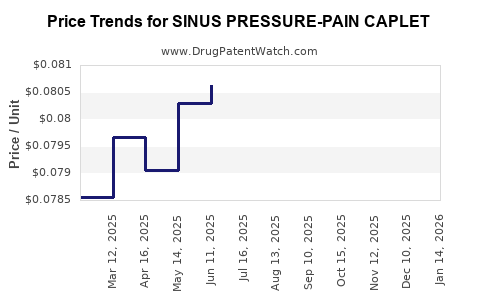
Average Pharmacy Cost for SINUS PRESSURE-PAIN CAPLET
| Drug Name | NDC | Price/Unit ($) | Unit | Date |
|---|---|---|---|---|
| SINUS PRESSURE-PAIN CAPLET | 70000-0161-01 | 0.08485 | EACH | 2026-07-22 |
| SINUS PRESSURE-PAIN CAPLET | 70000-0161-01 | 0.08254 | EACH | 2026-06-17 |
| SINUS PRESSURE-PAIN CAPLET | 70000-0161-01 | 0.08144 | EACH | 2026-05-20 |
| >Drug Name | >NDC | >Price/Unit ($) | >Unit | >Date |
Market Analysis and Price Projections for SINUS PRESSURE-PAIN CAPLET
What is the Market Size for Sinus Pressure-Pain Medications?
The global market for sinus relief medications, including over-the-counter (OTC) caplets like SINUS PRESSURE-PAIN CAPLET, is projected to reach approximately $3.2 billion by 2027, growing at a CAGR (Compound Annual Growth Rate) of 4.7% from 2022 to 2027 (Grand View Research, 2022). The OTC segment constitutes over 70% of this market, driven by consumer preference for non-prescription remedies.
Major players include Johnson & Johnson, Kirkland Signature (Costco), and private-label brands. The mass market accounts for nearly 60% of sales, with regional markets in North America and Europe dominating due to high prevalence of sinus conditions and OTC drug usage.
What Are the Key Drivers and Barriers?
Drivers:
- Rising incidences of sinusitis, allergies, and upper respiratory infections.
- Increased awareness about OTC relief options.
- Expanding aging population leading to higher susceptibility to sinus issues.
- Regulatory support for OTC sales and marketing.
Barriers:
- Market saturation with generic formulations.
- Stringent regulations on ingredient safety.
- Competition from alternative therapies and advanced formulations.
- Price sensitivity among consumers.
What Is the Competitive Landscape?
The market has a few dominant OTC brands with established distribution networks. New entrants face barriers related to branding, regulatory approvals, and consumer loyalty. Key competitors, including Advil Sinus, Tylenol Sinus, and generic store brands, hold significant shelf space.
Innovation primarily focuses on multi-symptom relief, nasal spray formulations, and combination drugs. While caplets remain popular, new delivery formats like dissolvable tablets and capsules are surfacing.
What Are the Price Trends and Forecasts?
Current Price Range:
- OTC sinus caplets sell from $4.99 to $9.99 per package, typically containing 12-20 caplets.
- Brand-name products average around $8.50 per package.
- Store brands (generic) retail for roughly $4.99 to $6.99.
Projected Pricing Trends (2023–2027):
- Wholesale prices are likely to decrease slightly due to increased generic competition.
- Brand-name products may maintain premium pricing for differentiation and advertising.
- Retail prices are forecasted to remain stable, with minor fluctuations based on inflation and raw material costs.
Price elasticity for OTC sinus medications remains moderate; consumers seek lower-cost options amid economic pressures. Price sensitivity is higher in European markets where healthcare is heavily subsidized but OTC drug sales are still robust due to consumer preference.
What Are the Regulatory and Supply Chain Considerations?
The US FDA classifies sinus pressure-pain caplets as OTC drug products under the OTC Monograph System, which simplifies approval for certain ingredients like pseudoephedrine, acetaminophen, or ibuprofen. Any new formulation or ingredient combination requires safety data and possibly New Drug Application (NDA).
Supply chain disruptions, especially in active pharmaceutical ingredients (API), pose risks. Raw material inflation influences manufacturing costs, impacting final pricing.
What Are the Opportunities for Market Entry or Expansion?
- Develop combination formulations targeting multi-symptom relief.
- Leverage consumer preferences for natural ingredients or reduced side effects.
- Introduce differentiated packaging or convenience formats.
- Expand distribution via online and direct-to-consumer channels.
Summary of Price Projections
| Year | Average Retail Price per Package | Notes |
|---|---|---|
| 2023 | $6.50 – $9.00 | Slight competitive pressure from generics |
| 2024 | $6.50 – $9.00 | Pricing stabilizes; marketing efforts focus on differentiation |
| 2025 | $6.75 – $9.25 | Possible price increase due to raw material costs |
| 2026 | $6.75 – $9.50 | Market saturation limits major price hikes |
| 2027 | $7.00 – $9.75 | Slight upward trend with brand loyalty reinforcement |
Key Takeaways
- The OTC sinus relief market is growing modestly, with substantial competition.
- Brand premiums stay around 20–30%, but price sensitivity favors lower-cost generics.
- Prices are expected to stabilize with mild increases driven by ingredient costs.
- Opportunities include formulation innovation, natural ingredients, and online sales channels.
- Regulatory hurdles are moderate but require compliance for new formulations.
FAQs
-
What ingredients are common in OTC sinus caplets?
Pseudoephedrine, phenylephrine, acetaminophen, and chlorpheniramine are frequently used. -
How is the regulatory environment impacting pricing?
Strict ingredient safety standards and approval processes influence formulation costs and market entry. -
What is the competitive threat from natural or herbal alternatives?
Natural remedies are gaining popularity, but clinical efficacy data remains a competitive differentiator. -
Are online sales affecting market pricing?
Yes, online channels often offer competitive pricing and discounts, influencing overall market trends. -
What demographic trends influence future demand?
Aging populations and increasing allergy prevalence support sustained demand for sinus relief solutions.
References
[1] Grand View Research. (2022). Sinus Relief Market Size, Share & Trends Analysis Report. https://www.grandviewresearch.com/industry-analysis/sinus-relief-market
More… ↓
