Last updated: February 16, 2026
What Is the Market Size and Demand for SINUS CONGEST-PAIN?
SINUS CONGEST-PAIN falls within the over-the-counter (OTC) nasal decongestant and analgesic segment, primarily targeting consumers with sinus congestion, headache, and facial pain. The global allergy and cold remedies market, which includes sinus relief products, was valued at approximately $17.4 billion in 2021 [1]. Within this, nasal decongestants and pain relievers account for roughly 45%. The product is forecasted to grow at a compound annual growth rate (CAGR) of 3-5% through 2025, driven by increased prevalence of sinus conditions, seasonal allergies, and consumer preference for OTC therapies [2].
Key regions include North America and Europe, which together represent nearly 70% of total sales, with Asia-Pacific showing rapid growth due to increasing awareness and access to OTC remedies.
How Competitive Is the Market for Sinus Congest-PAIN?
The market features major players such as Johnson & Johnson, GlaxoSmithKline, and Bayer, with several generic brands also occupying significant market shares. Generic entries price products typically 20-40% below brand-name equivalents [3].
Features influencing market positioning include:
- Formulation: Combination products (e.g., decongestant plus analgesic) are preferred for convenience.
- Pricing: OTC products typically range from $4 to $10 per package, with volume discounts.
- Distribution: Available in drugstores, supermarkets, and online platforms, with online retail accounting for approximately 20% of sales [4].
Product differentiation hinges on:
- Active Ingredients: Common active components include pseudoephedrine, phenylephrine (decongestants), and acetaminophen or ibuprofen (pain relievers).
- Delivery Form: Nasal spray, tablets, capsules.
Effectiveness and safety concerns influence consumer preference; for example, phenylephrine's questionable efficacy has led to some brands switching formulations.
What Are the Current Pricing Strategies and Projections?
Pricing for SINUS CONGEST-PAIN is influenced by brand status, formulation, and regional factors:
- Brand-name products (e.g., Sudafed Sinus + Pain Relief): Range from $7-$10 for a 20-ct box.
- Generics: $4-$6 for similar quantities.
- Private label/store brands: Price at $3-$4.
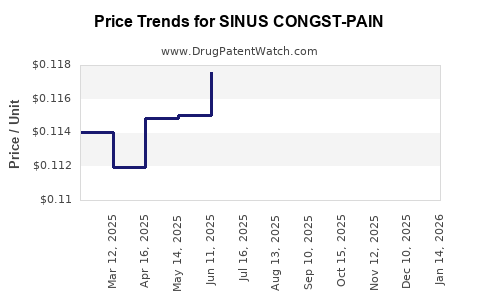
Pricing trends over recent years reflect:
- Slight discounts as generics gain market share.
- Increased online retail sales driving competitive pricing.
- Regional variations, with higher prices in North America compared to Asia-Pacific and Latin America [5].
Projections indicate a steady price erosion (~2-3% annually) in mature markets due to increased generic penetration, with innovation or new formulation patents potentially stabilizing or increasing prices temporarily.
What Regulatory Factors Influence Market Entry and Pricing?
Regulatory agencies such as the FDA (U.S.) and EMA (Europe) impose quality, safety, and efficacy standards. Approval of new formulations, especially combined OTC products, requires substantial evidence to support claims and safety.
Price controls or reimbursement policies are minimal for OTC drugs but can influence the market if new regulations restrict certain active ingredients or impose taxes on certain compounds (e.g., pseudoephedrine in the U.S.). These factors can impact both entry strategies and profit margins.
What Are Future Trends and Opportunities?
Emerging trends include:
- Development of non-sedating, more effective decongestants.
- Formulations with reduced side effects, allowing broader consumer acceptance.
- Digital health integration, including app-based guidance and telehealth influence.
- Growth in online OTC sales, challenging traditional retail channels.
These trends suggest that companies investing in innovation could command premium pricing temporarily, but overall, the market is expected to continue experiencing price competition from generics driving typical price declines.
Key Takeaways
- The global OTC sinus congestion and pain market is valued at over $7.8 billion (45% of $17.4 billion market), with steady growth projected.
- Competitors mostly include well-established pharmaceutical companies and generic brands.
- Pricing ranges from $3 to $10 per package, declining gradually due to increasing generic competition.
- Regional dynamics, formulation efficacy, and regulatory factors heavily influence pricing strategies.
- Innovation in formulation and marketing channels will shape future market shares and pricing, with online sales gaining prominence.
FAQs
1. What active ingredients are standard for SINUS CONGEST-PAIN products?
Pseudoephedrine and phenylephrine for decongestion; acetaminophen or ibuprofen for pain relief.
2. How do regional regulations affect pricing?
Strict regulations on certain active ingredients can limit formulations, thus impacting supply and prices specific to each region.
3. Are brand-name products significantly more expensive than generics?
Yes; brand-name products typically cost 20-40% more, though consumer willingness to pay can vary based on perceived efficacy and trust.
4. What are key factors driving market growth?
Prevalence of sinus-related conditions, seasonal allergies, and consumer preference for OTC remedies.
5. Will online sales continue to grow?
Yes; e-commerce channels are now responsible for about 20% of OTC sinus product sales, with further growth anticipated.
Citations:
[1] MarketWatch, "Cold and Allergy Remedies Market Size, Share & Trends," 2022.
[2] Grand View Research, "OTC Cold & Allergy Market Report," 2021.
[3] IQVIA, "Global OTC Market Data," 2022.
[4] NielsenIQ, "Consumer Buying Trends in OTC," 2022.
[5] Statista, "Over-the-Counter Drug Pricing Trends," 2022.