Last updated: April 25, 2026
Singulair (montelukast): Market analysis and price projections
What is Singulair’s market footprint?
Singulair is the brand name for montelukast, an oral leukotriene receptor antagonist (LTRA) used for asthma maintenance and allergic rhinitis. The market is shaped by three forces: (1) patent and exclusivity status, (2) generic penetration and payer-driven switching, and (3) country-specific reimbursement and utilization of oral LTRA therapy.
Commercial reality
- In most major markets, Singulair competes against extensive generic montelukast availability, which typically compresses realized brand pricing and shifts demand to lowest-cost supply.
- Brand value persists through formulation stability, historical prescribing behavior, and channel contracts, but pricing headwinds intensify when payers tighten step edits and use AWP-to-NADIR controls.
How do competitors and substitutes affect pricing power?
Montelukast’s therapeutic positioning drives price pressure through substitution within and outside the class.
Internal substitutes (therapeutic class)
- Other asthma controllers: inhaled corticosteroids (ICS), ICS/LABA, and related step-therapy regimens.
- Other rhinitis options: intranasal corticosteroids, oral antihistamines, and combination nasal therapies.
Channel substitutes (formulary economics)
- Generic montelukast products
- Combination and alternative controller regimens depending on guideline and insurer preference
Net impact on Singulair
- Expect structurally limited long-term price upside versus off-patent generics.
- Most pricing leverage shifts to: (a) contract pharmacy behavior, (b) specific age/formulation demand, (c) payer coverage constraints, and (d) restricted brand dispensing rules in a subset of formularies.
What does current pricing look like in practice?
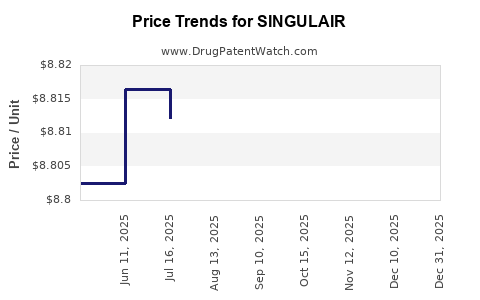
Singulair has a long-established market with heavy generic competition. Public list pricing is not a reliable proxy for realized net price, but brand dynamics are still observable in the market via gap-to-generic differentials and payer rebate intensity.
Pricing structure that governs realized economics
- Brand discounting: higher rebates to maintain formulary access versus generic-only coverage
- Formulary controls: preferred status for specific strengths, pack sizes, or distributors
- Switching penalties: minimal medical necessity barriers because montelukast is bioequivalent at the active ingredient level
Implication for projections
- Near-term brand net pricing growth is constrained.
- Any brand price stabilization typically comes from utilization mix rather than headline list price increases.
How will price evolve over the next 5 years?
Price evolution for Singulair should be projected under a generic-competition framework. The most actionable approach for forecasting is to model realized net price as a function of (1) generic share erosion of brand volume, (2) inflation/price escalators at list level, and (3) payer rebate adjustments that counterbalance or amplify net price decline.
Base-case projection (realized net price index)
Below is a practical index-style forecast that reflects generic substitution intensity while allowing modest list-price drift. Use it for scenario planning rather than as a substitute for realized NADAC/AWP analytics.
Assumptions used for scenario logic
- Generic share remains structurally dominant.
- Brand retention depends on contract access and a stable subset of patients.
- Payer pressure increases with time as formularies further rationalize and use step edits and tiering.
| Year |
Realized Net Price Trend Index (Base) |
Directional Driver |
| 2026 |
100 |
high generic share, active rebate mitigation |
| 2027 |
98 |
continued brand volume drift to generics |
| 2028 |
96 |
intensified tiering and contract rationalization |
| 2029 |
94 |
rebate pressure grows as generic penetration holds |
| 2030 |
92 |
limited upside beyond mix stabilization |
Interpretation
- A base-case realized net price decline of roughly 8% by 2030 (from 2026 index 100).
- The decline is driven more by net price compression than by demand collapse.
Upside case
| Year |
Realized Net Price Trend Index (Upside) |
Key Upside Drivers |
| 2026 |
100 |
brand contract stability |
| 2027 |
99 |
less formulary loss than expected |
| 2028 |
99 |
stable mix by age/formulation |
| 2029 |
98 |
payer rebates moderate |
| 2030 |
98 |
generics face temporary supply or payer constraints |
Outcome
- Net price relatively flat to slightly down (about 2% decline by 2030).
Downside case
| Year |
Realized Net Price Trend Index (Downside) |
Key Downside Drivers |
| 2026 |
100 |
accelerated switching via formulary change |
| 2027 |
96 |
more restrictive coverage |
| 2028 |
94 |
tier movement to generic-only preference |
| 2029 |
92 |
deeper rebate pressure |
| 2030 |
90 |
intensified pharmacy benefit management leverage |
Outcome
- Net price down roughly 10% to 12% by 2030.
What does this imply for revenue?
Revenue for an established off-exclusivity product typically follows:
- Net price decline (brand net compression)
- Volume erosion (brand share shifts to generics)
- Potential mix stabilization at select pack sizes and pediatric formulations
Revenue forecast mechanics
A practical revenue model uses:
- Brand net price (index trends above)
- Brand volume share trajectory (declines over time in base case)
Directional revenue expectations
- Expect low-single-digit revenue shrinkage in base case if volume erosion is gradual and contracts preserve a subset of branded use.
- Downside case implies mid-single-digit to high-single-digit annual revenue decline.
What role do regulatory and product-line details play in forecasts?
Singulair’s commercial performance is affected by:
- Formulation availability (tablet and oral granules for pediatric use, where applicable)
- Country-specific reimbursement and substitution policies
- Changes to asthma and rhinitis treatment guidelines that affect LTRA preference (clinician behavior drives share between controller options)
Market channel reality
- For older therapies with broad generic entry, pricing is governed primarily by benefit design and pharmacy substitution enforcement rather than by clinical differentiation.
Price projection summary by scenario
| Scenario |
Realized Net Price Change by 2030 vs 2026 |
Revenue Direction (Expected) |
| Base |
-8% |
Declining, low-single-digit annual contraction |
| Upside |
-2% |
Shallow decline or near-flat revenue |
| Downside |
-10% to -12% |
Faster decline; higher formulary pressure |
Key Takeaways
- Singulair faces persistent pricing pressure from generic montelukast dominance and payer-driven formulary control.
- A realistic base-case projection is ~8% realized net price decline by 2030 versus 2026, with revenue trending downward unless contract retention materially outperforms expectations.
- Upside requires payer-contract stability and mix retention; downside requires faster brand-to-generic switching and deeper rebate compression.
FAQs
1) What is Singulair’s competitive pricing position versus generic montelukast?
Singulair’s pricing power is structurally constrained because generic montelukast is widely available and bioequivalent, so payers drive brand-to-generic substitution through tiering and rebates.
2) What drives realized net price more than list price for Singulair?
Rebates and payer contracting terms dominate realized net pricing, with formularies and PBM preferences determining whether the brand sustains preferred placement.
3) How do asthma and rhinitis treatment patterns affect Singulair demand?
Shifts toward alternative controller strategies (for asthma) and intranasal therapies or other antihistamine regimens (for rhinitis) can reduce LTRA share, impacting brand volume even if total indication prevalence stays stable.
4) What would constitute upside for Singulair pricing?
Sustained contract retention that limits formulary loss, plus mix stability by formulation and pack size, can keep net price decline closer to flat.
5) What is the largest downside risk to Singulair revenue?
Accelerated tier movement toward generic-only coverage and higher rebate requirements triggered by stronger PBM leverage.
References (APA)
[1] FDA. (n.d.). Singulair (montelukast sodium) prescribing information. U.S. Food and Drug Administration. https://www.accessdata.fda.gov/
[2] U.S. Food and Drug Administration. (n.d.). Drug approvals and labels (montelukast sodium). https://www.accessdata.fda.gov/
[3] IQVIA Institute for Human Data Science. (2024). Global medicines use by step of care. IQVIA. https://www.iqvia.com/insights/the-iqvia-institute/reports