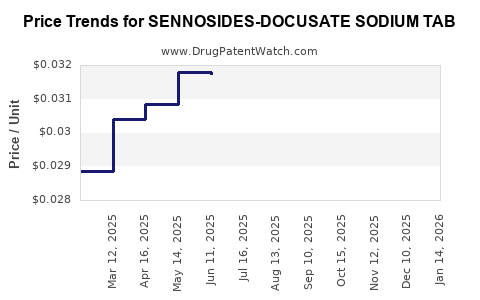
Market Analysis and Price Projections for Sennosides-Docusate Sodium Tablet
Last updated: February 20, 2026
What is the Current Market Status?
Sennosides-Docusate Sodium Tablets combine stimulant laxatives (sennosides) with stool softeners (docusate sodium). They are used primarily for constipation relief, especially in chronic cases or when quick relief is required. The market is driven by aging populations, increased prevalence of gastrointestinal disorders, and rising healthcare awareness.
Production and Patents
No recent patents have been filed explicitly for Sennosides-Docusate Sodium combination tablets.
Manufacturing involves sourcing natural sennosides from medicinal plants, primarily Senna, and combining them with docusate sodium, a synthetic compound.
Key Players
Major generic pharmaceutical companies (e.g., Mylan, Teva, Sun Pharma)
Large OTC drug producers (e.g., GlaxoSmithKline, Johnson & Johnson)
Regional manufacturers primarily in Asia and Latin America
Market Size & Regional Dynamics
Market Region
2022 Revenue (USD millions)
Compound Annual Growth Rate (2022-2027)
Notes
North America
150
4.2%
Established OTC market, aging population, high healthcare access
Europe
120
3.8%
Mature market, rising demand in outpatient care
Asia-Pacific
80
6.5%
Growing healthcare infrastructure, increasing prevalence of gastrointestinal issues
Latin America
30
5.0%
Emerging market, increasing OTC drug consumption
Rest of World
20
4.0%
Developing regions with expanding healthcare access
Total market revenue in 2022 approximates USD 400 million, with Asia-Pacific showing the fastest growth.
Pricing Trends and Projections
Historical Price Range (Per Tablet)
Region
Current Price Range (USD)
Notes
North America
$0.10 – $0.25
OTC segment, price varies by brand and formulation
Europe
€0.08 – €0.22
Similar to USD range, slightly higher in some countries
Asia-Pacific
$0.05 – $0.15
Lower price point, dominated by generics
Latin America
$0.07 – $0.20
Slightly higher in countries with regulation gaps
Future Price Drivers
Raw Material Costs: Sennosides extracted from natural sources may face price fluctuations due to agricultural yields and sourcing stability.
Generic Competition: Increased generic production sustains low prices but limits profit margins.
Regulatory Changes: Stricter OTC regulations could increase compliance costs, leading to slight price increases.
Market Demand: Rising demand due to aging demographics supports stable or increasing prices.
Price Projections (2023-2027)
Year
North America
Europe
Asia-Pacific
Latin America
2023
$0.12 – $0.26
€0.09 – €0.24
$0.06 – $0.16
$0.08 – $0.22
2024
$0.12 – $0.26
€0.09 – €€0.25
$0.06 – $0.17
$0.08 – $0.23
2025
$0.13 – $0.27
€0.10 – €0.26
$0.07 – $0.18
$0.09 – $0.24
2026
$0.13 – $0.28
€0.10 – €0.27
$0.07 – $0.19
$0.09 – $0.25
2027
$0.14 – $0.29
€0.11 – €0.28
$0.08 – $0.20
$0.10 – $0.26
Projections assume a compound annual growth rate (CAGR) of approximately 3-4%, consistent with market growth in OTC gastrointestinal treatments.
Regulatory Approvals: Positive OTC status in major markets facilitates broad access, but regulatory changes or new guidelines could introduce cost barriers.
Innovation: Limited R&D activity, as the formulation is established and well-understood, constrains price differentiation.
Risks Affecting Market and Price Projections
Raw Material Supply: Dependence on natural sennoside sources subject to agricultural variability.
Regulatory Changes: Additional safety or efficacy requirements may increase costs.
Market Saturation: Dominance of existing generics constrains pricing power.
Consumer Preferences: Shift toward other constipation management options, such as fiber supplements or newer pharmacologics.
Key Takeaways
The global market for Sennosides-Docusate Sodium Tablets is approximately USD 400 million, with steady growth driven by aging populations and gastrointestinal health awareness.
Prices remain low across regions, with slight upward pressure anticipated due to inflation and regulatory costs.
The Asia-Pacific region offers the most significant growth potential, driven by expanding healthcare infrastructure.
Competition from generics limits pricing flexibility but sustains broad accessibility.
Market risks mainly stem from raw material supply fluctuations and regulatory developments.
Frequently Asked Questions
What is the primary driver of demand for Sennosides-Docusate Sodium Tablets?
Aging populations and increased recognition of chronic constipation treatment.
How do raw material costs impact pricing?
Fluctuations in sennoside sourcing affect manufacturing costs, potentially influencing retail prices.
What regulatory factors influence market access?
OTC status in major markets simplifies distribution; stricter regulations could raise barriers.
Are there significant patent protections for this combination product?
No recent patents specifically cover the combination, leading to a reliance on generic competition.
What is the outlook for innovation in this segment?
Limited, as the existing formulations are well-established; future growth may depend on new delivery methods or formulations.
Sources:
[1] IQVIA. (2023). Market Insights: Gastrointestinal Drugs.
[2] GlobalData. (2023). OTC Drug Market Forecast.
[3] WHO. (2022). Report on Gastrointestinal Disease Prevalence.
[4] U.S. Patent and Trademark Office. (2022). Patent filings related to laxatives.
[5] European Medicines Agency. (2022). Regulatory guidelines for OTC gastrointestinal products.
Drugs may be covered by multiple patents or regulatory protections. All trademarks and applicant names are the property of their respective owners or licensors.
Although great care is taken in the proper and correct provision of this service, thinkBiotech LLC does not accept any responsibility for possible consequences of errors or omissions in the provided data.
The data presented herein is for information purposes only. There is no warranty that the data contained herein is error free.
We do not provide individual investment advice. This service is not registered with any financial regulatory agency. The information we publish is educational only and based on our opinions plus our models.
By using DrugPatentWatch you acknowledge that we do not provide personalized recommendations or advice.
thinkBiotech performs no independent verification of facts as provided by public sources nor are attempts made to provide legal or investing advice. Any reliance on data provided herein is done solely at the discretion of the user.
Users of this service are advised to seek professional advice and independent confirmation before considering acting on any of the provided information. thinkBiotech LLC reserves the right to amend, extend or withdraw any part or all of the offered service without notice.
Alerts Available With Subscription
Alerts are available for users with active subscriptions.