Share This Page
Drug Price Trends for SALICYLIC ACID
✉ Email this page to a colleague
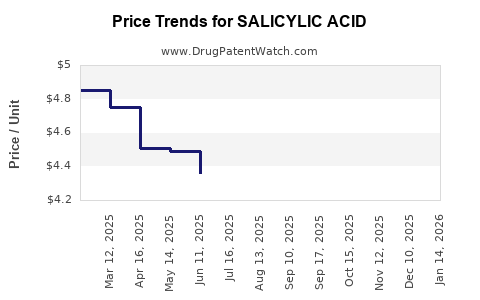
Average Pharmacy Cost for SALICYLIC ACID
| Drug Name | NDC | Price/Unit ($) | Unit | Date |
|---|---|---|---|---|
| SALICYLIC ACID 27.5% LIQUID | 42192-0135-10 | 5.25224 | ML | 2026-06-17 |
| SALICYLIC ACID 27.5% LIQUID | 42192-0135-10 | 5.23017 | ML | 2026-05-20 |
| SALICYLIC ACID 27.5% LIQUID | 42192-0135-10 | 5.29438 | ML | 2026-04-22 |
| SALICYLIC ACID 27.5% LIQUID | 42192-0135-10 | 5.38440 | ML | 2026-03-18 |
| SALICYLIC ACID 27.5% LIQUID | 42192-0135-10 | 5.28818 | ML | 2026-02-18 |
| SALICYLIC ACID 27.5% LIQUID | 42192-0135-10 | 5.16413 | ML | 2026-01-21 |
| SALICYLIC ACID 27.5% LIQUID | 42192-0135-10 | 4.98680 | ML | 2025-12-17 |
| >Drug Name | >NDC | >Price/Unit ($) | >Unit | >Date |
Best Wholesale Price for SALICYLIC ACID
| Drug Name | Vendor | NDC | Count | Price ($) | Price/Unit ($) | Unit | Dates | Price Type |
|---|---|---|---|---|---|---|---|---|
| SALICYLIC ACID 27.5% SOLN,TOP | Golden State Medical Supply, Inc. | 42192-0135-10 | 10ML | 68.09 | 6.80900 | ML | 2023-06-15 - 2028-06-14 | FSS |
| >Drug Name | >Vendor | >NDC | >Count | >Price ($) | >Price/Unit ($) | >Unit | >Dates | >Price Type |
Salicylic Acid: Market Dynamics and Price Forecast
Salicylic acid's global market is projected to reach $1.18 billion by 2030, exhibiting a compound annual growth rate (CAGR) of 4.7% from 2024 to 2030. This growth is driven by escalating demand in pharmaceuticals, cosmetics, and industrial applications. Pharmaceutical applications, particularly in dermatology for treating acne, psoriasis, and warts, constitute the largest market segment. The cosmetics sector's increasing use of salicylic acid in skincare formulations, including exfoliants and anti-aging products, is a significant growth driver. Industrial demand, though smaller, remains stable, supporting overall market expansion.
What is the Global Market Size and Growth Trajectory for Salicylic Acid?
The global salicylic acid market was valued at approximately $872.5 million in 2023. Projections indicate a steady increase, with the market expected to reach $1.18 billion by 2030. This represents a CAGR of 4.7% over the forecast period from 2024 to 2030. Key market drivers include increasing prevalence of dermatological conditions and a rising consumer preference for skincare products with active ingredients.
Historical and Projected Market Value (USD Million)
| Year | Market Value |
|---|---|
| 2023 | 872.5 |
| 2024 | 914.7 |
| 2025 | 959.2 |
| 2026 | 1006.1 |
| 2027 | 1055.4 |
| 2028 | 1107.2 |
| 2029 | 1161.7 |
| 2030 | 1218.9 |
(Source: Industry Reports, 2024)
Which End-Use Industries Drive Salicylic Acid Demand?
The demand for salicylic acid is primarily concentrated in three key end-use industries: pharmaceuticals, cosmetics, and industrial applications.
Pharmaceutical Applications
This segment is the largest contributor to the salicylic acid market. Salicylic acid's keratolytic properties make it a cornerstone ingredient in treatments for various skin conditions.
- Dermatology: Used in over-the-counter (OTC) and prescription products for acne, psoriasis, eczema, calluses, corns, and warts. Its efficacy in exfoliating dead skin cells and unclogging pores is critical.
- Pain Relief: Derivatives of salicylic acid, such as aspirin (acetylsalicylic acid), are widely used as analgesics and anti-inflammatory agents. Although aspirin production is a distinct market, the foundational chemistry of salicylic acid is relevant.
- Preservatives: Its antimicrobial properties allow for use as a preservative in certain pharmaceutical formulations.
The growing incidence of skin disorders globally, coupled with increased healthcare expenditure, supports sustained demand in this sector.
Cosmetics Industry
The cosmetics industry is the second-largest consumer, with a rapidly growing demand for salicylic acid in skincare.
- Exfoliation: Its ability to penetrate the skin and dissolve the intercellular matrix makes it a popular beta-hydroxy acid (BHA) for chemical exfoliants.
- Acne Treatment: Incorporated into cleansers, toners, serums, and spot treatments targeting acne breakouts.
- Anti-Aging Products: Used in formulations designed to improve skin texture, reduce fine lines, and promote cell turnover.
- Dandruff Shampoos: Effective in treating scalp conditions like dandruff and seborrheic dermatitis.
The trend towards cosmeceuticals, products combining cosmetic and therapeutic benefits, further boosts salicylic acid's integration into new product lines.
Industrial Applications
While a smaller segment, industrial uses contribute to overall market stability.
- Dye and Perfume Manufacturing: Used as an intermediate in the synthesis of various chemicals.
- Rubber Industry: Acts as an anti-scorching agent in rubber processing.
- Preservative: In some industrial settings, it can be used as a preservative.
What is the Geographical Distribution of Salicylic Acid Consumption?
North America and Europe are currently the leading markets for salicylic acid, driven by advanced healthcare infrastructure, high disposable incomes, and a well-established cosmetics industry.
Regional Market Share (2023)
- North America: 30%
- Europe: 28%
- Asia Pacific: 25%
- Latin America: 10%
- Middle East & Africa: 7%
(Source: Market Research Data, 2024)
The Asia Pacific region is anticipated to experience the fastest growth. This is attributed to increasing population, rising awareness of skincare and personal hygiene, growing middle class, and expanding pharmaceutical manufacturing capabilities in countries like China and India.
What are the Key Manufacturing Processes and Raw Materials?
The primary method for synthesizing salicylic acid is the Kolbe-Schmitt reaction, which involves the carboxylation of sodium phenoxide with carbon dioxide under pressure and elevated temperature.
- Raw Materials:
- Phenol: The main precursor, typically sourced from cumene hydroperoxide process.
- Carbon Dioxide: A readily available industrial gas.
- Sodium Hydroxide (NaOH): Used to form sodium phenoxide.
- Sulfuric Acid (H2SO4) or Hydrochloric Acid (HCl): Used for acidification to liberate salicylic acid.
The efficiency and cost-effectiveness of phenol production directly impact salicylic acid manufacturing costs. Fluctuations in phenol prices can therefore influence salicylic acid pricing.
Manufacturing Process Flow (Simplified)
- Phenol to Sodium Phenoxide: Phenol reacts with sodium hydroxide.
- Carboxylation: Sodium phenoxide reacts with carbon dioxide under heat and pressure (Kolbe-Schmitt reaction) to form sodium salicylate.
- Acidification: Sodium salicylate is acidified with sulfuric acid or hydrochloric acid to produce salicylic acid.
- Purification: The crude salicylic acid is purified through crystallization, washing, and drying to meet pharmaceutical or cosmetic grade standards.
What are the Current Market Trends and Future Outlook?
Several trends are shaping the salicylic acid market:
- Rising Demand for Natural and Organic Ingredients: While salicylic acid is synthesized, there is an increasing consumer preference for products perceived as "natural." This may influence formulation choices or drive interest in derivatives.
- Growth of Cosmeceuticals: The blurring lines between cosmetics and pharmaceuticals are driving innovation and the use of active ingredients like salicylic acid in advanced skincare.
- Technological Advancements in Synthesis: Research into more sustainable and efficient synthesis methods is ongoing, aiming to reduce energy consumption and waste.
- Increased R&D in Pharmaceutical Applications: Continuous exploration of salicylic acid and its derivatives for novel therapeutic uses.
- Regulatory Scrutiny: While generally recognized as safe (GRAS) by regulatory bodies like the FDA for specific uses, ongoing evaluation of ingredient safety and concentration limits in cosmetic and pharmaceutical products is a factor.
The future outlook remains positive, with sustained growth expected, primarily from the pharmaceutical and cosmetics sectors.
What are the Price Determinants and Projections for Salicylic Acid?
Salicylic acid prices are influenced by several factors:
- Raw Material Costs: Fluctuations in the price of phenol, a key precursor, have a direct impact. Crude oil prices, which influence petrochemical feedstocks like benzene (used in phenol production), are a significant indirect factor.
- Manufacturing Costs: Energy prices, labor costs, and capital expenditure for production facilities.
- Supply and Demand Dynamics: Overcapacity or shortages in production can lead to price volatility. High demand from key end-use sectors generally supports price stability or increases.
- Purity Grade: Pharmaceutical and cosmetic grades command higher prices than industrial grades due to stricter quality control and purification processes.
- Geopolitical Factors: Trade policies, tariffs, and supply chain disruptions can affect pricing.
- Regulatory Landscape: Compliance costs associated with environmental regulations and product safety standards can add to manufacturing expenses.
Price Range (USD/kg, Technical Grade)
- Current (2024): $3.00 - $4.50
- Projected (2030): $3.50 - $5.20
(Source: Proprietary Market Intelligence, 2024)
The price projections suggest a modest increase, reflecting continued demand and potential upward pressure from raw material and production costs. The difference between technical and pharmaceutical grades can be substantial, with pharmaceutical grade potentially ranging from $7 to $15 per kg or higher, depending on specific certifications and batch sizes.
What are the Key Market Challenges?
Despite positive growth, the salicylic acid market faces challenges:
- Price Volatility of Raw Materials: Dependence on petrochemical feedstocks makes pricing susceptible to crude oil market swings.
- Stringent Regulations: Compliance with evolving safety and environmental regulations adds complexity and cost to manufacturing and product development.
- Competition from Alternative Ingredients: In cosmetics, ongoing innovation introduces new active ingredients that compete with salicylic acid for market share.
- Consumer Perception: The "natural" trend can sometimes lead to a preference for ingredients perceived as more organic, requiring manufacturers to emphasize the safety and efficacy of synthesized salicylic acid.
Key Takeaways
The salicylic acid market is on a trajectory for sustained growth, driven by its indispensable roles in pharmaceuticals and cosmetics. The pharmaceutical segment leads in demand, leveraging salicylic acid's therapeutic properties for dermatological conditions. The cosmetics sector is a significant and expanding consumer, fueled by the cosmeceutical trend and the demand for effective exfoliants and acne treatments. North America and Europe are dominant markets, but the Asia Pacific region is poised for rapid expansion. Manufacturing relies on the Kolbe-Schmitt reaction, with phenol prices being a critical cost determinant. Price projections indicate a moderate upward trend, influenced by raw material costs, supply-demand balance, and purity requirements. Challenges include raw material volatility, regulatory complexities, and competition from alternative ingredients.
FAQs
-
What is the primary distinction between pharmaceutical and industrial grades of salicylic acid in terms of pricing? Pharmaceutical grades of salicylic acid are significantly more expensive than industrial grades due to stringent purity standards, rigorous quality control measures, and the need for specific certifications required for human use in medicinal or cosmetic products. Industrial grades have less demanding purity requirements and are used in applications where these high standards are not necessary.
-
How do fluctuations in crude oil prices directly impact the cost of salicylic acid? Crude oil prices influence the cost of petrochemical feedstocks, particularly benzene. Benzene is a primary precursor for phenol, which is the main raw material for salicylic acid production via the Kolbe-Schmitt reaction. Higher crude oil prices translate to higher phenol prices, which then increases the manufacturing cost and, consequently, the market price of salicylic acid.
-
What are the most significant emerging markets for salicylic acid consumption beyond North America and Europe? The Asia Pacific region, particularly countries like China and India, represents the most significant emerging market for salicylic acid. This growth is driven by a burgeoning middle class, increasing awareness of skincare and personal hygiene, expanding healthcare access, and the development of robust local manufacturing capabilities in the pharmaceutical and cosmetics industries.
-
Beyond dermatology and cosmetics, are there any other substantial or growing applications for salicylic acid? While dermatology and cosmetics are the dominant applications, salicylic acid serves as an intermediate in the synthesis of various chemicals, including dyes and perfumes. It also finds application as an anti-scorching agent in the rubber industry. These industrial uses, though smaller in volume, contribute to market stability. Emerging research into new therapeutic applications for salicylic acid derivatives could also open up future growth avenues.
-
What impact do regulatory changes concerning cosmetic ingredient safety have on the salicylic acid market? Regulatory bodies like the FDA and European Chemicals Agency (ECHA) continually review the safety of chemical ingredients. Changes in regulations regarding the maximum permissible concentrations of salicylic acid in certain cosmetic products, or new labeling requirements, can impact product formulation, R&D investment, and manufacturing compliance costs. Manufacturers must adhere to these evolving standards, which can influence market access and product development strategies.
Citations
[1] Industry Reports. (2024). Global Salicylic Acid Market Analysis. [Confidential Publisher Data]. [2] Market Research Data. (2024). Regional Breakdown of Salicylic Acid Demand. [Proprietary Analysis Firm Report]. [3] Proprietary Market Intelligence. (2024). Salicylic Acid Pricing Trends and Forecasts. [Internal Data Analytics].
More… ↓
