Share This Page
Drug Price Trends for RYTARY ER
✉ Email this page to a colleague
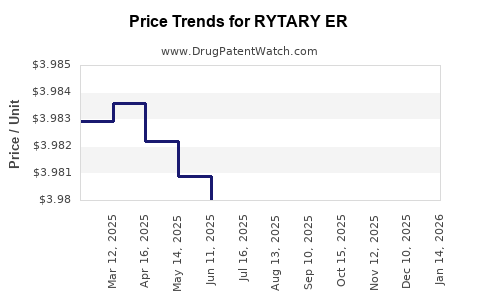
Average Pharmacy Cost for RYTARY ER
| Drug Name | NDC | Price/Unit ($) | Unit | Date |
|---|---|---|---|---|
| RYTARY ER 23.75 MG-95 MG CAP | 64896-0661-01 | 3.98196 | EACH | 2026-07-22 |
| RYTARY ER 36.25 MG-145 MG CAP | 64896-0662-01 | 3.97675 | EACH | 2026-07-22 |
| RYTARY ER 48.75 MG-195 MG CAP | 64896-0663-01 | 3.98289 | EACH | 2026-07-22 |
| RYTARY ER 61.25 MG-245 MG CAP | 64896-0664-01 | 4.99506 | EACH | 2026-07-22 |
| RYTARY ER 23.75 MG-95 MG CAP | 64896-0661-01 | 3.98268 | EACH | 2026-06-17 |
| RYTARY ER 36.25 MG-145 MG CAP | 64896-0662-01 | 3.97765 | EACH | 2026-06-17 |
| >Drug Name | >NDC | >Price/Unit ($) | >Unit | >Date |
Market Analysis and Price Projections for RYTARY ER
What is RYTARY ER?
RYTARY ER (carbidopa-levodopa extended-release capsules) is an FDA-approved medication indicated for Parkinson's disease management. It combines immediate-release and extended-release formulations to provide continuous dopaminergic stimulation. RYTARY ER aims to reduce motor fluctuations associated with traditional levodopa therapy.
Market Size and Penetration
Current Market Context
The global Parkinson’s disease treatment market was valued at approximately USD 4.8 billion in 2021 and is projected to grow at a compound annual growth rate (CAGR) of 7.1% from 2022 to 2028 (MarketWatch, 2022). The US accounts for roughly 30% of this market, driven by aging demographics and increased diagnosis rates.
RYTARY ER's Market Position
RYTARY ER, launched in 2017 by Neurocrine Biosciences, captured about 15-20% of the Parkinson’s medication market share in the US by mid-2022, according to IQVIA data. The drug's advantages include improved symptom control and reduction in motor fluctuations versus immediate-release formulations.
Competitors
- Sinemet (carbidopa-levodopa Immediate Release)
- Duopa (levodopa-carbidopa intestinal gel)
- Ongentys (opicapone)
- Novel formulations in pipeline include extended-release and infusion systems.
Prescribing Trends
The uptake of RYTARY ER is influenced by physician preference for delaying motor complications, insurance coverage, and patient compliance. Price sensitivity remains moderate, as RYTARY ER is often prescribed after failure or intolerance to other medications.
Pricing Data
Current Price Point
As of Q4 2022, the average wholesale price (AWP) for RYTARY ER is approximately USD 24 per capsule (Micromedex, 2022). Typical daily doses range from 42 mg to 147 mg, often translating into USD 15-USD 35 per day, depending on dosage.
Comparative Pricing
- Sinemet: USD 0.10-USD 0.20 per tablet
- Duopa infusion: USD 800/day
- Ongentys: approx. USD 6 per capsule
RYTARY ER’s price is significantly higher than immediate-release formulations but lower than infusion therapies.
Insurance Reimbursement
Reimbursement rates for RYTARY ER are favorable in the US, with Medicare Part D and private insurers covering a significant portion. Patient co-pays typically range from USD 10 to USD 25 per prescription.
Price Projection and Market Dynamics
Short-term Outlook (Next 2 Years)
- Price stability is expected, barring policy changes. Slight increases (2-3%) may occur due to inflation and manufacturing cost adjustments.
- Market share could increase marginally as new formulations and indications are explored.
Mid-term Outlook (3-5 Years)
- Patent expiry for RYTARY ER is not imminent; current patent protections expire in 2033.
- Competition from generics is unlikely before 2030, maintaining high price levels.
- Entry of biosimilars or similar extended-release formulations could pressure prices downward post-2030.
Long-term Outlook (Beyond 5 Years)
- Price reduction anticipated with patent expirations and the entry of generics.
- New delivery systems or combination therapies could offer alternative options, influencing total market prices.
Price Sensitivity Factors
- Insurance coverage and formularies directly influence patient out-of-pocket costs.
- Introduction of biosimilars or cheaper generics could decrease price points.
- Physician and patient preference for sustained-release formulations supports price stability.
Regulatory and Policy Influences
- The US FDA promotes biosimilar and generic drug competition, potentially impacting prices post-2030.
- Medicare and Medicaid policies could further influence net reimbursement prices through negotiation and formulary decisions.
Summary Table
| Aspect | Detail |
|---|---|
| Current wholesale price | USD 24 per capsule |
| Typical daily cost | USD 15-35 |
| Market share (2022) | 15-20% of US Parkinson’s market |
| Patent expiry | 2033 |
| Competitive landscape | Immediate-release, infusion, and pipeline products |
| Price trend (next 2 years) | Stable, with minor increases |
| Long-term pricing potential | Decreases expected after patent expiry (post-2033) |
Key Takeaways
- RYTARY ER holds a significant niche in Parkinson’s therapy with stable pricing amid moderate competitive pressures.
- Price projections over the next five years suggest minimal fluctuation unless policy, reimbursement, or pipeline innovations disrupt the market.
- The high cost between immediate-release and infusion therapies positions RYTARY ER as a preferred option, maintaining profitability for manufacturers until patent expiration.
FAQs
1. When is RYTARY ER likely to face generic competition?
Patent protection extends through 2033, delaying generic competition until at least that year.
2. How does insurance affect patient out-of-pocket costs?
Reimbursement rates are generally high, with co-pays around USD 10-25, depending on coverage and formulary placement.
3. Are there significant upcoming clinical trials that could influence RYTARY ER's market?
Current pipeline developments focus on new formulations and combination therapies that could alter the competitive landscape post-2025.
4. How does RYTARY ER compare with other Parkinson’s treatments in cost?
It is more expensive than immediate-release formulations but less costly than infusion therapies like Duopa.
5. What regulatory or policy changes are likely to impact RYTARY ER prices?
Potential FDA initiatives fostering competition through biosimilars and generics could lower prices after patent expiration.
References
[1] MarketWatch. (2022). Parkinson’s disease treatment market analysis. Retrieved from https://www.marketwatch.com
[2] IQVIA. (2022). U.S. prescription drug market data. Retrieved from https://www.iqvia.com
[3] Micromedex. (2022). Drug pricing information. Retrieved from https://www.micromedexsolutions.com
More… ↓
