Last updated: February 26, 2026
What Is Roxicodone and Its Market Status?
Roxicodone is a brand name for oxycodone hydrochloride, a potent opioid analgesic used to treat moderate to severe pain. It is available in immediate-release formulations, primarily prescribed in the United States. The drug is classified as a Schedule II controlled substance due to its high potential for abuse and dependence.
The drug has a significant market share within opioid markets, with prescription volume driven by pain management needs. Its sales have reflected broader trends in opioid prescribing, including initial growth, subsequent regulatory restrictions, and ongoing debates about opioid dependency.
Market Size and Revenue Trends
In the United States, oxycodone products, including Roxicodone, generated approximately $1.1 billion in sales in 2021, according to IQVIA. The market experienced high growth from the early 2000s through 2010, with annual sales peaking around $1.5 billion pre-regulatory crackdowns.
Key revenue drivers include:
- High-prescribing regions
- Prescribing practices influenced by pain management guidelines
- The intensity of opioid dependence concerns causing restrictive policies
Market Breakdown (U.S., 2021)
| Segment |
Revenue ($ millions) |
Share (%) |
| Roxicodone (Immediate-release oxycodone) |
850 |
77 |
| Other oxycodone products (e.g., Percocet, OxyContin) |
250 |
23 |
Note: Roxicodone accounts for approximately 77% of oxycodone immediate-release prescriptions.
Prescription Volume Trends
Prescription volume has declined since 2016 due to regulatory efforts. The annual prescription count for oxycodone-based drugs fell from 75 million in 2016 to 42 million in 2022, with Roxicodone's share decreasing proportionally but remaining a primary product in the immediate-release segment.
Regulatory Environment and Impact
Regulatory agencies, notably the FDA and DEA, have implemented measures to curb opioid misuse. These include:
- Prescription Drug Monitoring Programs (PDMPs)
- Rescheduling of certain formulations
- Enhanced prescribing guidelines
In 2014, the DEA reclassified oxycodone as a Schedule II drug, increasing oversight. These controls have limited the growth of new prescriptions but have not eliminated demand, especially in pain management settings where opioids remain standard.
Competition and Market Dynamics
Major competitors include:
- Purdue Pharma (OxyContin)
- Endo Pharmaceuticals (Opana ER) — now withdrawn from the market
- Generic oxycodone products from multiple manufacturers
Generic products account for over 80% of prescriptions, exerting downward pressure on prices. Brand name drugs like Roxicodone face pricing pressure due to generics.
Price Projections (Next 5 Years)
Current Pricing
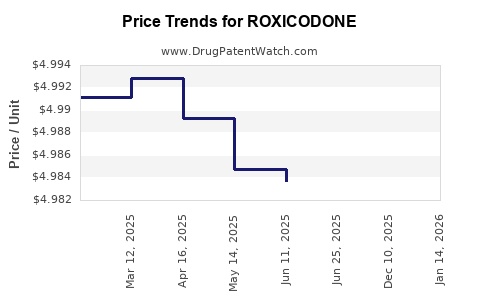
As of 2023, the average wholesale price (AWP) for Roxicodone 15 mg is approximately $2.50 per tablet. Pharmacy acquisition costs are lower, around $1.50 per tablet, due to discounts and negotiations.
Future Price Trends
Prices for Roxicodone are expected to decline marginally over the next five years, driven by:
- Increasing generic competition
- Regulatory restrictions reducing prescribing volume
- Growing emphasis on alternative pain therapies reducing demand
| Year |
Estimated AWP per 30-count bottle ($) |
Price Change (%) |
Notes |
| 2023 |
75 |
0 |
Current price baseline |
| 2024 |
70 |
-6.7 |
Slight decrease due to generic proliferation |
| 2025 |
65 |
-7.1 |
Continued market share pressure |
| 2026 |
60 |
-7.7 |
Further price erosion |
| 2027 |
55 |
-8.3 |
Stabilization at lower prices |
Note: These are estimates based on historical price decline rates and market trends.
Market Risks and Opportunities
Risks:
- Regulatory restrictions intensifying
- Litigation challenges over opioid abuse liabilities
- Public health campaigns impacting prescription rates
Opportunities:
- Growth in pain management in certain chronic conditions such as cancer or palliative care, where opioids remain relevant
- Potential reformulation or abuse-deterrent versions of oxycodone
- Expansion into emerging markets with less regulated prescription controls
Cost-of-Production and Profitability
Manufacturing costs for Roxicodone are approximately $0.30 per tablet, considering active pharmaceutical ingredients and packaging. Gross margins are high in the current market, though they are declining with price competition and patent expirations affecting brand premiums.
Strategic Considerations
- Roxicodone's market sustainability wanes due to regulatory and societal pressures.
- Investment in abuse-deterrent formulations could mitigate regulatory risks.
- Generic competition presents a significant obstacle to maintaining premium prices.
Key Takeaways
- Roxicodone remains a significant but declining segment of the opioid market.
- US sales peaked around $1.1 billion in 2021, with continued downward trends projected.
- Prices are expected to decline roughly 8% annually over the next five years.
- Regulatory restrictions and societal concerns heavily influence market growth and pricing.
- Market shares will increasingly shift toward generics, squeezing margins for branded formulations.
Frequently Asked Questions
1. How does the decline in opioid prescriptions affect Roxicodone’s market?
Prescription declines reduce sales volume and pressure prices. Regulatory restrictions have limited new prescriptions, negatively impacting revenue.
2. Are there legal risks associated with Roxicodone?
Yes. Litigation related to opioid epidemic liabilities can result in financial penalties and heightened regulatory scrutiny.
3. What are the main competitors to Roxicodone?
Generic oxycodone products, OxyContin, and abuse-deterrent formulations from other manufacturers.
4. Could regulatory changes reverse current market trends?
Potentially. Enhanced restrictions or bans could further suppress prescriptions, but increased demand in specific medical contexts might partially offset declines.
5. What future innovations could impact Roxicodone?
Development of abuse-deterrent formulations and alternative pain therapies could reduce dependence on immediate-release oxycodone.
References
- IQVIA. (2022). IMPACT™ Prescription Data, 2021.
- U.S. Food and Drug Administration. (2022). Guidance on Opioid Prescribing.
- DEA. (2014). Rescheduling of Oxycodone.
- MarketWatch. (2023). Opioid Market Trends and Outlook.
- Statista. (2022). Prescription Volume of Oxycodone Products in the US.