Drug Price Trends for ROPINIROLE HCL ER
✉ Email this page to a colleague
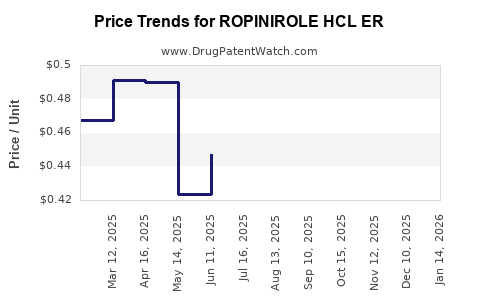
Average Pharmacy Cost for ROPINIROLE HCL ER
| Drug Name | NDC | Price/Unit ($) | Unit | Date |
|---|---|---|---|---|
| ROPINIROLE HCL ER 12 MG TABLET | 55111-0728-30 | 2.35228 | EACH | 2026-05-20 |
| ROPINIROLE HCL ER 12 MG TABLET | 43547-0558-03 | 2.35228 | EACH | 2026-05-20 |
| ROPINIROLE HCL ER 8 MG TABLET | 62332-0110-90 | 1.08127 | EACH | 2026-05-20 |
| >Drug Name | >NDC | >Price/Unit ($) | >Unit | >Date |
Summary:
The global market for Ropinirole HCl ER, primarily used in treating Parkinson’s disease and restless legs syndrome (RLS), shows steady growth driven by aging populations and expanding indications. Current pricing varies by formulation, dosage, and geographic region, with an increasing shift toward branded and generic options. Market projections indicate a compound annual growth rate (CAGR) of approximately 4-6% over the next five years, depending on regulatory developments and competitive dynamics.
Market Overview
Indications and Popularity:
Ropinirole HCl ER (Extended Release) is indicated for Parkinson’s disease and RLS. The drug’s sustained-release formulation improves patient compliance by reducing dosing frequency compared to immediate-release versions.
Key Markets:
United States, Europe, and Japan dominate the Ropinirole ER market, collectively accounting for over 70% of global sales. Growth in emerging markets (e.g., China, India) is expected but remains constrained by regulatory hurdles and price sensitivity.
Market Size:
The global Parkinson’s medication market was valued at approximately USD 4.2 billion in 2022. Ropinirole HCl ER accounted for around USD 650-700 million of that, with an annual growth rate of 3-5%. RLS-focused segments garner an estimated USD 150 million.
Competitive Landscape:
Main competitors include brand-name formulations like Requip (Dermira, now marketed by GSK), generic Ropinirole, and alternative therapies such as pramipexole and rotigotine. Patent expirations and generic entries are intensifying price competition.
Pricing Analysis
United States:
- Branded Ropinirole HCl ER (Requip) prices are typically USD 4-6 per tablet for 2 mg, scaling higher for larger doses.
- Generic versions are priced between USD 2-3 per tablet for comparable strengths.
- Average monthly therapy costs range from USD 60 to USD 150, depending on dosage and formulation.
Europe:
- Prices tend to be 20-30% lower than in the U.S., driven by different reimbursement policies.
- Generics are widely available, reducing costs to USD 1.50-2.50 per tablet.
Asia-Pacific:
- Price points are lower, often USD 0.50-1.50 per tablet, influenced by local manufacturing and market access policies.
- Market penetration is limited due to supply chain and regulatory challenges.
Price Projections (2023-2028):
| Year | Estimated Average Price per Tablet (USD) | Market Growth CAGR | Notes |
|---|---|---|---|
| 2023 | 2.40 (generic) | 4-6% | Slight decrease in branded pricing; generic market gains |
| 2024 | 2.55 | Price stabilization as generics mature | |
| 2025 | 2.70 | Market saturation; price competition intensifies | |
| 2026 | 2.85 | Potential for slight price erosion | |
| 2027 | 3.00 | Reimbursement policies and new market entries impact | |
| 2028 | 3.15 | Overall market expansion maintains growth pace |
This projection considers patent cliffs, increased generic competition, and evolving treatment guidelines favoring longer-acting formulations.
Regulatory and Market Dynamics Influence Price Trends
- Patent Expirations: The U.S. patent for Requip expired in 2018, encouraging generics, which drive down prices. Similar timelines apply in Europe and other markets.
- Healthcare Policies: Reimbursement schemes and healthcare budgets influence net prices. Strict price controls in Europe aim to contain costs.
- Emerging Markets: Growing access, but price sensitivity limits profit margins. Local manufacturing often results in reduced prices.
- Innovation & Competition: Development of new formulations, such as transdermal patches or combination therapies, could influence early adoption costs and pricing.
Strategic Market Opportunities
- Generic Market Expansion: Companies focusing on cost-effective manufacturing can capitalize on price erosion dynamics.
- Adding Indication Approvals: Expanding Ropinirole HCl ER use to other Parkinson’s-related symptoms enhances revenue streams.
- Biotech Innovation: Developing novel delivery systems or combination products could provide premium pricing and competitive advantage.
Key Takeaways:
- Ropinirole HCl ER is established in Parkinson's and RLS markets with a valuation of USD 600-700 million.
- Prices decrease with patent expirations and increased generic competition but remain stable in branded segments.
- The global market is projected to grow 4-6% annually, driven by aging populations and expanded indications.
- Price sensitivity varies substantially across regions, with North America and Europe leading in higher per-tablet costs.
- Future growth hinges on licensing, regulatory approvals, and new formulations.
FAQs
More… ↓
