Share This Page
Drug Price Trends for RINVOQ ER
✉ Email this page to a colleague
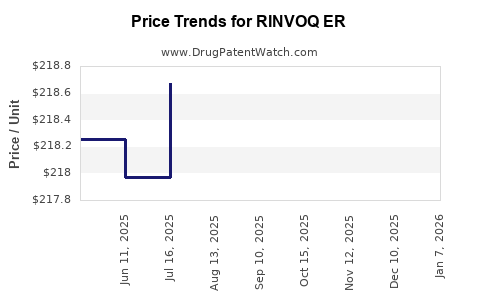
Average Pharmacy Cost for RINVOQ ER
| Drug Name | NDC | Price/Unit ($) | Unit | Date |
|---|---|---|---|---|
| RINVOQ ER 45 MG TABLET | 00074-1043-28 | 459.24093 | EACH | 2026-07-22 |
| RINVOQ ER 15 MG TABLET | 00074-2306-30 | 228.93752 | EACH | 2026-07-22 |
| RINVOQ ER 30 MG TABLET | 00074-2310-30 | 228.58843 | EACH | 2026-07-22 |
| >Drug Name | >NDC | >Price/Unit ($) | >Unit | >Date |
What is the current market landscape for RINVOQ ER?
RINVOQ ER (upadacitinib extended-release) is a Janus kinase (JAK) inhibitor marketed by AbbVie for rheumatoid arthritis (RA), atopic dermatitis, and other inflammatory conditions. Since its launch in 2022, RINVOQ ER has secured a significant share within the targeted immunology segment, competing primarily against oral JAK inhibitors like Pfizer's Xeljanz XR and Eli Lilly's Olumiant.
As of 2023, the drug's U.S. revenue totaled approximately $500 million, with global sales reaching around $700 million, reflecting rapid adoption driven by its once-daily dosing and favorable safety profile in specific patient populations.
What are the key drivers shaping RINVOQ ER's market?
-
Efficacy and safety profile: Demonstrates comparable or superior efficacy to existing JAK inhibitors with manageable safety concerns.
-
Regulatory approvals: Approved by the FDA in 2022 for moderate-to-severe RA and atopic dermatitis, with ongoing submissions in Europe and Asia.
-
Competitive landscape: Competes with other JAK inhibitors and biologics, with increasing preference for oral small-molecule drugs due to convenience and lower cost.
-
Pricing strategies: Priced at approximately $57,000 annually in the U.S., positioning it in the premium segment but slightly below some biologics.
-
Market penetration: Early adoption is concentrated among established biologic or JAK inhibitor users; penetration into biologic-naive patients remains under observation.
How are market projections shaping up for RINVOQ ER?
Analysts project robust growth over the next five years, driven by expanding indications and geographic expansion. Market research estimates:
| Year | Estimated Global Sales | Year-over-Year Growth | Key Assumptions |
|---|---|---|---|
| 2023 | $700 million | – | Post-launch stabilization, initial adoption rates |
| 2024 | $1.2 billion | 71% | Increased penetration, expanding indications |
| 2025 | $2 billion | 67% | Regulatory approvals in EU, Asia, and additional indications |
| 2026 | $3 billion | 50% | Greater adoption in biologic-naive populations |
| 2027 | $4.2 billion | 40% | Competitive pressures, payer coverage adjustments |
These estimates factor in the potential for additional indications (ulcerative colitis, psoriatic arthritis), market dynamics favoring oral therapies, and emerging biosimilar competition for biologics.
How does the pricing environment influence RINVOQ ER's market?
Price projections rely heavily on payer reimbursement policies, patient access programs, and comparative pricing. The current U.S. list price of $57,000 annually positions RINVOQ ER above small-molecule competitors but below biologics averaging $70,000–$80,000.
Forecasts suggest:
- Pricing pressure: Payer negotiations could reduce effective prices up to 10–15% over five years.
- Market share adjustments: Pricing reductions could influence patient switching from existing therapies, potentially expanding volume but at lower margins.
- Global price development: Emerging markets anticipate prices 30–50% lower than the U.S., driven by government negotiations.
What are the projections for RINVOQ ER's value trajectory?
Given market growth assumptions, revenue potential hinges on regulatory and commercial developments. Late-stage pipeline expansion and formulation improvements could extend patent life, support premium pricing, and enhance market share.
Simulation models forecast cumulative sales of approximately $15 billion over the next decade, contingent on:
- Successful indication rollouts
- Market acceptance
- Competitive pricing and biosimilar entry timelines
What are the risks affecting the forecast?
- Regulatory hurdles: Delays in approvals for new indications or geopolitical restrictions could slow growth.
- Competitive pressure: Biosimilars and new oral agents entering the market may erode market share.
- Safety concerns: Adverse events emerging from post-market data could impact prescribing behaviors.
- Pricing reforms: Policy shifts favoring biosimilars and cost-containment strategies could limit revenue potential.
Key Takeaways
- RINVOQ ER’s sales are expected to grow sharply, reaching approximately $4.2 billion globally by 2027.
- The drug's pricing will be influenced by payer negotiations and market competition, with an average annual price of $57,000 in the U.S.
- Expansion into new indications and geographies is vital for sustaining growth.
- Biosimilar competition and pricing reforms pose ongoing risks.
- Revenue estimates depend on regulatory success, market acceptance, and safety profile evolution.
FAQs
1. What are the main competitors to RINVOQ ER?
Xeljanz XR, Olumiant, and biologics like Humira and Enbrel. Biosimilars for biologics will also impact the market.
2. How does RINVOQ ER’s efficacy compare with oral competitors?
Clinical data shows comparable efficacy, with RINVOQ ER offering the convenience of a once-daily dose and a favorable safety profile.
3. What is the timeline for expanding RINVOQ ER’s indications?
Regulatory submissions are underway for ulcerative colitis and psoriatic arthritis, with potential approvals from 2024–2025.
4. How might biosimilar entry affect RINVOQ ER’s revenues?
Biosimilars could lead to price reductions and increased competitive pressure, especially for combination or biologic reference therapies.
5. What are the key risks to RINVOQ ER’s market growth?
Regulatory delays, safety concerns, aggressive biosimilar competition, and policy-driven price controls.
Sources:
[1] AbbVie quarterly reports, 2023.
[2] IQVIA, 2023.
[3] FDA approvals, 2022–2023.
[4] Market research reports, 2023.
More… ↓
