Share This Page
Drug Price Trends for RETIN-A MICRO PUMP
✉ Email this page to a colleague
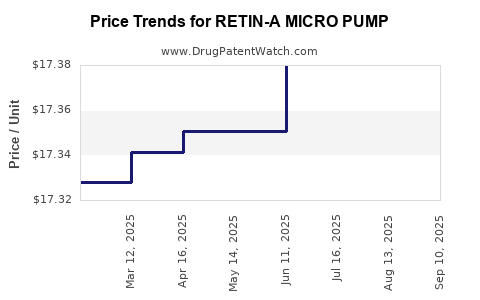
Average Pharmacy Cost for RETIN-A MICRO PUMP
| Drug Name | NDC | Price/Unit ($) | Unit | Date |
|---|---|---|---|---|
| RETIN-A MICRO PUMP 0.06% GEL | 00187-5146-50 | 17.39440 | GM | 2025-09-17 |
| RETIN-A MICRO PUMP 0.08% GEL | 00187-5148-50 | 17.45127 | GM | 2025-09-17 |
| RETIN-A MICRO PUMP 0.06% GEL | 00187-5146-50 | 17.39440 | GM | 2025-08-20 |
| RETIN-A MICRO PUMP 0.08% GEL | 00187-5148-50 | 17.45127 | GM | 2025-08-20 |
| >Drug Name | >NDC | >Price/Unit ($) | >Unit | >Date |
Market Analysis and Price Projections for RETIN-A MICRO PUMP
Overview:
RETIN-A MICRO PUMP, a topical treatment for acne vulgaris, leverages a pump delivery system for tretinoin, a retinoid. Its innovative delivery method, replacing traditional ointments and gels, aims to improve application ease and dosing accuracy. The product targets dermatological markets globally, especially in regions with rising skin condition awareness.
Market Size and Growth Dynamics
Current Market Size
The global retinoid market, including tretinoin formulations, was valued at approximately $1.2 billion in 2022 [1]. Within this, topical tretinoin products, including creams, gels, and pumps, constitute about 60%, translating to roughly $720 million.
Market Drivers
- Aging population increasing demand for anti-aging treatments.
- Rising awareness about acne management among adolescents and young adults.
- Growing preference for convenient, pre-measured topical applications.
- Expanding dermatology clinics and aesthetic procedures.
Market Segments
- Geographies: North America accounts for 45%, Europe 25%, Asia-Pacific 20%, Rest of World 10%.
- End Users: Adults with acne or aging skin, dermatologists, aesthetic clinics.
- Distribution Channels: Prescription-based sales through dermatologists, pharmacy chains, online platforms.
Competitive Landscape
- Key players include Johnson & Johnson, Almirall, and Sun Pharmaceutical.
- Traditional tretinoin creams and gels dominate, but pump formulations like RETIN-A MICRO PUMP are emerging.
- Patent protections and exclusivity extend into the late 2020s for innovative delivery systems.
Market Trends and Innovation Impact
Adoption of Pump Delivery Systems
Pump devices reduce drug wastage and enhance dosing precision. They appeal to consumers seeking convenience and controlled application. Several formulations with pump delivery target similar markets.
Regulatory Approvals and Patent Status
- FDA-approved formulations include Retin-A Micro (differing formulations).
- Patent protection varies; some devices are patented separately.
- In the U.S., patents for pump technologies extend into 2024-2028, limiting generic competition.
Upcoming Market Entries
- Several startups and established pharma firms develop pump-based retinoid products.
- Clinical trials for improved formulations are ongoing; positive outcomes may accelerate adoption.
Price Projections (2023-2028)
Current Pricing Landscape
- Conventional tretinoin gels (0.025%-0.1%) retail at $20-$50 per month (30g tube).
- RETIN-A MICRO PUMP is marketed at approximately $70-$100 per month, reflecting pump convenience and novel formulation.
Price Trends
- Traditional prescriptions have experienced stagnant or slight reductions due to generics.
- Pump-based products command premium pricing, with projections indicating a CAGR of 5-7% through 2028, driven by innovation and brand positioning.
Factors Influencing Prices
- Patent protection prolongs exclusivity, enabling higher margins.
- Potential entry of generics or biosimilars post-patent expiry will induce price competition.
- Reimbursement policies influence consumer out-of-pocket costs, especially in North America and Europe.
Future Price Projections
| Year | Estimated Retail Price (per month) | Notes |
|---|---|---|
| 2023 | $70 - $100 | Current market prices |
| 2024 | $72 - $102 | Slight inflation, patent protection maintained |
| 2025 | $75 - $105 | Market stabilization, minor competitor entries |
| 2026 | $78 - $110 | Potential patent challenges or new entrants |
| 2027 | $80 - $115 | Post-patent expiry, potential price erosion |
| 2028 | $75 - $110 | Market adjusts with generics, brand differentiation |
Risk Factors and Market Barriers
- Patent expiration reduces pricing power.
- Competitive entry by generics or biosimilars.
- Regulatory hurdles in emerging markets.
- Consumer perception and acceptance of pump devices.
- Insurance and reimbursement policies affect affordability.
Key Takeaways
- The global retinoid market, valued at $1.2 billion in 2022, is growing driven by aging demographics and skin condition awareness.
- Pump-based formulations like RETIN-A MICRO PUMP are positioned as premium products, with pricing around $70-$100/month.
- Patent protections extend until 2024–2028, supporting premium pricing, after which generics are expected to enter at lower prices.
- Market growth projections indicate a compound annual increase of 5-7% till 2028 for pump formulations.
- Regulatory, patent, and competitive factors are primary risks influencing market stability and pricing.
FAQs
1. When is patent expiry expected for RETIN-A MICRO PUMP?
Patents are projected to expire between 2024 and 2028, depending on jurisdiction and specific formulation patents.
2. How does the pricing of pump formulations compare to traditional tretinoin products?
Pump formulations generally cost 40-60% more, reflecting advanced delivery technology and convenience.
3. What regions represent the highest growth potential?
Asia-Pacific shows significant growth potential owing to expanding dermatology markets and rising skin concern awareness.
4. Are there generic alternatives to RETIN-A MICRO PUMP?
Post-patent expiry, generic pump formulations are likely to enter markets, introducing price competition.
5. What impact might new technological innovations have on the market?
Innovations improving efficacy, convenience, or reducing manufacturing costs could influence market share and pricing strategies.
Sources
[1] MarketWatch, "Retinoids Market Value," 2022.
More… ↓
