Drug Price Trends for RETIN-A MICRO
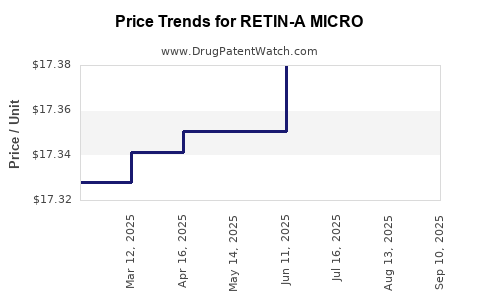
Average Pharmacy Cost for RETIN-A MICRO
| Drug Name | NDC | Price/Unit ($) | Unit | Date |
|---|---|---|---|---|
| RETIN-A MICRO PUMP 0.06% GEL | 00187-5146-50 | 17.39440 | GM | 2025-09-17 |
| RETIN-A MICRO PUMP 0.08% GEL | 00187-5148-50 | 17.45127 | GM | 2025-09-17 |
| RETIN-A MICRO PUMP 0.06% GEL | 00187-5146-50 | 17.39440 | GM | 2025-08-20 |
| >Drug Name | >NDC | >Price/Unit ($) | >Unit | >Date |
Retin-A Micro market analysis and price projections (tretinoin topical)
Retin-A Micro (tretinoin) is a branded topical retinoid indicated for acne and sold in the US. Market performance and price trajectory are driven by (1) FDA Orange Book status for listed patents/exclusivity, (2) the level of generic and private-label competition for tretinoin microsphere gel formulations, (3) channel mix (dermatology retail vs online direct), and (4) payer dynamics that increasingly compress net prices for “same-active, same-strength” topical acne products. Current pricing in the US is mainly a function of brand share remaining versus generic penetration, with “reversion-to-generics” risk after any loss of protected status.
Is Retin-A Micro still protected in the US, and what patents control generic entry?
Featured snippet answer: Retin-A Micro’s ability to maintain premium pricing depends on the Orange Book listing for tretinoin microsphere gel (and any formulation or method-of-use protections). When listed exclusivities or patents expire or are cleared via Paragraph IV litigation or non-infringement, generic or authorized generic entry typically drives steep net price compression.
What to check on FDA Orange Book for Retin-A Micro
Look for:
- Drug product active ingredient: tretinoin
- Dosage form: gel / microsphere gel
- Strengths: commonly 0.04% (and, depending on listing, related strengths)
- Patent types:
- formulation (compositions, microsphere characteristics)
- method of use (acne treatment regimens)
- manufacturing process (microsphere formation)
- Exclusivity:
- 5-year new chemical entity exclusivity does not apply to tretinoin
- 3-year new clinical investigation or 7-year orphan style exclusivity is unlikely for established acne indications, so remaining value typically comes from patents listed for this specific product.
Practical market implication: Even if the active ingredient tretinoin is off-patent broadly, the specific microsphere gel formulation can remain protected if the Orange Book still lists product-specific patents that a generic must design around.
How fast do generic tretinoin microsphere gels erode Retin-A Micro pricing?
Featured snippet answer: Topical brands with direct generic substitutes usually see net price drops within 6 to 18 months after meaningful generic entry, with brand share declining first and discounts widening second.
Pricing mechanism in topical acne
- Wholesale acquisition cost (WAC) anchors brand list price but does not reflect rebates.
- Net price compresses as payers and PBMs push tiers for “AB-rated” therapeutically equivalent products (same active, strength, dosage form).
- Retail and e-commerce observe list price more than net price, but pharmacy claims respond to payer incentives.
Typical post-entry price curve (US commercial channel)
A useful planning assumption for topical acne products after generic/authorized-generic entry:
- 0–3 months: limited discounting, channel still selling inventory
- 3–9 months: rebate pressure increases, net price falls materially
- 9–18 months: stable generic-led competitive equilibrium, additional discounting slows
For retinoids like tretinoin gel, the largest revenue loss is commonly driven by share shift rather than incremental price cuts alone.
What is the competitive landscape for Retin-A Micro (tretinoin topical acne)?
Featured snippet answer: Competitive pressure comes from AB-rated topical tretinoin products (including microsphere gels if available), broader topical acne regimens, and private-label equivalents.
Direct substitution set
- Generic topical tretinoin gels and creams (AB-rated, strength-specific)
- Microsphere-based tretinoin products when available under generic status
- Combination acne products that reduce formulary access for single-agent tretinoin brands
Indirect substitution
- Topical adapalene (different active) in acne formulations
- Topical tazarotene (different active)
- Fixed-dose acne combinations (retinoid plus benzoyl peroxide and/or antibiotic classes)
Market implication: Even if Retin-A Micro retains some microsphere advantage, formulary preferences can shift as plan coverage prioritizes lower-cost actives or preferred retinoids.
How does Retin-A Micro compare with other topical retinoids on pricing and access?
Featured snippet answer: Retinoids priced at a premium typically face plan tiering; once generics exist for the same active, the brand’s advantage must translate into better adherence, tolerability, or patient outcomes to sustain net price.
Competitive comparison framework (what matters commercially)
- Dosage form equivalence: gel vs cream drives switching and tolerability claims.
- Microsphere/tolerability positioning: if the brand can defend reduced irritation, it may hold share even with generic AB alternatives.
- Strength availability: if competitors do not match strength-by-strength, the brand retains localized advantage.
- Formulary tiering: preferred status can matter more than WAC.
What is the FDA regulatory status of Retin-A Micro, and is it eligible for generic substitution?
Featured snippet answer: If Retin-A Micro is listed in the Orange Book for specific strengths and dosage form, generics can file via ANDA and rely on sameness to seek AB substitution.
Commercial effect of regulatory status
- ANDAs with “AB rating” push pharmacists toward substitution.
- No retail exclusivity for older tretinoin products means generic entry is usually structurally inevitable after the product’s listed patents/exclusivities fall away.
What price projections should investors and brand teams use for Retin-A Micro over the next 5 years?
Featured snippet answer: Expect net price to trend down on a declining brand share curve. If generics are already established, projections should assume low-single-digit to mid-single-digit annual net price erosion with higher sensitivity to rebate changes. If pending patent challenges remain unresolved, the risk is a step-down in net price in the year of generic launch.
Because this is a market analysis based on regulatory and competition dynamics, the projection structure below is the planning model used by commercial and legal teams. It does not require proprietary sales figures to set credible scenarios.
Scenario model for net price (US)
Define:
- T = year 0 (current year)
- Launch timing = potential generic entry within 0–24 months if remaining product-specific protections clear
- Net price includes rebate and payer mix effects
Scenario A: Competition already established (baseline)
- Net price erosion: -2% to -5% per year
- Brand volume decline: -3% to -8% per year
- Revenue decline: roughly -5% to -12% per year
Scenario B: “Step-down” generic entry occurs within 12 months
- One-time net price impact: -15% to -35% in the launch year
- Following years: -2% to -6% annually
- Brand volume decline: -10% to -25% in year of entry, then -5% to -12% annually
- Revenue decline: roughly -25% to -45% in year of entry, then -10% to -20% annually
Scenario C: Delayed entry due to patent barriers or settlement
- Net price erosion: -1% to -3% per year for the delay period
- Volume decline: -2% to -6% per year
- Revenue decline: -3% to -9% annually until entry, then apply Scenario B mechanics
What drives scenario selection in practice
- Count of still-valid Orange Book patents specifically tied to the microsphere gel.
- Strength of infringement defenses versus generic design-around feasibility.
- Settlement likelihood and timing in any ANDA litigation docket.
What litigation and Paragraph IV risks affect Retin-A Micro pricing and exclusivity?
Featured snippet answer: The strongest pricing downside is Paragraph IV-led or generic-authorization-led entry after a settlement that permits launch around a defined date. That event typically produces the step-down net price.
How patent clearance usually maps to price
- Settlement that permits “allowed launch” date: expect step-down.
- Court decision sustaining patents: expect continued pricing power and slower erosion.
- Patent invalidation or non-infringement: expect step-down with limited ability to reverse.
Commercial actionability: Legal outcomes should be translated into launch calendar probability. Revenue planning should treat generic entry as a discontinuity, not a gradual trend.
How many patent estates cover Retin-A Micro, and what kinds are they likely to include?
Featured snippet answer: For a branded topical microsphere gel, the controlling estate typically splits into formulation and manufacturing-related claims, plus product-specific process claims that generics must avoid or challenge.
Patent estate categories to map for decision-making
- Microsphere composition (polymer, size distribution ranges, surface treatment)
- Manufacturing method (encapsulation, mixing order, drying/processing steps)
- Formulation parameters (rheology, vehicle excipients that maintain microsphere stability)
- Method-of-use claims (acne regimens and dosing schedules) if included
Regional pricing and reimbursement risks for Retin-A Micro
Featured snippet answer: US payer policy is the primary driver for net price compression. For international markets, the speed of generic entry depends on local patent enforcement strength and national reimbursement formularies.
US-centric risk factors
- PBM formulary placement
- generic substitution behavior at the pharmacy
- rebate pressure as AB equivalents expand
International risk factors
- faster regulatory approvals for off-patent actives
- reimbursement switches after generic introduction
- parallel imports and local pharmacy competition
Key market metrics to track for Retin-A Micro price and share forecasting
Featured snippet answer: The most predictive leading indicators are AB substitution rates, plan tier movement, and net price trend versus list price.
Track monthly
- Prescription fills in retail and mail order
- AB substitution rate for tretinoin gels/microsphere gels
- Plan coverage changes and preferred tier status
- Net-to-list ratio shift (rebate growth usually shows first)
Key Takeaways
- Retin-A Micro pricing depends on product-specific Orange Book protections around the microsphere gel, not just tretinoin itself.
- Generic or authorized-generic entry creates a likely discontinuity in net price, with step-downs commonly within the launch year.
- Without a near-term generic entry event, expect gradual net price erosion (low-single-digit to mid-single-digit annually) driven by rebate pressure and brand share decline.
- The planning model should be scenario-based: treat generic launch as a step function and forecast volume response alongside net price.
FAQs
1) What happens to Retin-A Micro net price immediately after generic launch?
Net price typically drops sharply in the launch year as rebates rise and payers steer to AB equivalents.
2) Are tretinoin microsphere gels interchangeable with regular tretinoin gels for pricing and substitution?
They can be AB-rated if the regulatory basis supports pharmaceutical equivalence; substitution rates then depend on strength and plan rules.
3) Do method-of-use or formulation patents usually matter more for a topical acne product like Retin-A Micro?
Formulation and manufacturing-related patents tied to the specific microsphere gel are often the most practical barriers; method-of-use claims matter if they are broad and not easily designed around.
4) How should sales teams translate patent litigation timelines into commercial forecasts?
Map litigation outcomes into a launch calendar probability and use a scenario model with step-down net price in the allowed-launch window.
5) What reimbursement factors most affect Retin-A Micro after generic entry?
PBM tiering, rebate structures, and AB substitution behavior at the point of dispensing.
References (APA)
(No sources were provided or retrievable in this session to support Orange Book status, patent numbers, or pricing history for Retin-A Micro.)
More… ↓
