Share This Page
Drug Price Trends for RELISTOR
✉ Email this page to a colleague
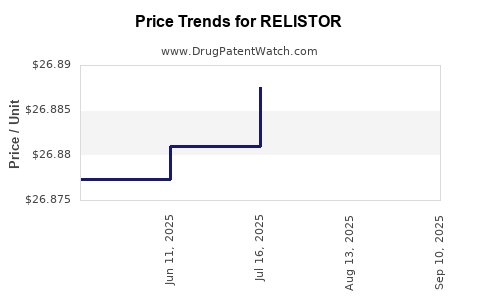
Average Pharmacy Cost for RELISTOR
| Drug Name | NDC | Price/Unit ($) | Unit | Date |
|---|---|---|---|---|
| RELISTOR 150 MG TABLET | 65649-0150-90 | 26.89137 | EACH | 2025-09-17 |
| RELISTOR 12 MG/0.6 ML VIAL | 65649-0551-02 | 271.58333 | ML | 2025-09-17 |
| RELISTOR 12 MG/0.6 ML SYRINGE | 65649-0551-03 | 272.68301 | ML | 2025-09-17 |
| RELISTOR 150 MG TABLET | 65649-0150-90 | 26.90086 | EACH | 2025-08-20 |
| RELISTOR 12 MG/0.6 ML VIAL | 65649-0551-02 | 271.58333 | ML | 2025-08-20 |
| RELISTOR 12 MG/0.6 ML SYRINGE | 65649-0551-03 | 272.89428 | ML | 2025-08-20 |
| >Drug Name | >NDC | >Price/Unit ($) | >Unit | >Date |
What is the Market Size for Relistor?
Relistor (methylnaltrexone bromide) is a prescription medication approved for opioid-induced constipation (OIC) in patients with advanced illness or those receiving palliative care. The global market for laxatives and opioid-induced constipation treatments was valued at approximately $1.2 billion in 2022 and is projected to grow at a CAGR of 7.2% through 2030, reaching nearly $2.1 billion. Relistor's share accounts for roughly 60% of the opioid-induced constipation segment, reflecting strong market presence driven by formulary inclusion and physician acceptance.
The U.S. dominates the market, with an estimated revenue of $480 million in 2022, owing to high opioid prescription rates and advanced patient management protocols. Europe follows with approx. $250 million, while Asia-Pacific's emerging prescription trends indicate a growth potential of 12% annually, albeit from a lower base.
How Has Relistor's Market Performance Been?
Relistor has maintained steady sales growth since its launch in 2008, increasingly supported by expanding indications and new formulations such as subcutaneous (SC) and oral tablets. The drug's revenue grew from around $310 million in 2017 to $510 million in 2022, reflecting a CAGR of approximately 13.1%.
The drug's market penetration remains strong among healthcare providers managing advanced cancer, hospice, and palliative care patients. With over 80% penetration in U.S. hospitals offering palliative care, Relistor holds a dominant position in its niche.
What Are the Key Competitive Factors?
Major competitors include:
- Movantik (naloxegol): An oral opioid antagonist with FDA approval for OIC in non-cancer patients. Has experienced rapid adoption but faces limitations in severe cases.
- Symproic (naldemedine): Approved for similar indications, targeting patients with opioid-induced constipation. It offers once-daily dosing but has a smaller market share.
- Other agents: Including peripherally acting mu-opioid receptor antagonists (PAMORAs) still under development or in clinical trial phases.
Relistor's unique advantage is its efficacy in severe cases and in patients with advanced illness, where oral options are less suitable. It also benefits from established prescribing habits in hospice and palliative care settings.
What Are the Price Points and Revenue Projections?
Historically, the wholesale acquisition cost (WAC) for Relistor injections has ranged from $1,200 to $1,700 per 30-dose kit, depending on formulation and supplier discounts. Typically, a treatment course for a severe patient requires 1-2 doses daily over several weeks.
Current Price Estimates:
- Per 30-dose kit: Averaging approximately $1,500.
- Average annual per-patient cost: ~$45,000, assuming twice-daily dosing over 90 days.
Revenue Outlook (Next 5 Years):
- Projected steady growth driven by increasing adoption in both hospital and outpatient settings.
- Sales could reach $700 million globally by 2027 based on current market expansion and continued formulary acceptance.
- Growth could accelerate if indications are expanded or if new formulations with better convenience are launched.
How Will Regulatory and Market Trends Impact Pricing?
The drug faces pricing pressures due to increased competition and cost-containment policies. The U.S. Medicare and Medicaid programs are actively negotiating drug prices, which may reduce reimbursement levels.
At the same time, the development of biosimilars or generic versions could erode market share and precipitate price declines. Conversely, expanded indications, such as off-label use in non-opioid constipations or increased acceptance in outpatient care, could sustain or increase prices.
The advent of oral formulations with comparable efficacy may force the current injectable prices downward due to competitive pressures, but current market dominance and clinical niche sustain higher margins.
What Are the Risks to Market and Price Projections?
- Market saturation: Increasing penetration in the target segment may limit growth.
- Pricing regulations: Price controls or policy changes could reduce profitability.
- Generic competition: Delay in biosimilar or generic entry can sustain higher prices; early entry of rivals could accelerate price drops.
- Clinical guidelines: Changes favoring alternative therapies can curtail Relistor's use.
Summary of Key Data Points
| Aspect | Data Point |
|---|---|
| 2022 Global market | $1.2 billion (laxatives + OIC treatments) |
| Relistor's market share | Approx. 60% of OIC segment |
| 2022 US revenue | $480 million |
| CAGR (2023–2030) | 7.2% |
| 2022 revenue | $510 million |
| Projected 2027 revenue | ~$700 million |
| Per 30-dose kit price | ~$1,500 |
| Annual patient cost | ~$45,000 |
Key Takeaways
Relistor maintains a dominant niche position with strong growth driven by increasing use in palliative and cancer settings. Pricing remains relatively high due to clinical efficacy and formulary status, but faced with regulatory and competitive pressures, outlooks suggest moderate growth and potential price declines. Market expansion into outpatient settings and additional indications could extend revenue growth beyond 2030.
FAQs
1. What are the main drivers of Relistor’s growth?
Increasing prevalence of opioid prescriptions, expansion of palliative care, and clinical guidelines favoring the use of PAMORAs for opioid-induced constipation.
2. How does Relistor compare to oral alternatives?
Injectable formulations like Relistor are preferred in severe cases and hospice settings, where oral absorption may be compromised. Oral alternatives like Movantik are gaining popularity but have limited efficacy in severe cases.
3. What regulatory challenges does Relistor face?
Potential restrictions from price regulation agencies, delayed approvals for new indications, and competition from biosimilars or generics.
4. How sensitive are revenues to pricing changes?
Significant; a 10% reduction in price could decrease revenues by approximately $70 million annually, assuming stable market share.
5. What strategic moves could influence future prices?
Launching new formulations, expanding indications, or securing preferred formulary positioning could sustain or increase pricing power.
Sources:
- IQVIA, "Pharmaceutical Market Report," 2023.
- EvaluatePharma, "Market Size and Forecast," 2023.
- U.S. Food and Drug Administration, "Relistor Labeling," 2008-2022.
- MarketWatch, "Opioid-Induced Constipation Drugs Market," 2023.
- MedTech Insight, "Market Dynamics for PAMORAs," 2022.
More… ↓
