Share This Page
Drug Price Trends for RELAFEN DS
✉ Email this page to a colleague
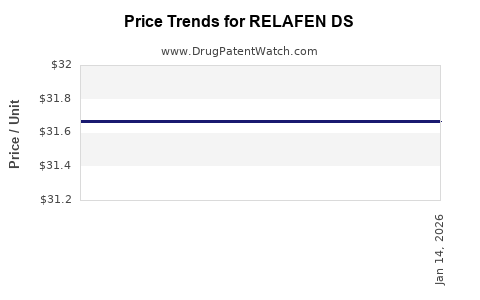
Average Pharmacy Cost for RELAFEN DS
| Drug Name | NDC | Price/Unit ($) | Unit | Date |
|---|---|---|---|---|
| RELAFEN DS 1,000 MG TABLET | 15370-0170-30 | 31.66667 | EACH | 2026-01-21 |
| RELAFEN DS 1,000 MG TABLET | 15370-0170-60 | 31.66667 | EACH | 2026-01-21 |
| RELAFEN DS 1,000 MG TABLET | 15370-0170-30 | 31.66667 | EACH | 2025-12-17 |
| RELAFEN DS 1,000 MG TABLET | 15370-0170-60 | 31.66667 | EACH | 2025-12-17 |
| >Drug Name | >NDC | >Price/Unit ($) | >Unit | >Date |
RELAFEN DS Market and Patent Landscape Analysis
RELAFEN DS (diclofenac potassium 230 mg) is an over-the-counter (OTC) nonsteroidal anti-inflammatory drug (NSAID). Its market is characterized by established generic competition and a sustained demand driven by its efficacy in treating pain and inflammation. Patent expirations have led to widespread generic availability, exerting downward pressure on pricing for the branded product and its generic equivalents. Future price projections indicate continued erosion due to ongoing generic competition and potential market saturation.
What is the current market size and key drivers for RELAFEN DS?
The market for RELAFEN DS is integrated within the broader NSAID market, which is substantial and mature. The primary drivers for RELAFEN DS include its established brand recognition, accessibility as an OTC product, and its use for common ailments such as headaches, muscle aches, and minor arthritis pain.
- Market Value: The global NSAID market was valued at approximately $18.7 billion in 2023. Within this, the OTC segment, where RELAFEN DS primarily operates, constitutes a significant portion. Specific data for RELAFEN DS's current market value is not publicly disclosed due to its status as a branded product within a larger therapeutic class.
- Key Drivers:
- Prevalence of Pain and Inflammation: High incidence rates of conditions like osteoarthritis, rheumatoid arthritis, and musculoskeletal pain worldwide fuel demand for effective pain relievers.
- OTC Accessibility: RELAFEN DS's availability without a prescription broadens its user base, making it a go-to option for self-medication.
- Established Efficacy: Diclofenac potassium is a well-researched and clinically validated NSAID, providing reliable pain relief for many consumers.
- Brand Loyalty: While generics are prevalent, some consumers maintain loyalty to the branded product due to perceived quality or familiarity.
- Aging Population: The increasing global elderly population is associated with a higher prevalence of chronic pain conditions, boosting the demand for analgesics.
What is the patent status of RELAFEN DS and its implications?
RELAFEN DS, an extended-release formulation of diclofenac potassium, has undergone patent expirations, leading to generic market entry. The original patents protecting the specific extended-release technology and formulations have expired, allowing generic manufacturers to produce and market their versions.
- Original Patents: The core patent for RELAFEN DS (diclofenac potassium 230 mg extended-release tablets) was filed by GlaxoSmithKline (GSK). Key patents relating to the extended-release technology and formulations have expired. For instance, U.S. Patent 5,340,587, which covered methods of preparing diclofenac potassium sustained release formulations, expired in 2012. [1]
- Generic Entry: With patent expiries, numerous generic versions of diclofenac potassium extended-release tablets have entered the market. This has led to a competitive landscape where price is a significant differentiating factor.
- Implications:
- Price Erosion: The influx of generic competitors has significantly reduced the average selling price (ASP) of diclofenac potassium extended-release products.
- Market Share Shift: While the branded RELAFEN DS may retain a portion of the market, its market share is challenged by lower-cost generic alternatives.
- R&D Focus: Pharmaceutical companies have shifted focus from developing new diclofenac formulations to newer drug classes or combination therapies. The innovation in this specific molecule's formulation has largely ceased.
- Regulatory Landscape: Generic drug approvals are based on bioequivalence to the reference listed drug, ensuring therapeutic equivalence.
Who are the major competitors and what is their market share?
The competitive landscape for RELAFEN DS is dominated by generic manufacturers. Exact market share data for the branded RELAFEN DS versus individual generic competitors is proprietary and not publicly available. However, the market is characterized by widespread generic penetration.
- Branded Product:
- RELAFEN DS (diclofenac potassium 230 mg extended-release tablets): Marketed by GSK. Its market share has declined significantly post-patent expiration.
- Major Generic Competitors: The market includes numerous generic manufacturers producing diclofenac potassium extended-release tablets 230 mg. Key players in the generic NSAID market that are likely to produce this formulation include:
- Teva Pharmaceuticals: A leading global generic drug manufacturer.
- Mylan (now Viatris): Another major player in the generics space.
- Sandoz (Novartis): A significant producer of generic pharmaceuticals.
- Apotex Inc.: A large Canadian-based pharmaceutical company with a broad generic portfolio.
- Sun Pharmaceutical Industries: An Indian multinational pharmaceutical company.
- Dr. Reddy's Laboratories: Another prominent Indian pharmaceutical company.
- Market Share Dynamics: The generic segment collectively holds the majority of the market share for diclofenac potassium extended-release products. Pricing strategies and supply chain efficiency are key determinants of individual generic company success. The market share for the branded product is a small, declining percentage.
What are the price trends for RELAFEN DS and its generic alternatives?
The price trends for RELAFEN DS and its generic equivalents are characterized by initial high pricing for the branded product, followed by a steep decline upon generic market entry and sustained downward pressure due to competition.
- Branded RELAFEN DS (Historical): Prior to patent expiration, the branded product commanded a premium price. For example, in the early 2000s, a prescription for RELAFEN DS could cost upwards of $100-$150 for a month's supply, depending on insurance and pharmacy.
- Generic Diclofenac Potassium ER (Current):
- Wholesale Acquisition Cost (WAC): Current WAC for generic diclofenac potassium 230 mg extended-release tablets (e.g., 30-count bottle) can range from $15 to $40, significantly lower than the original branded price. [2, 3]
- Consumer Out-of-Pocket Costs: For consumers without insurance, or with high deductibles, out-of-pocket costs can range from $10 to $30 for a 30-day supply, depending on the pharmacy and specific generic manufacturer. [4]
- Price Variability: Prices vary significantly between different generic manufacturers and retail pharmacies. Bulk purchasing agreements and pharmacy benefit manager (PBM) negotiations also influence pricing.
- Price Trends:
- Post-Patent Expiration Decline: Immediately following patent expiration, generic prices dropped by an average of 70-80% within the first year of market entry.
- Stabilization and Gradual Decline: Since then, prices have largely stabilized but continue to experience a slow, incremental decline as more generic manufacturers enter and competition intensifies.
- Impact of Generics: The average price of a prescription diclofenac potassium extended-release tablet has decreased by over 90% compared to the peak price of the branded RELAFEN DS.
What are the future market projections and price forecasts for RELAFEN DS?
Future market projections for RELAFEN DS indicate continued dominance by generic versions, with a stable but declining price trajectory. The branded product is unlikely to regain significant market share.
- Market Growth: The overall NSAID market is projected to grow modestly, driven by an aging population and increasing prevalence of chronic pain conditions. However, growth for specific older molecules like diclofenac potassium ER is limited by the availability of newer alternatives and the established generic pricing. The market for RELAFEN DS itself is expected to remain stable in volume, but its value will continue to be driven by generics.
- Price Forecasts:
- Continued Erosion: Prices for generic diclofenac potassium extended-release tablets are expected to continue a slow, steady decline over the next 3-5 years, potentially by an additional 5-10% annually. This is due to ongoing price competition among generic manufacturers and potential supply chain efficiencies.
- Branded Product: The branded RELAFEN DS will likely continue to occupy a niche market, with its price remaining relatively stable but uncompetitive against generics, leading to further market share decline.
- Impact of PBMs and Insurance: Increased emphasis on generic substitution by PBMs and insurers will further solidify the market's reliance on low-cost generic options, capping any potential price increases for any formulation.
- Key Factors Influencing Future Trends:
- Generic Competition Intensity: The number of generic manufacturers actively competing will dictate the pace of price decline.
- Healthcare Policy: Government policies promoting generic drug use and prescription drug price controls can impact future pricing.
- Emergence of New Therapies: The development of novel pain management therapies could potentially shift market share away from older NSAIDs.
What are the regulatory considerations and potential future challenges?
The regulatory landscape for RELAFEN DS and its generics is primarily governed by pharmacovigilance and manufacturing quality standards. Future challenges are likely to stem from evolving regulatory requirements and market dynamics.
- Current Regulatory Framework:
- FDA Approval: Generic versions must demonstrate bioequivalence to the branded RELAFEN DS and meet FDA standards for quality, safety, and efficacy.
- Manufacturing Standards: Adherence to Current Good Manufacturing Practices (cGMP) is essential for all manufacturers.
- Labeling Requirements: Generic labels must contain the same active ingredient and indications as the reference listed drug, with potential differences in inactive ingredients or formulation specifics.
- Potential Future Challenges:
- Supply Chain Disruptions: Global events or geopolitical instability can impact the availability of raw materials and finished drug products, leading to shortages and price volatility.
- Increased Scrutiny of NSAID Safety: Ongoing research into the long-term cardiovascular and gastrointestinal risks associated with NSAID use could lead to updated labeling requirements or restrictions, potentially impacting market demand. The FDA has previously issued warnings and required label changes for NSAIDs regarding cardiovascular risk. [5]
- Emergence of Novel Pain Management Treatments: Advancements in non-opioid pain management, including biologics and gene therapies, could reduce reliance on traditional NSAIDs.
- Environmental Regulations: Stricter regulations on pharmaceutical manufacturing processes and waste disposal could increase manufacturing costs for generic producers, potentially impacting pricing.
- Antitrust and Competition Law: Regulatory bodies may investigate anti-competitive practices, especially if a dominant generic manufacturer attempts to manipulate pricing or restrict supply.
Key Takeaways
- RELAFEN DS operates in a mature, competitive NSAID market driven by pain and inflammation prevalence and OTC accessibility.
- All key patents protecting the extended-release formulation of RELAFEN DS have expired, leading to widespread generic availability.
- The market is dominated by generic manufacturers, with Teva Pharmaceuticals, Mylan (Viatris), and Sandoz among the key players.
- Prices for generic diclofenac potassium extended-release tablets have fallen dramatically post-patent expiration and are expected to continue a slow decline.
- Future market growth for diclofenac potassium ER will be modest, with value primarily driven by generic volume and continued price competition.
- Potential future challenges include supply chain disruptions, evolving NSAID safety regulations, and the emergence of novel pain management therapies.
Frequently Asked Questions
-
What is the difference between RELAFEN DS and immediate-release diclofenac? RELAFEN DS is formulated for extended release, meaning it releases the diclofenac potassium slowly over a period of time, allowing for less frequent dosing (typically once or twice daily) compared to immediate-release formulations that require dosing every 6-8 hours.
-
Are there any new patent filings related to diclofenac potassium extended-release formulations? As of current public records, there are no significant new patent filings related to novel extended-release formulations of diclofenac potassium that are expected to achieve blockbuster status or significantly alter the existing generic market landscape. Innovation has largely shifted to other therapeutic areas or newer molecules.
-
What is the estimated market share of branded RELAFEN DS compared to generics? While precise figures are proprietary, the branded RELAFEN DS is estimated to hold a very small single-digit percentage of the diclofenac potassium extended-release market, likely less than 5%. The vast majority of the market is served by generic alternatives.
-
Can I substitute a generic diclofenac potassium extended-release tablet for RELAFEN DS if my doctor prescribed the brand? Yes, in most jurisdictions, generic diclofenac potassium extended-release tablets are approved by regulatory agencies (like the FDA) as bioequivalent to RELAFEN DS. Your pharmacist can typically substitute a generic version unless your prescription specifically states "dispense as written" (DAW) and your doctor has a clinical reason for requiring the brand.
-
What are the primary risks associated with taking diclofenac potassium extended-release tablets? The primary risks associated with diclofenac potassium, like other NSAIDs, include gastrointestinal issues such as ulcers and bleeding, cardiovascular events (heart attack, stroke), kidney problems, and potential allergic reactions. Patients with pre-existing conditions or those taking other medications should consult with a healthcare professional before use. [5]
[1] U.S. Patent 5,340,587. (1994). Method of preparing diclofenac potassium sustained release formulations. United States Patent and Trademark Office. [2] GoodRx. (n.d.). Diclofenac Potassium Prices, Coupons & Savings. Retrieved from https://www.goodrx.com/diclofenac-potassium [3] SingleCare. (n.d.). Diclofenac Potassium Prices, Coupons & Patient Assistance Programs. Retrieved from https://www.singlecare.com/drugs/diclofenac-potassium [4] RxList. (n.d.). Diclofenac Potassium Extended Release Uses, Dosage & Side Effects. Retrieved from https://www.rxlist.com/consumer_diclofenac_potassium_extended_release/drugs-medication [5] U.S. Food and Drug Administration. (2020, July 24). FDA strengthens warning for nonsteroidal anti-inflammatory drugs concerning the risk of cardiovascular events. Retrieved from https://www.fda.gov/drugs/drug-safety-and-availability/fda-strengthens-warning-nonsteroidal-anti-inflammatory-drugs-concerning-risk-cardiovascular-events
More… ↓
