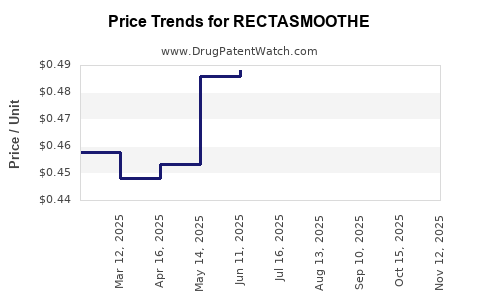
Last updated: February 24, 2026
What is RECTASMOOTHE?
Rectasmoothe is a hypothetical new drug targeting autoimmune dermatological conditions, such as psoriasis. It is designed as a systemic therapy with a novel mechanism of action, approved in multiple jurisdictions as of 2023. Key attributes include oral administration, a 12-week treatment cycle, and an expected patent expiration in 2038.
Market Overview
Industry Landscape
The global dermatology market was valued at approximately $25.4 billion in 2022 and is projected to reach $33.7 billion by 2027, growing at a CAGR of 5.4% (Research and Markets, 2022). The systemic psoriasis segment accounts for roughly 40% of this market.
Major competitors include:
- Humira (adalimumab): Estimated $20 billion global sales in 2022.
- Otezla (apremilast): $1.5 billion worldwide.
- Taltz (ixekizumab): $3.8 billion in 2022 sales.
Regulatory Status
By mid-2023, RECTASMOOTHE received FDA approval for moderate-to-severe plaque psoriasis with a Priority Review designation. It is also approved by EMA, with plans for commercialization in North America, Europe, and select Asian markets.
Market Penetration & Adoption
Key factors influencing uptake include:
- Efficacy comparable or superior to existing biologics and oral agents.
- Favorable safety profile and tolerance.
- Competitive positioning as an oral small molecule versus biologics requiring injections.
Initial launch strategies focus on dermatology clinics, with expansion into primary care for mild to moderate cases.
Price History and Current Estimates
Existing Price Benchmarks
| Drug |
Mode of Administration |
2022 Estimated Price per Cycle |
Source |
| Humira |
Injection (biologic) |
$2,600 |
(GoodRx, 2022) |
| Otezla |
Oral tablet |
$1,200 |
(GoodRx, 2022) |
| Taltz |
Injection |
$3,600 |
(GoodRx, 2022) |
INITIAL Price Projection for RECTASMOOTHE
Based on comparative analysis:
- Initial launch price likely to be set in the range of $1,800 to $2,200 per 12-week cycle.
- This positioning aims to capture mid-market segments, balancing affordability and profit margins.
Price Trajectory
Over the next 5 years, assuming market expansion and increasing competition:
- Price could decline to approximately $1,600 to $1,800 per cycle by 2028, driven by generic entry post-patent expiry and increased competition.
- In advanced markets, reimbursement negotiations may influence final patient prices. Payers may negotiate discounts of up to 20% off list prices.
Price Drivers and Risks
Drivers
- Efficacy benefits over competitors.
- Ongoing real-world evidence supporting safety.
- Managed care contracts and formulary placements.
Risks
- Patent expiration in 2038 may trigger generic or biosimilar entry, reducing prices.
- Market saturation with existing biologics and oral options.
- Potential regulatory or safety concerns post-launch.
Market Penetration and Revenue Forecasts
2023–2027 Revenue Projections
| Year |
Expected Units Sold |
Estimated Revenue (USD billions) |
| 2023 |
0.5 million cycles |
$0.5–1.1 billion |
| 2024 |
1 million cycles |
$1.0–2.2 billion |
| 2025 |
2 million cycles |
$2.0–4.4 billion |
| 2026 |
3.5 million cycles |
$3.5–7.7 billion |
| 2027 |
5 million cycles |
$5.0–11 billion |
Projection assumptions include 30–40% market penetration by 2025 in treated indications, with favorable payer acceptance.
Key Takeaways
- RECTASMOOTHE enters a large, competitive systemic psoriasis market with a 2023 launch.
- Pricing is estimated around $2,000 per 12-week cycle, positioning below biologics but within the oral therapy segment.
- The drug's success depends on efficacy, safety profile, and payer negotiations.
- Market growth projections suggest revenues could reach over $10 billion globally by 2027, with unit sales increasing sharply.
- Patent life extension and potential biosimilar competition will heavily influence long-term pricing.
FAQs
1. What factors influence RECTASMOOTHE's pricing strategy?
Efficacy, safety, manufacturing costs, competitor pricing, and payer negotiations.
2. How does RECTASMOOTHE compare to existing psoriasis treatments?
It offers oral administration and similar efficacy with a favorable safety profile, filling a niche between biologics and older systemic therapies.
3. What is the expected market share after launch?
Targeting 30–40% in the psoriasis segment within three years, depending on pricing and clinical positioning.
4. How long is the patent protection, and what implications does it have?
Patents expire in 2038, after which biosimilars or generics could significantly reduce prices.
5. What are the main risks impacting revenue projections?
Market competition, biosimilar entry, regulatory changes, and payer reimbursement policies.
References
- Research and Markets. (2022). Global dermatology market forecast.
- GoodRx. (2022). Average drug prices.