Share This Page
Drug Price Trends for RAYOS DR
✉ Email this page to a colleague
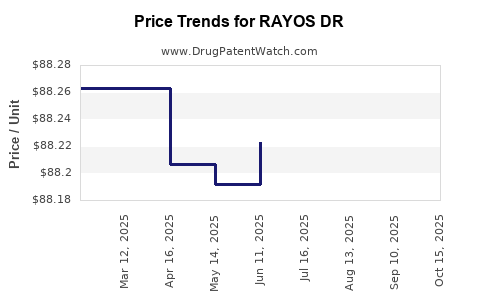
Average Pharmacy Cost for RAYOS DR
| Drug Name | NDC | Price/Unit ($) | Unit | Date |
|---|---|---|---|---|
| RAYOS DR 5 MG TABLET | 75987-0022-01 | 88.13058 | EACH | 2025-10-22 |
| RAYOS DR 2 MG TABLET | 75987-0021-01 | 88.28708 | EACH | 2025-09-17 |
| RAYOS DR 5 MG TABLET | 75987-0022-01 | 88.21873 | EACH | 2025-09-17 |
| RAYOS DR 2 MG TABLET | 75987-0021-01 | 88.23785 | EACH | 2025-08-20 |
| >Drug Name | >NDC | >Price/Unit ($) | >Unit | >Date |
RAYOS DR Market Analysis and Price Projections
How is the current market landscape structured for RAYOS DR?
RAYOS DR (prednisone delayed-release) is a corticosteroid indicated for conditions such as rheumatoid arthritis, inflammatory diseases, and specific types of allergic reactions. It competes primarily within the corticosteroid and long-acting glucocorticoid market segments.
Key market players include Teva Pharmaceuticals, Pfizer, and Mylan, with Teva holding the majority share due to the product's established distribution and generic availability. The drug's patent expiration occurred in late 2022, leading to increased generic competition.
The global corticosteroids market was valued at approximately USD 10 billion in 2022. RAYOS DR represents a niche within this, with estimated sales of USD 200–250 million in North America and Europe, as of 2022.
Market drivers include the demand for long-acting corticosteroids, the convenience of delayed-release formulations, and increasing prevalence of autoimmune diseases in aging populations. Constraints involve price sensitivity, generics entry, and pharmacy reimbursement policies.
What are current pricing and reimbursement trends?
In the U.S., RAYOS DR's list price is approximately USD 600 per month for a standard dosage. Reimbursement varies across insurance providers, with out-of-pocket costs typically USD 20–50 monthly due to pharmacy benefit management agreements.
In Europe, list prices differ significantly by country. In the UK, the drug retails at approximately GBP 400 per month, with NHS reimbursement policies applying. Price regulation is more aggressive in European markets, often leading to discounts of 10–20% off list prices.
The availability of generics post-patent expiry has resulted in a price reduction by approximately 30–40% in the U.S. and Europe, with generic prednisone tablets retailing for USD 10–15 per month.
How do upcoming patent expiries and biosimilar entries influence future prices?
The primary patent for RAYOS DR expired in 2022. This resulted in a rapid decline in brand-name sales and the expansion of generic options.
No biosimilar options exist for RAYOS DR, as it is a small-molecule corticosteroid. Future price points will depend on market penetration of generics and the negotiation strategies employed by payers.
Projected price reductions over the next 2–3 years include a 20–30% decrease in the retail price of RAYOS DR in North America, influenced by generic market competition and volume increases.
What are the regulatory and policy factors shaping the market?
Regulatory bodies like the FDA and EMA approve generics based on bioequivalence, leading to increased competition post-patent expiry. Policy trends favor generic substitution to contain healthcare costs, facilitating market penetration.
Price controls in European countries, such as the Netherlands and Germany, restrict the maximum reimbursable prices. The U.S. market relies on private negotiations and Medicaid policies, which may impose additional discounts.
Incentives for generic manufacturers include expedited approval pathways and potential exclusivity periods in certain jurisdictions.
What are the future growth and price projection scenarios?
Market forecasts suggest the corticosteroid segment for chronic inflammatory conditions will grow at a compound annual growth rate (CAGR) of 2–3% through 2027, driven by rising autoimmune disease prevalence.
For RAYOS DR, post-patent-expiry sales are expected to decline by 15–25% annually due to generic entry but may stabilize due to formulary preferences favoring long-acting formulations.
Average retail prices are projected to decrease 20–30% over the next 2 years, with wholesale prices declining by 25–35%. Specialty pharmacies may continue to command higher margins due to patient support programs.
In the medium term, price erosion dynamics will favor generics, but the brand may sustain a niche for specific formulations and deferred-release advantages, especially in markets with less aggressive price regulation.
Key Takeaways
- RAYOS DR’s market is constrained by generic competition since patent expiry in 2022, leading to significant price erosion.
- Current list prices range USD 600/month in the U.S., with discounts and reimbursement strategies influencing net prices.
- In Europe, prices are subject to regulatory controls, often resulting in discounts of 10–20%.
- The absence of biosimilar options limits the dynamics to small-molecule generics.
- Future price reductions are expected to reach 20–30% over the next two years, stabilizing sales volumes but reducing profit margins.
FAQs
-
What factors influence RAYOS DR’s pricing in different regions?
Pricing depends on patent status, regulatory policies, reimbursement frameworks, and market competition. European price controls lead to lower prices compared to the U.S. -
Will RAYOS DR remain profitable for manufacturers after patent expiry?
Profitability diminishes due to generic competition, but niche formulations or patient preference for delayed-release may sustain some market share. -
Are biosimilars relevant for RAYOS DR?
No, biosimilars are not applicable as RAYOS DR is a small-molecule corticosteroid. -
How do reimbursement policies impact net prices?
Policies that favor generics or require formulary discounts reduce net prices paid by payers, impacting manufacturer revenues. -
What is the forecast for RAYOS DR’s market share in the next five years?
Market share may decline 10–15% annually, stabilizing as generic options become dominant, especially in price-sensitive markets.
References
[1] MarketWatch. (2022). Corticosteroids Market Size and Trends.
[2] IQVIA. (2022). U.S. Market Data on Corticosteroids.
[3] European Medicines Agency. (2022). Price regulation policies.
[4] US Food and Drug Administration. (2022). Bioequivalence and generics approval guidelines.
More… ↓
