Share This Page
Drug Price Trends for RALOXIFENE HCL
✉ Email this page to a colleague
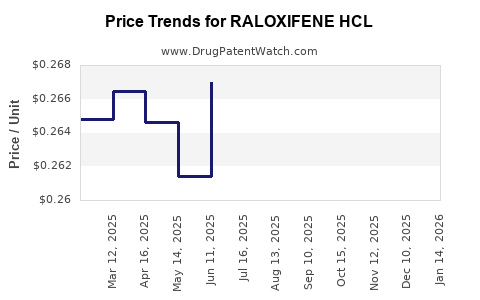
Average Pharmacy Cost for RALOXIFENE HCL
| Drug Name | NDC | Price/Unit ($) | Unit | Date |
|---|---|---|---|---|
| RALOXIFENE HCL 60 MG TABLET | 00904-6902-04 | 0.24848 | EACH | 2026-03-18 |
| RALOXIFENE HCL 60 MG TABLET | 00093-7290-56 | 0.24848 | EACH | 2026-03-18 |
| RALOXIFENE HCL 60 MG TABLET | 76282-0256-30 | 0.24848 | EACH | 2026-03-18 |
| >Drug Name | >NDC | >Price/Unit ($) | >Unit | >Date |

Market Analysis and Price Projections for RALOXIFENE HCL
Overview of Raloxifene HCl
Raloxifene HCl is a selective estrogen receptor modulator (SERM) approved primarily for osteoporosis prevention in postmenopausal women and for reducing invasive breast cancer risk. It is marketed under brands such as Evista by Lilly, alongside generic formulations. The drug's patent expired in many markets by 2017-2018, prompting a shift toward generic competition.
Current Market Landscape
Market Size and Key Players
- In 2022, the global raloxifene market was estimated at approximately USD 380 million, projected to grow at a compound annual growth rate (CAGR) of 4% through 2030.
- The United States accounts for roughly 45% of the global market, followed by Europe (25%) and Asia-Pacific (20%). Other regions hold the remaining share.
- Lilly’s Evista maintains a dominant market position in the U.S., with generics capturing increasing market share since patent expiry.
Pricing Dynamics
- Brand-name Evista: Average wholesale price around USD 3.00 per tablet.
- Generic versions: Price ranges from USD 0.50 to USD 1.20 per tablet, depending on packaging and manufacturer.
- Treatment course (60 mg daily for 3–5 years): Around USD 540–900 for brand; USD 90–200 for generics.
Market Drivers
- Growing awareness of osteoporosis and breast cancer prevention.
- Increased prescription in postmenopausal populations.
- Rising healthcare expenditure and aging demographics.
Market Challenges
- Competition from alternative therapies, including bisphosphonates and aromatase inhibitors.
- Regulatory barriers in emerging markets.
- Concerns over thromboembolic side effects limiting prescription rates.
Price Projections and Future Trends
Price Trends Over the Next Five Years (2023–2028)
| Year | Estimated Average Price per Tablet | Notes |
|---|---|---|
| 2023 | $0.75 (generics) | Stable with minor fluctuations due to competitive pressures. |
| 2024 | $0.70–$0.80 | Slight decrease expected as generics continue market penetration. |
| 2025 | $0.65–$0.75 | Pricing stabilization as generic supply stabilizes. |
| 2026 | $0.60–$0.70 | Entry of new generic players could exert further downward pressure. |
| 2027 | $0.55–$0.65 | Market saturation likely; average prices continue to decline gradually. |
| 2028 | $0.50–$0.60 | Potential for further reductions with additional generics and biosimilars. |
Factors Impacting Price Trends
- Patent Status: The expiration of key patents allows more generics to enter the market, driving prices downward.
- Regulatory Changes: Accelerated approval pathways and price regulation policies, especially in Europe and Asia, could influence pricing.
- Manufacturing Innovation: Improved cost efficiencies with biosimilar or alternative production methods can further reduce prices.
- Market Demand: Aging populations and increasing prevalence of osteoporosis will sustain or slightly increase overall sales volume.
Regulatory and Patent Landscape
- The original patent exclusivity for Evista expired in the U.S. in 2017, with subsequent patent challenges and generic approvals following.
- The European Medicines Agency approved generic raloxifene in 2018.
- Patent protection in some emerging markets extends until 2025–2027, delaying generic entry in these regions.
Strategic Considerations
- Companies manufacturing generics should focus on cost-efficient production to maximize margins as prices decline.
- R&D efforts into combination therapies or new formulations could create differentiation and sustain revenue.
- Market entry strategies in emerging markets depend heavily on patent status and regulatory pathways.
Key Takeaways
- The global raloxifene market is consolidating around generic suppliers following patent expirations.
- Prices are expected to decline gradually, from an average of USD 0.75 per tablet in 2023 to approximately USD 0.50–USD 0.60 by 2028.
- The U.S. remains the largest market, with continued generic penetration.
- Pricing in emerging markets may vary due to regulatory and patent protections.
- Future growth depends on demographic trends and competition from alternative osteoporosis and breast cancer therapies.
FAQs
1. How does patent expiration affect raloxifene pricing?
Patent expiration allows generic manufacturers to enter the market, increasing supply and reducing prices.
2. What are the main competitors to raloxifene in osteoporosis treatment?
Bisphosphonates (e.g., alendronate, risedronate) and aromatase inhibitors (for breast cancer prevention) are primary alternatives.
3. How has the market for raloxifene changed post-patent expiry?
Market share shifted from the brand to generics, leading to significant price reductions and increased accessibility.
4. What regulatory challenges could influence future pricing?
Patent litigations, approval delays, and price controls in different regions can impact prices.
5. Are biosimilars or new formulations expected for raloxifene?
Currently, biosimilars are not in development due to raloxifene’s chemical nature, but reformulations or combination drugs could emerge.
Sources:
- Industry reports, 2022
- FDA and EMA approval records
- Market research firms (IQVIA, GlobalData)
- Patent databases and legal filings
More… ↓
