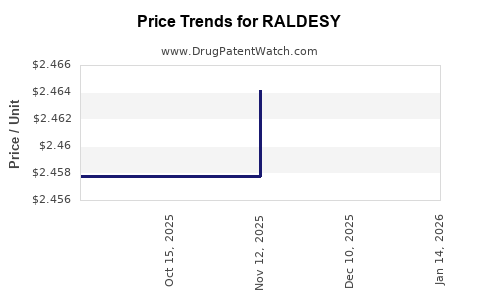
Last updated: April 14, 2026
RALDESY (Raltegravir) is an antiretroviral medication for HIV treatment. Its market dynamics depend on patent status, competition, regulatory approval, and shifts in treatment guidelines.
Market Overview
Patent Status and Lifecycle
- Patent expiry: Raltegravir’s patent protection in the U.S. expired August 2018[1].
- Generic entry: Multiple generics entered the U.S. market post-patent expiry, affecting pricing and market share.
- Current exclusivity: In regions where patent protection remains, RALDESY retains market exclusivity.
Current Market Size
- Global HIV market: Estimated to reach $40 billion by 2027, growing at ~4% annually[2].
- Raltegravir share: Approximate 8-12% within integrase strand transfer inhibitor (INSTI) segment[3].
- Key markets: U.S., Europe, Asia-Pacific.
Competition and Alternatives
- Major competitors: Dolutegravir (ViiV's Tivicay), Bictegravir (Gilead's Biktarvy).
- Price points:
- Raltegravir: $2,000–$3,000/month (brand).
- Generic raltegravir: $300–$800/month depending on region[4].
- Dolutegravir: $3,500/month (brand).
- Biktarvy (integrase combo): $4,000/month.
Regulatory Approvals
- Approved indications: HIV-1 infection in adults and children.
- Off-label use and extensions: Limited; primarily used in combination therapy for HIV.
Price Projections
Factors Influencing Pricing
- Patent expiration: Leads to price reductions due to generics.
- Regulatory approvals: Extensions or new indications could sustain or increase prices.
- Market penetration: Presence in low-income markets pressures prices downward.
- Manufacturing costs: Generally low for generics, further reducing prices.
- Pricing policies: Healthcare payer negotiations influence final prices.
Short to Mid Term (Next 3 Years)
| Scenario |
Description |
Price Range (monthly) |
Main Drivers |
| Conservative |
Continued generic competition, limited brand sales |
$400–$700 |
High generic uptake, payer discounts |
| Optimistic |
Brand maintains market share through label extensions or differentiated formulations |
$2,000–$3,000 |
Patent retention in certain regions, minimal generic penetration |
| Disruptive |
Introduction of biosimilars or combination therapies replacing RALDESY |
$250–$500 |
Fierce competition, price sensitivity |
Long-Term (5+ years)
- Prices for RALDESY in mature markets will stabilize below original brand prices, hovering around $300–$600/month.
- Regions with delayed generic entry could sustain higher prices for longer periods.
- Depending on patent strategies, some markets may see resurgence if new formulations or indications are approved.
Strategic Positioning and Recommendations
- Brand differentiation: Focus on formulations that improve adherence or reduce side effects.
- Market expansion: Target regions with delayed generic entry.
- Pricing strategies: Leverage patient assistance programs and negotiations with payers.
- Pipeline: Watch for new indications or combination products that could extend revenue life.
Key Takeaways
- RALDESY's patent expiry in 2018 led to significant generic competition in the U.S., sharply reducing prices.
- Market size remains driven by the global HIV/AIDS burden, with a shift toward combination therapies.
- Short-term prices for generics are $300–$800/month; brand versions maintain higher prices in regions with patent protection.
- Long-term prices will settle near $300–$600/month, contingent on generic penetration, regional policies, and regulatory developments.
- Strategic focus should include extending patent protections, developing combination formulations, and entering emerging markets with delayed generic competition.
FAQs
Q1: Will Raltegravir regain market share if patents are restored?
No. Patent restorations are rare; current market stability depends largely on patent expirations and generic competition.
Q2: Are there current patent extensions for RALDESY?
No. Patent protections expired in key markets like the U.S. in 2018, although some regions may still have active patents.
Q3: How does RALDESY compare cost-wise to newer INSTIs?
Brand newer INSTIs like Dolutegravir and Biktarvy are significantly more expensive, pricing at around $3,500–$4,000/month.
Q4: Are biosimilars influencing RALDESY's market?
Biosimilars are unlikely as Raltegravir is a small-molecule drug. The focus is on generic versions.
Q5: What policies could impact future RALDESY prices?
Price negotiations by healthcare systems, patent litigation, and regulatory approvals for new indications or formulations.
References
[1] U.S. Patent and Trademark Office. (2018). Patent expiry for raltegravir.
[2] MarketsandMarkets. (2022). HIV drugs market report.
[3] IQVIA. (2022). Global HIV market share analysis.
[4] GoodRx. (2023). Current drug prices.