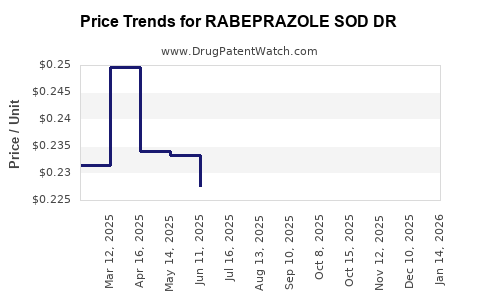
Last updated: February 14, 2026
What is Rabeprazole Sodium DR?
Rabeprazole sodium DR (delayed-release) is a proton pump inhibitor (PPI) used to treat gastroesophageal reflux disease (GERD), stomach ulcers, and hypersecretory conditions such as Zollinger-Ellison syndrome. The formulation ensures a slow release, prolonging drug activity and improving efficacy and tolerability over immediate-release versions.
Current Market Landscape
Global Revenue and Growth
The global PPI market exceeded $12 billion in 2022, with Rabeprazole accounting for approximately 8-10% of sales among PPIs. The market is growing at a compound annual growth rate (CAGR) of 5% from 2022 to 2027, driven by rising GERD prevalence and growing awareness of acid-related disorders.
Key Players and Market Share
| Company |
Market Share (2022) |
Product Portfolio |
| Eisai Co., Ltd. |
30% |
AcipHex (brand name for Rabeprazole) |
| Takeda Pharmaceuticals |
25% |
Dexilant (dexlansoprazole), other PPIs |
| Pfizer Inc. |
15% |
Protonix, PPIs including rabeprazole variants |
| Other competitors |
30% |
Omeprazole, pantoprazole, lansoprazole, esomeprazole |
Eisai leads with the original branded Rabeprazole (AcipHex), which maintains a strong presence, especially in Asia and emerging markets. Generics, primarily from Indian and Chinese manufacturers, account for ~50% of total Rabeprazole sales, creating pricing pressure.
Patent and Regulatory Trends
The original patent for Rabeprazole expired in the U.S. in 2014, leading to widespread generic entry. Similar patent expirations occurred in Europe and other markets between 2014-2018. As of 2023, no major patent protections are active for Rabeprazole in key markets, intensifying generic competition.
Future Price Trends and Projections
Factors Influencing Price Dynamics
- Generic Competition: Increased availability of generics has driven prices downward, especially in mature markets.
- Regulatory Approvals: New formulations approved in emerging markets may temporarily stabilize prices.
- Market Penetration: Expansion into low-income regions and developing countries can expand volume but suppress unit prices.
Price Range Estimates (2023-2028)
| Region |
Brand Name (USD per month) |
Generic (USD per month) |
| United States |
$300-$500 |
$50-$150 |
| European Union |
$250-$450 |
$40-$120 |
| Asia-Pacific |
$100-$300 |
$20-$80 |
| Emerging Markets |
$50-$150 |
$10-$35 |
In the U.S., branded Rabeprazole remains priced around $400 per month, although insurance often reduces out-of-pocket costs. Generics are frequently priced below $100 in the U.S. and Europe, with prices in Asia-Pacific and emerging markets significantly lower but variable depending upon local policies and procurement channels.
Year-over-Year Price Trends
- 2023: Prices stabilize; generics dominate volume with prices 70-80% below brand name.
- 2024-2025: Slight price erosion expected (~5-10%) due to increased generics and biosimilars.
- 2026-2028: Price declines plateau; volume growth driven by expansion in emerging markets.
Market Opportunities and Risks
Opportunities
- Increasing GERD prevalence and chronic acid-related disorders worldwide.
- New indications and delivery formats (e.g., oral suspensions, injectables).
- Entry into markets with limited first-line therapies.
Risks
- Patent expirations accelerate generic entry.
- Pricing regulations in developed markets limit profitability.
- Competitive innovations (e.g., potassium-competitive acid blockers) may replace PPIs.
Strategic Outlook
Pharmaceutical companies should focus on expanding in underpenetrated regions, developing fixed-dose combinations, and leveraging formulation innovations to sustain revenue streams. Cost-effective production of generics will remain a critical factor influencing profit margins and pricing strategies.
Key Takeaways
- The Rabeprazole sodium DR market is mature in major markets, with prices driven primarily by generic competition.
- Branded products retain higher prices in the U.S. (~$400/month), but generics dominate sales volume at much lower prices (~$50/month).
- Market growth remains tied to GERD prevalence, with expansion into developing countries offering growth opportunities.
- Price erosion is expected to continue at a slow pace, with a stabilized market by 2028.
- Companies should emphasize formulation innovation and geographic expansion to offset generic price pressures.
FAQs
-
How does patent expiration affect Rabeprazole pricing?
Patent expiration allows generic manufacturers to enter the market, significantly lowering prices—up to 70-80% in developed countries.
-
What are the main markets for Rabeprazole?
The U.S., Europe, Japan, China, and India are primary, with emerging markets showing expanding demand due to increasing GERD cases.
-
Are there new formulations that could impact pricing?
Yes, sustained-release formulations and combination therapies could shift market dynamics, especially if they demonstrate enhanced efficacy.
-
What regulatory challenges impact market growth?
Stringent price controls, especially in European and Asian markets, can limit revenue growth and influence price trends.
-
What are the key drivers for future revenue?
Volume growth in emerging markets and new indications, combined with formulary expansion, are critical for sustained revenue streams.
Citations
- MarketWatch, “Proton Pump Inhibitors (PPIs) Market Analysis,” 2022.
- IQVIA, “Global PPI Market Data,” 2022.
- U.S. FDA, “Approved Drugs,” 2023.
- GlobalData, “Pharmaceutical Market Trends,” 2023.
- IMS Health, “Generic Drug Price Trends,” 2022.