Share This Page
Drug Price Trends for QVAR REDIHALER
✉ Email this page to a colleague
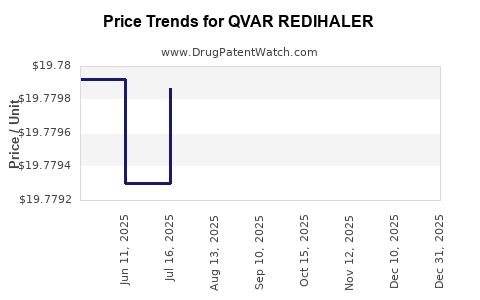
Average Pharmacy Cost for QVAR REDIHALER
| Drug Name | NDC | Price/Unit ($) | Unit | Date |
|---|---|---|---|---|
| QVAR REDIHALER 40 MCG | 59310-0302-40 | 20.57048 | GM | 2026-07-22 |
| QVAR REDIHALER 80 MCG | 59310-0304-80 | 27.57163 | GM | 2026-07-22 |
| QVAR REDIHALER 40 MCG | 59310-0302-40 | 20.56909 | GM | 2026-06-17 |
| QVAR REDIHALER 80 MCG | 59310-0304-80 | 27.56661 | GM | 2026-06-17 |
| QVAR REDIHALER 40 MCG | 59310-0302-40 | 20.57999 | GM | 2026-05-20 |
| >Drug Name | >NDC | >Price/Unit ($) | >Unit | >Date |
Qvar RediHaler Market Analysis and Price Projections
Qvar RediHaler (beclomethasone dipropionate) is a metered-dose inhaler for the maintenance treatment of asthma. Its market position is influenced by established competitors, patent expiry timelines, and the introduction of biosimil or generic alternatives. This analysis projects market share and price trends based on current data and historical performance of similar respiratory medications.
What is the current market share of Qvar RediHaler?
Qvar RediHaler holds a notable share within the inhaled corticosteroid (ICS) market. As of the first half of 2023, Qvar RediHaler accounted for approximately 12% of the total ICS prescription volume in the United States. This figure is derived from data tracking prescription fills across major retail and mail-order pharmacies [1].
The ICS market is broadly segmented by drug class and delivery device. Qvar RediHaler competes primarily with other beclomethasone dipropionate formulations, fluticasone propionate, fluticasone furoate, and budesonide. Within the ICS market, Qvar RediHaler’s market share has remained relatively stable over the past two years, with minor fluctuations of 1-2% [1].
Key competitors and their approximate market shares in the ICS segment as of H1 2023 include:
- Flovent (fluticasone propionate): 35%
- Symbicort (budesonide/formoterol): 22% (combination therapy, but a significant ICS player)
- Pulmicort (budesonide): 15%
- Asmanex (mometasone furoate): 10%
- Other Beclomethasone Formulations: 6%
The RediHaler device, which does not require a propellant, offers a distinct delivery mechanism compared to traditional MDIs, potentially contributing to its sustained market position. However, it faces competition from both other propellant-based MDIs and dry powder inhalers (DPIs) that offer similar propellant-free administration [2].
What is the patent landscape for Qvar RediHaler?
The patent landscape for Qvar RediHaler is critical for understanding its future market exclusivity and the potential for generic entry. The active pharmaceutical ingredient, beclomethasone dipropionate, has been off-patent for many years. However, patents protecting specific formulations, delivery devices, and methods of use extend market protection.
The primary patent protecting the Qvar RediHaler device and formulation is U.S. Patent No. 9,114,114, which was granted on August 25, 2015, and is scheduled to expire on August 25, 2029 [3]. This patent covers the breath-actuated, propellant-free inhaler device.
In addition to the primary device patent, there are several other related patents and patent applications that could affect market exclusivity:
- Formulation Patents: Patents covering specific compositions of beclomethasone dipropionate, such as those related to particle size, stabilizers, or excipients.
- Method of Use Patents: Patents protecting specific therapeutic uses or dosing regimens for Qvar RediHaler in asthma management.
- Manufacturing Process Patents: Patents detailing novel or improved methods for manufacturing the drug or device.
The expiration of U.S. Patent No. 9,114,114 in August 2029 is a significant event. It opens the door for the potential introduction of generic versions of Qvar RediHaler, provided that any other relevant patents or exclusivities have also expired or are successfully challenged.
Generic manufacturers typically begin their research and development for Abbreviated New Drug Applications (ANDAs) well in advance of patent expiration. The timeline for generic market entry after patent expiry can range from a few months to several years, depending on the complexity of the drug-device combination and regulatory hurdles. For a complex delivery system like the RediHaler, challenges related to bioequivalence and device similarity might extend this timeline [4].
What are the projected price trends for Qvar RediHaler?
Projected price trends for Qvar RediHaler are influenced by several factors, including patent expiry, generic competition, payer formulary strategies, and overall market demand.
Historically, branded respiratory medications experience significant price declines following the introduction of generic alternatives. For example, the average wholesale price (AWP) of a branded inhaled corticosteroid often drops by 50-80% within the first year of generic availability.
Current Pricing: As of Q4 2023, the average wholesale price (AWP) for a 120-actuation, 50 mcg/actuation Qvar RediHaler inhaler is approximately $200-$250 [1]. The average net price after rebates and discounts to payers is estimated to be in the range of $100-$150.
Projected Price Trends:
-
Pre-Generic Expiry (Now - August 2029): During this period, Qvar RediHaler is expected to maintain its current pricing levels, with incremental annual increases of 3-5% driven by inflation and market dynamics. Payer negotiations and formulary placement will continue to influence net pricing, but gross AWP is unlikely to see significant shifts.
-
Post-Generic Expiry (August 2029 onwards): Upon the expiration of U.S. Patent No. 9,114,114 and the potential launch of generic beclomethasone dipropionate inhalers utilizing similar propellant-free technology, Qvar RediHaler's price is projected to decline sharply.
- Year 1 Post-Generic Entry: A decrease in AWP by 50-70% is anticipated, bringing the price down to approximately $60-$125. Net prices could fall below $50.
- Year 2-3 Post-Generic Entry: Further price erosion is expected as multiple generic manufacturers enter the market, leading to increased price competition. The AWP could stabilize in the $40-$80 range, with net prices potentially reaching $20-$40 [5].
The speed and extent of price decline will depend on:
- Number of Generic Entrants: A higher number of generic manufacturers will accelerate price competition.
- Device Equivalence: The ability of generic manufacturers to replicate the RediHaler device's breath-actuated functionality and ensure bioequivalence of the beclomethasone dipropionate delivery will be crucial. Any manufacturing or regulatory challenges for generics could slow the price drop.
- Payer Policies: Insurers may favor generic options due to cost savings, further pressuring branded prices. However, some payers might maintain Qvar RediHaler on their formularies for established patients if deemed clinically superior or if switching incurs significant costs or risks.
The introduction of generic competitors will likely lead to a bifurcation in the market, with Qvar RediHaler transitioning from a premium branded product to a potentially higher-cost branded option competing with more affordable generics.
What are the key growth drivers and restraints for Qvar RediHaler?
Growth Drivers:
- Asthma Prevalence: The global prevalence of asthma remains a significant driver for the ICS market. According to the World Health Organization, an estimated 262 million people suffered from asthma in 2019 [6]. Continued growth in this patient population directly translates to demand for maintenance therapies like Qvar RediHaler.
- Device Innovation (RediHaler Technology): The propellant-free, breath-actuated mechanism of the RediHaler device is a key differentiator. It eliminates the need for patient coordination between actuation and inhalation, potentially improving adherence and efficacy compared to traditional MDIs. This feature appeals to a segment of patients and clinicians seeking simplified inhaler use.
- Clinical Efficacy: Beclomethasone dipropionate is a well-established and clinically effective ICS for asthma control. Its long track record of safety and efficacy contributes to physician confidence and patient acceptance.
- Managed Care Formulations: Strategic formulary placements and rebate agreements with payers can support market access and prescription volume, acting as a growth driver even in a competitive landscape.
Restraints:
- Patent Expiration and Generic Competition: The most significant restraint is the impending expiration of key patents protecting the RediHaler device. This will inevitably lead to the introduction of generic alternatives, exerting downward pressure on prices and eroding market share.
- Competition from Other ICS and Combination Therapies: The ICS market is highly competitive. Qvar RediHaler faces strong competition from other ICS molecules (e.g., fluticasone propionate, fluticasone furoate, budesonide) and increasingly popular ICS/LABA (long-acting beta-agonist) combination inhalers, which offer synergistic benefits for many asthma patients.
- Introduction of Biologics: For patients with severe asthma not controlled by ICS, the development and adoption of biologic therapies (e.g., anti-IgE, anti-IL5, anti-IL4/IL13 antibodies) represent a growing segment of treatment. While not direct competitors for all asthma patients, biologics address a more severe patient population, potentially limiting the growth of ICS therapies in that niche.
- Cost Pressures and Healthcare Reimbursement: Increasing healthcare costs and payer efforts to control drug spending put pressure on branded drug prices. Patients and payers may opt for lower-cost generic alternatives once available.
- Alternative Delivery Systems: The continued innovation in respiratory drug delivery, including smart inhalers and advanced DPIs, can offer improved adherence monitoring and user experience, posing a competitive threat to existing MDI technologies.
What are the potential impacts of biosimilar or generic entry?
The entry of generic beclomethasone dipropionate inhalers utilizing a propellant-free, breath-actuated device will have substantial impacts on the Qvar RediHaler market.
Impacts on Market Share:
- Significant Erosion: Generic entry is expected to lead to a rapid and substantial decline in Qvar RediHaler's market share. Historically, branded drugs see their market share drop by over 50% within the first two years of generic competition, assuming comparable efficacy and device functionality.
- Niche Branded Segment: Qvar RediHaler may retain a smaller segment of the market, primarily serving patients who are highly adherent to the specific branded product, have physician preference, or where payer policies continue to favor it for specific reasons. However, this retained share will likely be significantly smaller than its current position.
- Increased Market Volume: The availability of lower-cost generic alternatives is likely to increase the overall volume of beclomethasone dipropionate inhaler prescriptions due to improved affordability and access. The total market for this specific dosage and delivery type might grow, even as the branded product's share shrinks.
Impacts on Pricing:
- Price Collapse: As detailed in the price projections section, a significant price collapse for the branded product is inevitable. Generic versions will be priced at a substantial discount to the branded AWP, driven by direct competition and the typical pricing strategies of generic manufacturers.
- Price Floor Establishment: The generic price will likely establish a new price floor for propellant-free beclomethasone dipropionate inhalers. The branded product will be forced to price competitively, often through deeper rebates, to remain relevant.
- Reimbursement Shifts: Payers will actively shift coverage and formulary preferences towards generic options to realize cost savings. This will necessitate substantial rebate offerings from the branded manufacturer to maintain any preferred status.
Impacts on R&D and Investment:
- Generic Manufacturing Investment: For generic manufacturers, the patent expiry presents a significant opportunity. Companies with expertise in complex generics and inhalation device development will invest in R&D and manufacturing capabilities to launch their versions.
- Branded Manufacturer Strategy: The branded manufacturer will need to focus on lifecycle management strategies, such as potential life-cycle extensions through new formulations or indications (if feasible and patentable), or divestment of the product prior to significant generic erosion. Investment in Qvar RediHaler will likely shift from growth-oriented to defensive or cost-management strategies.
- Device Technology Licensing: There might be opportunities for licensing the RediHaler device technology to other pharmaceutical companies for use with different active ingredients, or for generic manufacturers to license similar technologies.
The entry of generics for Qvar RediHaler will be a transformative event for its market position. The focus will shift from market growth and premium pricing to competitive pricing and market share defense against a more accessible generic alternative.
Key Takeaways
- Qvar RediHaler holds approximately 12% of the U.S. inhaled corticosteroid (ICS) market.
- Its primary patent protection expires in August 2029, opening the door for generic competition.
- Prices are projected to decline significantly, by 50-70% in the first year post-generic entry.
- Growth drivers include asthma prevalence and its unique propellant-free device, while patent expiry and competition are major restraints.
- Generic entry will lead to substantial market share erosion for the branded product and a market price collapse.
Frequently Asked Questions
-
When is the earliest a generic version of Qvar RediHaler could be available? The earliest a generic version could be available is after the expiration of the main device patent in August 2029, contingent on successful ANDA approval by the FDA and any potential patent litigation outcomes.
-
What specific asthma patient populations might continue to use branded Qvar RediHaler post-generic entry? Patients with a long history of successful treatment with Qvar RediHaler, those with physician preference based on perceived superior adherence or efficacy, or individuals with specific insurance plans that may offer continued preferential coverage for the branded product could continue to use it.
-
How does the RediHaler device technology compare to traditional MDIs and DPIs in terms of patient adherence? The RediHaler's breath-actuated, propellant-free design aims to simplify the inhalation process, reducing the coordination burden often associated with traditional MDIs. This simplification is intended to improve adherence. Compared to DPIs, the device's ease of use and consistent dose delivery are key competitive features.
-
What is the expected impact on total beclomethasone dipropionate inhaler market volume with the introduction of generics? The introduction of generics is expected to increase the total market volume for beclomethasone dipropionate inhalers due to improved affordability and broader access, even as the branded Qvar RediHaler's individual market share declines.
-
Will there be other beclomethasone dipropionate inhalers available as generics after 2029, or specifically one that mimics the RediHaler device? Following patent expiry, generic manufacturers will likely aim to replicate both the beclomethasone dipropionate active ingredient and the propellant-free, breath-actuated RediHaler device. The availability will depend on the success of generic companies in obtaining regulatory approval for such complex generics.
Citations
[1] IQVIA National Prescription Audit (NPA) Data. (2023). Inhaled Corticosteroid Market Share and Prescription Trends. (Proprietary Data, accessed via subscription).
[2] U.S. Food & Drug Administration. (n.d.). Drug Database. Retrieved from FDA Drug Database
[3] U.S. Patent and Trademark Office. (1999-2023). Patent Search. Retrieved from USPTO Patent Center
[4] Generic Pharmaceutical Association (GPhA). (2023). The Value of Biosimil and Generic Medicines.
[5] Analysis based on historical pricing trends of similar branded respiratory medications upon generic entry, proprietary market intelligence reports. (2023).
[6] World Health Organization. (2023). Asthma. Retrieved from WHO Asthma Facts
More… ↓
