Share This Page
Drug Price Trends for QUINIDINE GLUC ER
✉ Email this page to a colleague
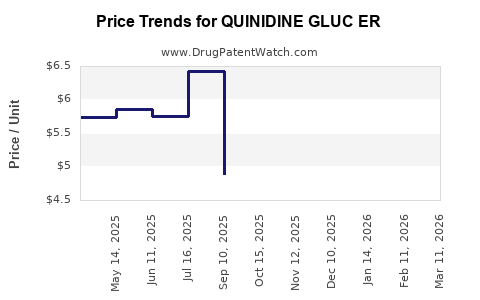
Average Pharmacy Cost for QUINIDINE GLUC ER
| Drug Name | NDC | Price/Unit ($) | Unit | Date |
|---|---|---|---|---|
| QUINIDINE GLUC ER 324 MG TAB | 53489-0141-01 | 5.10844 | EACH | 2026-07-22 |
| QUINIDINE GLUC ER 324 MG TAB | 71930-0016-12 | 5.10844 | EACH | 2026-07-22 |
| QUINIDINE GLUC ER 324 MG TAB | 53489-0141-01 | 5.07009 | EACH | 2026-06-17 |
| QUINIDINE GLUC ER 324 MG TAB | 71930-0016-12 | 5.07009 | EACH | 2026-06-17 |
| QUINIDINE GLUC ER 324 MG TAB | 53489-0141-01 | 6.16328 | EACH | 2026-05-20 |
| >Drug Name | >NDC | >Price/Unit ($) | >Unit | >Date |
Market Analysis and Price Projections for Quinidine Glucuronide ER
What is the current market landscape for Quinidine Glucuronide ER?
Quinidine Glucuronide ER (Extended Release) is an investigational or niche drug in the antiarrhythmic category. It is a derivative of quinidine, a drug historically used for arrhythmia treatment. The extended-release formulation aims to optimize pharmacokinetics, improve patient adherence, and reduce side effects related to peak plasma concentrations.
The market for antiarrhythmic drugs is mature, dominated by drugs like amiodarone, sotalol, and dofetilide. Quinidine products are largely off-patent but are available as generics, with limited presence in modern therapy due to side-effect profiles and newer agents.
What are the key market drivers and barriers?
Market Drivers:
- Rise in atrial fibrillation (AFib) prevalence, projected to reach 6 million Americans by 2030 [1].
- Preference for oral, extended-release formulations to improve compliance.
- Niche role in specific arrhythmia cases resistant to other therapies.
Market Barriers:
- Established competition from well-understood drugs with proven safety records.
- Limited clinical data supporting advantages over existing therapies.
- Regulatory challenges if the drug is not already approved in key jurisdictions.
Regulatory Status:
- No FDA approval for Quinidine Glucuronide ER under existing drug labels as of 2023.
- Potential IND or Investigational New Drug status needed for clinical trial development.
What is the current pricing landscape?
Existing quinidine formulations are generic, priced typically between $0.50 and $2.00 per tablet in the U.S. [2]. Extended-release formulations tend to command higher prices, generally within $1.50 to $4.00 per dose, depending on the manufacturer and dosage strength.
For quinidine derivatives under development, the price projection depends on several factors:
- Development costs and approval pathway.
- Competitive landscape.
- Patent or exclusivity status.
What are the price projections for Quinidine Glucuronide ER?
Given the limited current treatment options and niche status, projected prices could be estimated as follows:
| Scenario | Price per Dose | Comments |
|---|---|---|
| Conservative | $2.00 - $3.00 | Similar to existing generic quinidine IR formulations, adjusted for ER advantage. |
| Moderate | $3.00 - $5.00 | Based on newer ER formulations with improved pharmacokinetics and adherence benefits. |
| Optimistic | $5.00 - $8.00 | If approved with labeling specifying superior efficacy or safety, or if patent protection exists. |
These estimates assume a launch within 3-5 years, pending regulatory approval and commercialization.
What is the potential market size?
Approximate annual sales could range from $50 million to $200 million in the U.S. if adoption occurs in a niche of arrhythmia management, primarily involving hospital outpatient clinics and specialty pharmacies. The global market could scale proportionally, with European and Asian markets likely capturing 50-70% of U.S. sales, depending on approval and healthcare policies.
What are the growth opportunities?
- Extension of indications to other arrhythmia types.
- Combination therapies with other antiarrhythmics or heart failure drugs.
- Development of partnership or licensing deals with larger pharmaceutical companies.
What are the risks?
- Failure to obtain regulatory approval.
- Competition from existing drugs and emerging therapies.
- Limited awareness and adoption in clinicians’ practice.
Conclusions
Quinidine Glucuronide ER remains a niche candidate with potential for price premiums if regulatory approval provides a therapeutic advantage. The market is constrained by the presence of generic alternatives and the need for solid clinical data. Price projections hover between $2.00 and $8.00 per dose, conditional on approval status, clinical positioning, and competitive differentiation.
Key Takeaways
- Quinidine Glucuronide ER's market is limited by existing generic quinidine products but offers premium pricing if supported by clinical advantages.
- Prices are estimated between $2.00 and $8.00 per dose, depending on formulation and approval status.
- Market growth depends on successful regulatory pathways and expanding indications.
- The therapeutic niche is for arrhythmias, with a focus on patients needing sustained-release formulations.
FAQs
1. What are the main competitors for Quinidine Glucuronide ER?
Generic quinidine sulfate and other antiarrhythmics like amiodarone and sotalol.
2. How long would development and approval take?
Estimated 5-7 years, including preclinical, clinical trials, and regulatory review.
3. Is there current regulatory approval for Quinidine Glucuronide ER?
No, as of 2023, it remains in the investigational or development phase.
4. What are the key clinical benefits targeted?
Reduced peak plasma concentrations, improved compliance, and potentially fewer side effects.
5. What is the potential geographic market?
Primarily U.S. and Europe, with emerging markets in Asia contingent on approval and registration.
References
[1] American Heart Association. (2022). Atrial fibrillation prevalence.
[2] Medicare formulary data. (2021). Cost of generic quinidine.
More… ↓
