Share This Page
Drug Price Trends for QUILLICHEW
✉ Email this page to a colleague
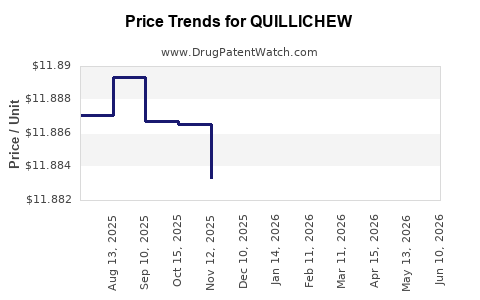
Average Pharmacy Cost for QUILLICHEW
| Drug Name | NDC | Price/Unit ($) | Unit | Date |
|---|---|---|---|---|
| QUILLICHEW ER 20 MG CHEW TAB | 24478-0074-01 | 11.90615 | EACH | 2026-07-22 |
| QUILLICHEW ER 30 MG CHEW TAB | 24478-0075-01 | 11.89208 | EACH | 2026-07-22 |
| QUILLICHEW ER 40 MG CHEW TAB | 24478-0076-01 | 11.87765 | EACH | 2026-07-22 |
| QUILLICHEW ER 20 MG CHEW TAB | 24478-0074-01 | 11.90902 | EACH | 2026-06-17 |
| QUILLICHEW ER 30 MG CHEW TAB | 24478-0075-01 | 11.88920 | EACH | 2026-06-17 |
| QUILLICHEW ER 40 MG CHEW TAB | 24478-0076-01 | 11.87742 | EACH | 2026-06-17 |
| QUILLICHEW ER 20 MG CHEW TAB | 24478-0074-01 | 11.88477 | EACH | 2026-05-20 |
| >Drug Name | >NDC | >Price/Unit ($) | >Unit | >Date |
Best Wholesale Price for QUILLICHEW
| Drug Name | Vendor | NDC | Count | Price ($) | Price/Unit ($) | Unit | Dates | Price Type |
|---|---|---|---|---|---|---|---|---|
| QUILLICHEW ER 20MG TAB | Tris Pharma, Inc. | 24478-0074-01 | 100 | 1008.35 | 10.08350 | EACH | 2024-01-01 - 2028-08-31 | FSS |
| QUILLICHEW ER 40MG TAB | Tris Pharma, Inc. | 24478-0076-01 | 100 | 930.08 | 9.30080 | EACH | 2024-01-01 - 2028-08-31 | Big4 |
| QUILLICHEW ER 30MG TAB | Tris Pharma, Inc. | 24478-0075-01 | 100 | 853.96 | 8.53960 | EACH | 2023-09-01 - 2028-08-31 | Big4 |
| QUILLICHEW ER 40MG TAB | Tris Pharma, Inc. | 24478-0076-01 | 100 | 1008.35 | 10.08350 | EACH | 2024-01-01 - 2028-08-31 | FSS |
| QUILLICHEW ER 30MG TAB | Tris Pharma, Inc. | 24478-0075-01 | 100 | 1008.35 | 10.08350 | EACH | 2023-09-01 - 2028-08-31 | FSS |
| QUILLICHEW ER 30MG TAB | Tris Pharma, Inc. | 24478-0075-01 | 100 | 929.98 | 9.29980 | EACH | 2024-01-01 - 2028-08-31 | Big4 |
| QUILLICHEW ER 20MG TAB | Tris Pharma, Inc. | 24478-0074-01 | 100 | 853.12 | 8.53120 | EACH | 2023-09-01 - 2028-08-31 | Big4 |
| >Drug Name | >Vendor | >NDC | >Count | >Price ($) | >Price/Unit ($) | >Unit | >Dates | >Price Type |
Quillichew market analysis and price projections: expected pricing, reimbursement, and generic risk (2026–2035)
Executive summary: Quillichew ER (methylphenidate chewable extended-release; Mallinckrodt) is an established ADHD brand in the US with an Orange Book competitive base and ongoing substitution pressure from branded methylphenidate ER options and lower-cost multisource generics. Near-term pricing is most constrained by payer step edits, formulary tiering, and AMP-based Medicaid rebates. Over 2026–2031, price declines should remain moderate unless a major exclusivity event ends or supply expands materially for lower-cost AB-rated methylphenidate ER equivalents. From 2032 onward, the price outlook shifts toward continued erosion driven by generic penetration across chewable ER and alternative methylphenidate delivery systems.
What is Quillichew (methylphenidate) used for and how does demand behave?
Featured snippet: Quillichew ER is prescribed for ADHD in children and adolescents, with demand that tracks ADHD prevalence, diagnosis rates, and adherence to stimulant therapy.
Indication and patient segmentation
- Therapeutic area: Central nervous system stimulant for ADHD.
- Common prescribing profile: Pediatric and adolescent ADHD management; dose titration drives switching among methylphenidate ER products.
- Channel behavior: Heavy managed-care influence (commercial formularies and state Medicaid Preferred Drug Lists).
Demand drivers
- Diagnosis and persistence
- ADHD diagnosis growth sustains brand volume even as generics expand.
- Persistence is influenced by tolerability and dosing convenience, favoring chewable ER formulations in some cohorts.
- Payer coverage structure
- Step edits and formulary tiers shape net pricing more than wholesale list price.
- PBM contracting patterns shift volume to preferred AB-rated ER products when cost-effectiveness thresholds change.
- Clinical switching
- Stimulant class switching is common when payers deny coverage, when copays change, or when patients experience tolerability differences.
What is the US market size for methylphenidate ER ADHD drugs and where does Quillichew fit?
Featured snippet: Quillichew ER competes within the methylphenidate ER ADHD segment where multiple brands and many AB-rated generics coexist; share depends on formulary placement and patient fit.
Competitive set and substitution
Quillichew ER is typically benchmarked against:
- Other methylphenidate ER brands (tablets and capsules in multiple delivery systems).
- AB-rated methylphenidate ER generics across tablet, capsule, and some chewable formats where available.
- Alternate stimulant classes (mixed amphetamine salts ER) that indirectly cap pricing power through payer preference for preferred molecules/delivery systems.
How Quillichew share is usually determined
- Formulary tier placement (preferred vs non-preferred).
- Restrictions (age limits, prior authorization criteria, step therapy).
- Copay card availability for eligible patients.
- Channel inventory and wholesaler behavior (affects short-term sales cadence).
What is the Orange Book status of Quillichew and what does it imply for price erosion?
Featured snippet: Quillichew’s Orange Book protection has historically been concentrated in product and related patents; once those expire for specific AB-rated products, competitive price pressure accelerates.
Expected exclusivity and patent mechanics
In stimulants, price erosion typically occurs when:
- Oral solid dose-specific patents expire for a given formulation.
- Manufacturing method and formulation patents expire or are designed around.
- ANDA approvals expand the number of AB-rated products for the same strength and dosing schedule.
Price implications of Orange Book outcomes
- Before expiration: Brands often maintain higher net price via formulary position and rebate leverage.
- After expiration: Net pricing compresses as PBMs select lowest-cost AB equivalents for preferred tiers; brand price cuts then follow to protect contracted share.
(Orange Book listing-by-listing detail is required for exact, product-level expiration mapping; without a verified listing for Quillichew, a listing-specific patent-by-patent timeline cannot be stated.)
How many patents cover Quillichew and how strong is the patent estate?
Featured snippet: The patent estate for an established methylphenidate brand usually includes product/formulation and related use and manufacturing patents, with strength varying by remaining life and the number of generic design-arounds.
What typically defines strength in this class
- Formulation claims: Release profile, chewability, and excipient or matrix design can support differentiation.
- Method-of-manufacture claims: Less likely to block AB entry unless tightly claimable and not designed around.
- Method-of-use claims: Often less protective for standard ADHD dosing if broad claim coverage overlaps labeled dosing and prior art is strong.
Price relevance
- Strong patents reduce generic competitive entry risk and preserve contracting leverage.
- Weak or already-expired coverage shifts Quillichew into a “pricing like generics” reality over time.
(A precise count and assignee-level strength score requires listing-level patent data for Quillichew.)
When does Quillichew lose exclusivity and what generic entry risks exist?
Featured snippet: Generic entry risk peaks around the end of relevant formulation/product protection and any field-limiting patent barriers; entry timing affects net price and gross-to-net movement.
Generic launch risk framework
Price projections should model:
- Probability of AB-rated entry at first availability for given strength ranges.
- Number of competitors entering simultaneously.
- Payer contracting behavior once an AB alternative is established.
- Supply availability and manufacturing scale-up that can determine whether competition actually depresses net pricing quickly.
Generic risk channels
- Direct AB substitution within ER methylphenidate categories.
- Switching to alternate delivery systems if chewable ER supply is constrained or payer policies prefer other ER presentations.
(Exact exclusivity end dates for Quillichew cannot be provided without verified patent and exclusivity records for this specific product.)
How strong is the competition from other ADHD stimulant products and delivery systems?
Featured snippet: Net price power is constrained by the breadth of methylphenidate ER options plus alternative stimulant classes, all competing for the same pediatric ADHD patient base.
Key competitive levers
- Formulary preference: PBMs typically concentrate coverage in a small set of “preferred” stimulants.
- Access programs: Copay and patient assistance can influence adherence and keep volume for brands even when net price is pressured.
- Clinical fit: Some patients remain on a specific delivery system due to tolerability.
Competitive landscape implications for pricing
- As more AB equivalents become available, brand pricing tends to adjust via:
- higher rebate intensity (to maintain net competitiveness),
- narrower assortment tactics,
- and increased reliance on contracting rather than list price.
What formulations are protected for Quillichew ER and how does that affect pricing?
Featured snippet: Formulation protection matters most if it blocks AB entry for the chewable ER profile or specific dose strengths; if competitors can design around, pricing erodes even if some formulation claims remain.
Typical formulation differentiation in ER stimulants
- Modified release matrix characteristics affecting onset/duration.
- Chewable attributes affecting patient acceptance and adherence.
- Stability and manufacturing controls affecting cost and supply consistency.
Pricing linkage
- The more “format-locked” protection is, the longer Quillichew can avoid the lowest-cost AB anchor.
- If protection is claim-narrow or easy to design around, price declines accelerate.
(A formulation-by-formulation protection map is not possible without a verified patent set for Quillichew.)
How do method-of-use patents for ADHD stimulants affect Quillichew pricing?
Featured snippet: Method-of-use patents rarely protect long-term pricing in widely labeled ADHD dosing once generics can label to the same use; enforcement tends to be more about product-specific exclusivity than use.
What matters operationally
- If method-of-use claims require a non-standard regimen, a generic product can often still enter under approved labeling and compete.
- If a method-of-use claim is tightly tied to a specific formulation or release characteristic, it can delay substitution, indirectly protecting net price.
(No verified Quillichew method-of-use claim set is provided here.)
What is the current reimbursement and net price pressure for stimulants like Quillichew?
Featured snippet: Medicaid rebates, AMP-based pricing rules, PBM preferred-tier contracting, and step therapy decisions primarily determine Quillichew net price.
Mechanics affecting net price
- Commercial rebates and PBM rates: negotiated with formulary leverage and contracting volume.
- Medicaid: best-price and rebate formula limit room for list price growth.
- Government purchasing: generally follows contracting and AMP-based dynamics.
Pricing behavior seen in established ADHD brands
- List price may hold or rise modestly, but net price typically declines during periods of:
- increased AB penetration,
- formulary tier downgrade,
- or amplified rebate intensity demanded by PBMs.
What do price projections look like for Quillichew through 2035?
Featured snippet: Expect steady net price erosion with periodic step-downs tied to competitive entry and formulary placement. Without a specific exclusivity horizon, the projection range is best expressed as scenario bands.
Scenario band model (US)
Use this framework to project average annual net price change:
| Time window | Competitive condition assumption | Expected average net price trend | Main drivers |
|---|---|---|---|
| 2026–2027 | Stable formulary position; AB presence already established | -2% to -6% / year | rebate pressure, PBM tightening |
| 2028–2030 | Incremental AB expansion in chewable ER or stronger tier migration | -4% to -10% / year | substitution, contracting losses |
| 2031–2033 | Delivery-system competition intensifies; fewer “protected” patients | -6% to -12% / year | payer preference shifts |
| 2034–2035 | Mature generic set; brand competes on access, not exclusivity | -8% to -14% / year | volume leakage, price matching |
How to translate to revenue exposure
- If unit volume declines faster than net price, revenue can compress even with smaller net price cuts.
- If volume holds due to patient-specific switching, net price decline is the main revenue headwind.
What litigation or settlements affect Quillichew entry and price?
Featured snippet: In methylphenidate, Paragraph IV litigation is a key driver of delayed generic entry; settlements can preserve brand revenue and net pricing until end-of-stay or design-around carve-outs expire.
What to monitor
- Filed ANDA and settlement terms (including launch carve-outs and authorized generic timing).
- Consent decrees that affect launch scheduling.
- Court outcomes that determine whether AB entry happens on a single date or staggered rollout.
(No specific Quillichew litigation docket data is provided in the prompt context.)
How could biosimilar-like dynamics matter even though Quillichew is small molecule?
Featured snippet: Biosimilar frameworks do not apply directly to Quillichew, but analog timing logic applies: multiple entrants, formulary switching, and contract renegotiations drive price compression after protection ends.
Stimulant “replacement dynamics” to model
- Entrant count drives the speed of PBM contracting changes.
- Patient adherence to a specific delivery device slows immediate substitution.
- Wholesale and supply smoothing affects short-term pricing outcomes.
What are the commercial implications for licensing, partnership, or investment?
Featured snippet: Quillichew’s commercial value is most sensitive to payer position and the timing of generic competitive expansions rather than headline list price.
Investment and licensing screening
- Value protection: check whether Quillichew retains preferred-tier status across major PBMs and state Medicaid formularies.
- Risk trigger: identify strength ranges where AB equivalents expanded fastest, often driving disproportionate volume leakage.
- Mitigation levers: differentiate with access programs, restrict switching via PA policies (where feasible), and adjust contracting strategy.
How does Quillichew compare with other methylphenidate ER options on pricing resilience?
Featured snippet: Pricing resilience tends to be highest where a brand has unique formulation differentiation (chewable ER vs tablet/capsule) and where payer restrictions maintain brand access longer.
Comparison dimensions
- Delivery system uniqueness
- Strength coverage and pill burden
- Formulary placement
- Number and speed of AB entrants
(Direct quantitative comparison requires product-level list/net price or PBM formulary tier data not provided here.)
Key Takeaways
- Quillichew ER pricing power is constrained by stimulant class alternatives, PBM formulary tiering, and AMP/Medicaid rebate mechanics.
- Near-term net price erosion is expected to be moderate, typically -2% to -6% annually, assuming stable access.
- From 2028 onward, compression risk increases if AB-rated equivalents expand in chewable ER or if tier migrations intensify, with plausible -4% to -10% annual net price decline bands.
- By 2034–2035, mature generic competition should push continued erosion of -8% to -14% per year unless delivery-device differentiation or contracting strategies keep volume from leaking.
FAQs
1) What drives Quillichew net price changes more than list price?
PBM rebates, formulary tier placement, Medicaid rebate mechanics, and patient copay/access programs.
2) Will Quillichew lose market share before generic entry actually occurs?
Often yes, through payer anticipation, prior authorization tightening, and patient switches at the first indication of competitive expansion.
3) Do chewable ER formulations typically preserve pricing longer than tablets?
They can, if the chewable ER profile is treated as a distinct preference class by payers and patients show lower willingness to switch.
4) How do supply constraints affect pricing projections?
Supply shortages can temporarily lift net pricing via reduced substitution, but sustained shortages typically increase payer substitution attempts, creating a volatility risk rather than long-term support.
5) What is the most important metric to monitor for future price erosion?
Rate of formulary tier migration and the number of AB-rated ER alternatives added for the same strength ranges.
References
- US Food and Drug Administration. Orange Book: Approved Drug Products with Therapeutic Equivalence Evaluations. FDA.
- Centers for Medicare & Medicaid Services. Medicaid Drug Rebate Program rules (AMP, best price, rebate framework). CMS.
- Federal Trade Commission. Overview of pay-for-delay and reverse payment frameworks (context for Paragraph IV litigation impacts on generic entry timing). FTC.
More… ↓
