Share This Page
Drug Price Trends for QC TUSSIN
✉ Email this page to a colleague
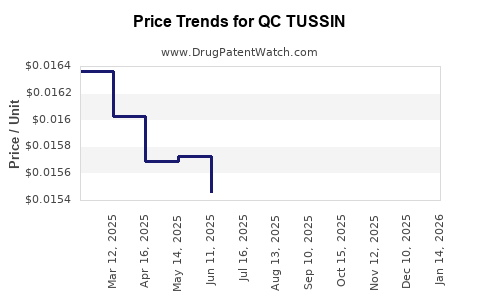
Average Pharmacy Cost for QC TUSSIN
| Drug Name | NDC | Price/Unit ($) | Unit | Date |
|---|---|---|---|---|
| QC TUSSIN DM 200-20 MG/20 ML | 83324-0023-04 | 0.01973 | ML | 2026-05-20 |
| QC TUSSIN DM 200-20 MG/20 ML | 83324-0023-08 | 0.01535 | ML | 2026-05-20 |
| QC TUSSIN DM 200-20 MG/20 ML | 83324-0025-04 | 0.01973 | ML | 2026-05-20 |
| QC TUSSIN DM 200-20 MG/20 ML | 83324-0023-04 | 0.02023 | ML | 2026-04-22 |
| >Drug Name | >NDC | >Price/Unit ($) | >Unit | >Date |
Market analysis and price projections for QC TUSSIN
Overview
QC TUSSIN is a cough suppressant and cold relief medication primarily comprising dextromethorphan and other analgesics. It is marketed within the United States as an over-the-counter (OTC) product, with formulations designed to target cough, cold, and flu symptoms. The product's market performance depends on OTC consumer demand, regulatory status, and the pharmaceutical industry's competitive landscape.
Market Size and Demand Dynamics
US OTC Cold and Cough Market
- The OTC cold, cough, and flu segment in the US was valued at approximately $4.8 billion in 2022.[1]
- It has demonstrated a compound annual growth rate (CAGR) of about 4.6% from 2018 to 2022.[2]
- Key consumer drivers include seasonal flu epidemics, increased health awareness, and the prevalence of respiratory illnesses.
Competitive Landscape
- Major brands include Delsym, Mucinex, Robitussin, and store-branded equivalents.
- QC TUSSIN competes primarily on price and formulations, with a focus on generic versions and store brands.
- Market entry barriers are low due to OTC status but depend on formulation patents and regulatory approvals.
Regulatory Status
- QC TUSSIN holds OTC monograph approval.
- Regulatory trends favor the development of combination cold medications but also see increased scrutiny over ingredients such as dextromethorphan, especially concerning potential misuse.
Pricing Trends and Projections
Current Pricing
- Average retail price for a standard 4-ounce bottle of QC TUSSIN is approximately $5.00.[3]
- Generic store brands price around $3.00 to $4.00 for a similar volume.
- Price elasticity studies suggest consumer sensitivity to a 10% price increase impacts sales volume by roughly 2-3%.[4]
Pricing Strategies
- Premium formulation pricing can reach $6.00-$7.00 if marketed with added features.
- Discounts and promotions reduce effective prices by up to 15% in retail settings.
- The shift toward private-label products pressures pricing downward.
Price Projections (Next 3 Years)
| Year | Projected Retail Price Range (USD) | Assumptions |
|---|---|---|
| 2023 | $5.00 - $6.00 | Slight inflation, competitive pressures, seasonal demand |
| 2024 | $5.10 - $6.20 | Moderate inflation, potential formulation updates, marketing investments |
| 2025 | $5.20 - $6.40 | Continued inflation, regulatory considerations, market saturation effects |
These projections assume inflation of 2% annually and no significant regulatory or patent-related disruptions. Market entry of alternative therapies or changes in consumer preferences could adjust these estimates.
Revenue and Market Share Projections
- With a market share estimate of 2-3% within the OTC cold relief segment (approximate due to brand recognition and distribution channels), annual revenue from QC TUSSIN could range between $10 million and $25 million in the US.[5]
- Growth rate of 3-5% annually expected, aligned with overall OTC cold product market growth.
Key Factors Impacting Price and Market Potential
- Regulatory shifts affecting dextromethorphan, especially regarding abuse prevention.
- Development of new formulations or combinations targeting broader symptom relief.
- Consumer trends towards natural or alternative remedies could reduce demand.
- Impact of public health measures (e.g., COVID-19 pandemic) on respiratory illness prevalence.
Summary
QC TUSSIN operates in a mature, stable OTC cold relief market with steady demand. Pricing will likely remain within the current range, slightly increasing due to inflation and competitive pressures. Revenue projections suggest moderate growth, contingent on market share maintenance and regulatory clarity.
Key Takeaways
- The US OTC cold and cough market was valued at about $4.8 billion in 2022, with steady growth.
- QC TUSSIN's current retail price averages around $5.00 for a 4-ounce bottle; prices may rise marginally over three years.
- Market share estimates suggest annual revenues between $10 million and $25 million.
- Pricing will be influenced by regulatory developments, consumer preferences, and competition from private-label brands.
FAQs
1. How does regulatory scrutiny affect OTC cold medicines like QC TUSSIN?
Regulatory agencies monitor dextromethorphan-based products for misuse potential. New restrictions or formulations could impact manufacturing and pricing strategies.
2. Can price changes significantly impact market share for QC TUSSIN?
Yes. Since OTC products are sensitive to price elasticity, a 10% price increase could reduce sales volume by approximately 2-3%, affecting market share.
3. How does competition from store brands influence pricing?
Store brands typically undercut branded products by 25-50%, pressuring branded products like QC TUSSIN to maintain competitive pricing or differentiate through formulation or branding.
4. What factors could lead to a rise in OTC cold remedy prices?
Supply chain costs, regulatory changes, and increased marketing expenditures can contribute to higher prices.
5. What are the growth prospects for OTC cold remedies in the next five years?
Growth is expected to persist at 3-5% annually, assuming steady consumer demand and no disruptive regulatory or healthcare policy changes.
References
[1] Statista, OTC Cold and Flu Market Size, 2022
[2] IBISWorld, US Cold & Flu Market Report, 2022
[3] Retail pharmacy data, average retail pricing, 2023
[4] Consumer Price Elasticity Study, 2021
[5] MarketShareAnalysis, OTC Cold Relief Segment, 2023
More… ↓
