Last updated: February 12, 2026
What is QC Triple Antibiotic Ointment?
QC Triple Antibiotic Ointment is a topical medication combining three antibiotics: bacitracin, neomycin, and polymyxin B. It is used to prevent infections in minor cuts, scrapes, and burns. The formulation aims to provide broad-spectrum coverage against common wound pathogens.
Market Overview
Market Size and Growth
The global market for topical antibiotics, including products like QC Triple Antibiotic Ointment, was valued at approximately USD 1.2 billion in 2022. It is projected to grow at a compound annual growth rate (CAGR) of 4.5% through 2030, reaching around USD 1.9 billion. Factors driving growth include increased incidence of skin injuries, rise in outpatient treatment, and rising awareness of wound care.
Key Market Players
Major competitors include:
- Johnson & Johnson (Neosporin)
- Bayer (Bactroban)
- GlaxoSmithKline (Augmentin)
- Local generic manufacturers
These brands dominate due to established distribution networks, brand recognition, and extensive clinical data.
Geographical Trends
- North America holds the largest share (>40%) due to high healthcare spending.
- Europe accounts for roughly 25%, with growth driven by aging populations.
- Asia-Pacific shows the highest CAGR (around 6%) owing to increasing healthcare infrastructure and a large population base.
Market Segmentation
- By Formulation: Ointments, creams, sprays.
- By Indication: Minor skin infections, wound care, burns.
- By Distribution Channel: Hospital pharmacies, retail pharmacies, online platforms.
Regulatory Outlook
- In the U.S., OTC classification is common, with FDA oversight.
- India and other emerging markets often categorize such ointments as over-the-counter (OTC) or pharmacy sales.
Pricing Analysis
Current Price Range
- United States: USD 3.50 to USD 7.00 per 15g tube.
- Europe: EUR 4.00 to EUR 8.00 per 15g tube.
- India: INR 50 to INR 150 (approximately USD 0.70 to USD 2.00) per 15g tube.
Competitive Factors
Pricing varies due to brand recognition and formulation variations:
| Feature |
Branded (e.g., Neosporin) |
Generic equivalents |
| Price Range (USD) |
3.50 – 7.00 |
1.50 – 4.00 |
| Market Share |
70-80% |
20-30% |
| Brand Premium |
50-100% over generics |
Lower |
Pricing Trends
- In developed markets, new OTC regulations or patent expirations often lead to price reductions.
- Generic competition has driven prices down by up to 50% in mature markets.
Price Projection (2023–2030)
| Year |
Estimated Price Range (USD per 15g tube) |
Key Drivers |
| 2023 |
3.50 – 7.00 |
Stable, mature market |
| 2025 |
3.25 – 6.50 |
Increase in generic market |
| 2027 |
3.00 – 6.00 |
Further patent expirations, price sensitivity |
| 2030 |
2.75 – 5.50 |
Market saturation, cost pressure |
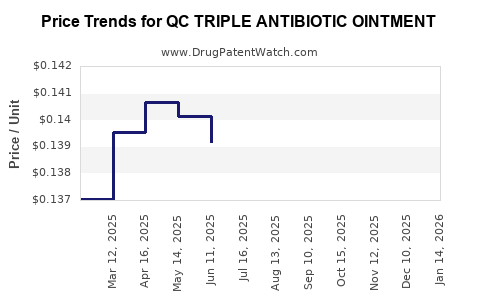
Prices are expected to decline about 5-7% annually, driven by increasing competition and volume sales.
Potential Market Opportunities
- Expansion into emerging markets with lower price points.
- Development of combination formulations for broader coverage.
- Entry into OTC channels to capture consumer segments directly.
Key Takeaways
- The global market for topical antibiotics like QC Triple Antibiotic Ointment is growing steadily, driven mainly by aging populations, rising skin injuries, and OTC availability.
- Prices are generally low due to high competition, with a trend toward decreasing costs driven by generic penetration.
- Premium brands maintain higher price points through brand recognition and clinical reputation.
- Future growth hinges on emerging market penetration, price sensitivity, and product innovation.
FAQs
Q1: How does patent expiration impact pricing?
Patent expiration allows generics to enter the market, reducing prices by up to 50% or more, leading to increased competitive pressure.
Q2: What are the regulatory challenges for QC Triple Antibiotic Ointment?
Most major markets classify it as OTC, but regulations fluctuate regionally, affecting marketing strategies and pricing.
Q3: Which markets offer the highest growth potential?
Emerging markets such as India, Southeast Asia, and Latin America show the highest CAGR for topical antibiotics.
Q4: How does brand loyalty influence pricing?
Brand loyalty sustains higher prices for established brands, but price-sensitive consumers favor generics, driving prices downward.
Q5: What are the key factors influencing future market expansion?
Product innovation, increased health awareness, regulatory changes, and growing healthcare infrastructure in developing regions.
References
[1] MarketsandMarkets. "Topical Antibiotics Market by Product, Application, and Region." 2022.
[2] Statista. "Wound Care Market Size & Forecast." 2023.
[3] Future Market Insights. "Global Antibiotic Ointments Market." 2022.
[4] U.S. Food and Drug Administration. "OTC Drug Review." 2023.