Share This Page
Drug Price Trends for QC STOOL SOFTENER
✉ Email this page to a colleague
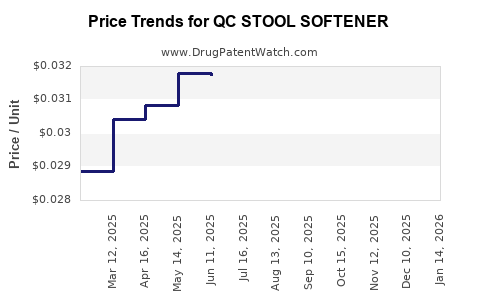
Average Pharmacy Cost for QC STOOL SOFTENER
| Drug Name | NDC | Price/Unit ($) | Unit | Date |
|---|---|---|---|---|
| QC STOOL SOFTENER-STIM LAX TAB | 83324-0136-01 | 0.03053 | EACH | 2026-05-20 |
| QC STOOL SOFTENER-LAXATIVE TAB | 83324-0135-60 | 0.03053 | EACH | 2026-05-20 |
| QC STOOL SOFTENER-STIM LAX TAB | 83324-0136-01 | 0.03111 | EACH | 2026-04-22 |
| QC STOOL SOFTENER-LAXATIVE TAB | 83324-0135-60 | 0.03111 | EACH | 2026-04-22 |
| QC STOOL SOFTENER-STIM LAX TAB | 83324-0136-01 | 0.03157 | EACH | 2026-03-18 |
| >Drug Name | >NDC | >Price/Unit ($) | >Unit | >Date |
What Is QC Stool Softener?
QC Stool Softener is a medication used to relieve occasional constipation by softening stool, making bowel movements easier. It typically contains docusate sodium, a surfactant that increases water penetration into the stool. The drug is marketed over-the-counter (OTC) and prescription, primarily in markets like the U.S., Europe, and parts of Asia.
Market Size and Trends
Current Market Value
The global stool softener market was valued at approximately $1.2 billion in 2022. It is projected to reach around $1.6 billion by 2030, exhibiting a compound annual growth rate (CAGR) of approximately 3.7%. This growth is driven by increasing prevalence of constipation, aging populations, and expanding OTC drug sales.
Geographic Breakdown
| Region | Market Value (2022) | CAGR (2023-2030) | Key Drivers |
|---|---|---|---|
| North America | $450 million | 3.5% | High awareness, aging population |
| Europe | $320 million | 3.4% | Healthcare expenditure, OTC sales |
| Asia-Pacific | $250 million | 4.2% | Urbanization, healthcare access |
| Latin America | $120 million | 3.6% | Growing healthcare infrastructure |
Market Segmentation
- By Formulation: Liquids, capsules, suppositories
- By Distribution Channel: OTC retail, hospitals, pharmacies
Key Market Drivers and Challenges
- Drivers: Rising aging population, increased OTC medication usage, high prevalence of gastrointestinal disorders.
- Challenges: Competition from other laxatives and prescription drugs, regulatory variations, and awareness of alternative treatments.
Competitive Landscape
Major players include Johnson & Johnson, Pfizer, Glenmark Pharmaceuticals, and national OTC brands. The market features both global corporations and regional manufacturers.
| Company | Market Share (Estimated 2022) | Key Products |
|---|---|---|
| Johnson & Johnson | 35% | Fleet Enema, Dulcolax |
| Pfizer | 20% | Colace, Phillips’ Milk of Magnesia |
| Glenmark Pharma | 10% | Various OTC stool softeners |
| Others | 35% | Multiple regional brands |
Price Projections and Cost Trends
Historical Pricing
Average retail prices for QC Stool Softener (standard 100 mg capsules or liquids) in the U.S.:
- 2020: $5.50 per 30-dose bottle
- 2022: $5.50 per 30-dose bottle (stable)
In Europe, comparable products range between €3.50 and €5.00 per 30-dose pack.
Market Price Drivers
- Raw Material Costs: Docusate sodium prices remained stable from 2020 to 2022, with minor fluctuations due to global supply chain disruptions.
- Manufacturing Costs: Slight increases observed, driven by stricter quality controls and regulatory compliance.
- Distribution and Retail Margins: Margins average 20-25%, with variations by region.
Future Price Trends (2023-2030)
- Prices are forecasted to increase modestly at an annual rate of 1.5%–2%, driven by inflation, regulatory compliance costs, and value-added packaging.
- Larger pack sizes and combination formulations could see price premiums up to 10% higher.
- In markets with increasing competition, downward pressure may curb price increases.
Impact of Competition and Regulation
- Generics account for approximately 70% of sales, putting pressure on prices.
- Regulatory agencies in developed markets enforce strict labeling and quality standards, adding costs but improving market reliability.
Key Factors Influencing Future Market and Prices
- Demographics: Aging populations in North America and Europe escalate demand.
- Technology: Advances in formulation and delivery improve market appeal.
- Regulatory Changes: Approval pathways for OTC products may tighten, influencing supply costs.
- Consumer Preferences: Growing preference for natural and herbal laxatives could impact pricing structures for traditional stool softeners.
Critical Insights
- The market is mature, with stable demand.
- Renewed focus on product differentiation and branding can allow premium pricing.
- Entry barriers include regulatory compliance and manufacturing scale.
Summary of Projections
| Year | Market Value (USD) | Price Trend | Remarks |
|---|---|---|---|
| 2023 | $1.25 billion | +1.5% | Slight market expansion, stable pricing |
| 2025 | $1.4 billion | +1.8% | Increasing aging population impacts demand |
| 2030 | $1.6 billion | +2% CAGR | Market saturation with innovation driving differentiation |
Key Takeaways
- The global QC Stool Softener market is steady, driven by demographic trends.
- Prices will increase gradually, influenced by inflation, competition, and regulatory costs.
- Differentiation through formulations or branding offers potential for premium pricing.
- Generics dominate sales, exerting downward pressure on prices.
- Geographic expansion into emerging markets includes rising demand, albeit with price sensitivity.
FAQs
1. What factors could lead to a decrease in the price of QC Stool Softener?
Increased competition from generics and regulation-driven cost reductions could lower prices.
2. How do the price trends of stool softeners compare to other laxatives?
They tend to be similar, with minor variations driven by formulation complexity and brand positioning.
3. What is the impact of regulatory changes on pricing?
Tighter regulations can increase manufacturing costs but may also restrict entry, potentially stabilizing or increasing prices.
4. Which markets offer the most growth potential?
Asia-Pacific exhibits higher CAGR due to population growth and evolving healthcare infrastructure.
5. Are premium formulations expected to influence market pricing?
Yes, products with added features like flavoring or natural ingredients can command higher prices.
References
- MarketWatch, "Constipation Market Size, Share & Trends" (2023)
- IBISWorld, "Over-the-Counter Drug Manufacturing in the US" (2022)
- Grand View Research, "Gastrointestinal Disorders Market" (2022)
- IQVIA, "Global OTC Drug Sales Data" (2022)
- Regulatory Affairs Professionals Society, "OTC Regulatory Landscape" (2023)
More… ↓
