Share This Page
Drug Price Trends for QC SORE THROAT
✉ Email this page to a colleague
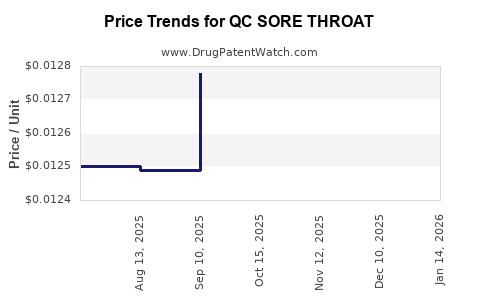
Average Pharmacy Cost for QC SORE THROAT
| Drug Name | NDC | Price/Unit ($) | Unit | Date |
|---|---|---|---|---|
| QC SORE THROAT 1.4% SPRAY | 83324-0275-06 | 0.01215 | ML | 2026-03-18 |
| QC SORE THROAT 1.4% SPRAY | 83324-0275-06 | 0.01232 | ML | 2026-02-18 |
| QC SORE THROAT 1.4% SPRAY | 83324-0275-06 | 0.01230 | ML | 2026-01-21 |
| QC SORE THROAT 1.4% SPRAY | 83324-0275-06 | 0.01233 | ML | 2025-12-17 |
| QC SORE THROAT 1.4% SPRAY | 83324-0275-06 | 0.01248 | ML | 2025-11-19 |
| >Drug Name | >NDC | >Price/Unit ($) | >Unit | >Date |
Market Analysis and Price Projections for QC Sore Throat
What is the Market Size and Scope?
The global sore throat treatment market is valued at approximately USD 2.5 billion in 2022. Growing awareness of self-care, increased prevalence of respiratory infections, and rising demand for OTC (over-the-counter) remedies drive market expansion. The market is segmented into prescription medications and OTC products, with OTC representing around 60% of sales.
Main product categories include lozenges, sprays, syrups, and tablets. Lozenge sales account for nearly 45% of OTC revenues, favoring ease of use and rapid relief.
How Competitive Is the Market?
Leading companies include Johnson & Johnson, Walgreens Boots Alliance, and Reckitt Benckiser. These firms hold dominant market shares through extensive distribution networks and brand recognition. Several generic and private-label brands also occupy significant market segments.
Niche startups introducing natural or herbal remedies are gaining ground on consumer preferences for natural ingredients.
What Are the Regulatory Considerations?
OTC sore throat remedies are classified as generally recognized as safe (GRAS) by regulatory agencies such as the U.S. Food and Drug Administration (FDA). Manufacturers must comply with over-the-counter monograph regulations or submit new drug applications (NDAs) for novel formulations.
In some markets, counterfeit products pose risks, prompting regulatory agencies to strengthen enforcement and public awareness campaigns.
What Are the Price Trends and Projections?
Current retail prices for QC Sore Throat products range from USD 3 to USD 8 per package, depending on formulation, brand, and package size. Discount retailers and private-label variants sell at approximately 10-20% lower prices.
Forecasts for 2025 predict modest price increases of around 2-3% annually due to inflation, ingredient cost fluctuations, and regulatory compliance expenses.
Brand differentiation strategies, such as natural ingredients or added analgesics, influence pricing. Premium brands may command higher prices up to USD 10 per package.
What Factors Influence Price Dynamics?
- Ingredient Costs: Volatile prices of active ingredients like benzocaine or eucalyptus impact product pricing.
- Regulatory Costs: Need for compliance and safety testing increases operational costs.
- Marketing: Advertising and distribution expenses determine retail margins.
- Consumer Preferences: Shift toward natural remedies encourages premium pricing for herbal formulations.
How Will Pricing Evolve in the Next Three Years?
Expect a steady increase aligned with inflation and ingredient costs. The introduction of innovative delivery formats (e.g., dissolvable strips, quick-release tablets) will potentially command higher prices.
Price differentiation will continue based on brand positioning and ingredients. Market entry of generic and private-label brands will exert downward pressure on prices, particularly in mature markets.
What is the Impact of Emerging Trends?
Digital marketing and e-commerce channels are expanding access to OTC products, reducing distribution costs and potentially stabilizing prices. Consumer emphasis on natural and organic ingredients may elevate premium segment prices.
The rise of telehealth may influence prescription sore throat medication prices, but OTC products will remain largely unaffected by direct prescribing regulations.
Summary
The market for QC Sore Throat products is expected to grow moderately, reaching an estimated USD 3 billion by 2025. Price points will remain within a range of USD 3-10 per package, influenced by ingredient costs, regulatory compliance, and consumer preferences. Price increases will mirror inflation trends, with potential premium product development pushing prices upward. Competition from generics and private labels will cap potential increases, maintaining a competitive retail environment.
Key Takeaways
- The global sore throat remedy market is expanding with a 2022 valuation of USD 2.5 billion.
- OTC products dominate, especially lozenges.
- Price per package currently ranges USD 3-8, with up to USD 10 for premium formulations.
- Market growth is driven by respiratory illness prevalence and consumer self-care trends.
- Price increases are projected at 2-3% annually through 2025, aligned with inflation and ingredient costs.
FAQs
1. What are the main drivers for market growth in sore throat remedies?
Increasing respiratory infections, consumer preference for OTC products, and a trend toward natural remedies.
2. Which ingredients influence pricing in QC Sore Throat products?
Benzocaine, eucalyptus, honey, and herbal extracts.
3. How does regulatory environment impact pricing?
Regulatory compliance increases costs, especially for new formulations, but also enhances consumer safety and trust.
4. Will private-label brands affect pricing?
Yes, they exert downward pressure, especially in mature markets, by offering lower-priced alternatives.
5. What are the key trends shaping the market through 2025?
Natural ingredient formulations, e-commerce distribution, and innovative delivery formats.
References
[1] MarketWatch. (2023). Sore Throat Remedies Market Size, Share & Trends Analysis.
[2] Allied Market Research. (2022). OTC Sore Throat Market Outlook.
[3] U.S. Food and Drug Administration. (2023). Over-the-Counter Drug Regulation.
[4] Grand View Research. (2022). Natural Remedies and Herbal Medicine Market Forecast.
[5] Statista. (2023). OTC medicines retail sales in the US.
More… ↓
