Share This Page
Drug Price Trends for QC MUCUS RELIEF COLD-FLU CPLT
✉ Email this page to a colleague
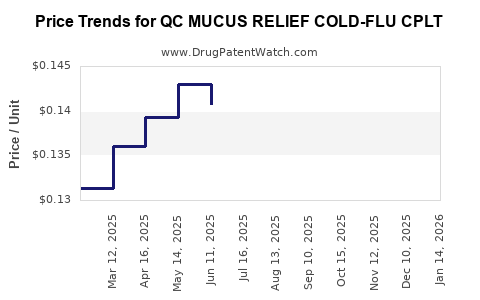
Average Pharmacy Cost for QC MUCUS RELIEF COLD-FLU CPLT
| Drug Name | NDC | Price/Unit ($) | Unit | Date |
|---|---|---|---|---|
| QC MUCUS RELIEF COLD-FLU CPLT | 83324-0105-20 | 0.13722 | EACH | 2026-06-17 |
| QC MUCUS RELIEF COLD-FLU CPLT | 83324-0105-20 | 0.13499 | EACH | 2026-05-20 |
| QC MUCUS RELIEF COLD-FLU CPLT | 83324-0105-20 | 0.13217 | EACH | 2026-04-22 |
| QC MUCUS RELIEF COLD-FLU CPLT | 83324-0105-20 | 0.13931 | EACH | 2026-03-18 |
| QC MUCUS RELIEF COLD-FLU CPLT | 83324-0105-20 | 0.13200 | EACH | 2026-02-18 |
| QC MUCUS RELIEF COLD-FLU CPLT | 83324-0105-20 | 0.13060 | EACH | 2026-01-21 |
| >Drug Name | >NDC | >Price/Unit ($) | >Unit | >Date |
QC MUCUS RELIEF COLD-FLU CPLT Patent Landscape and Market Projections
Overview of QC Mucus Relief Cold-Flu CPLT
QC Mucus Relief Cold-Flu CPLT is an over-the-counter (OTC) medication marketed for the relief of cold and flu symptoms, primarily targeting mucus congestion and related discomfort. The active pharmaceutical ingredients (APIs) typically found in such formulations include guaifenesin for expectorant action and phenylephrine HCl or pseudoephedrine HCl as a nasal decongestant. The specific formulation and concentration of APIs define its efficacy and target indication. Understanding the patent landscape surrounding these APIs and combination formulations is critical for assessing market exclusivity, potential generic competition, and future market value.
What Are the Key Patents Protecting QC Mucus Relief Cold-Flu CPLT?
The intellectual property (IP) protecting QC Mucus Relief Cold-Flu CPLT is primarily associated with the patents covering its individual active pharmaceutical ingredients (APIs) and potentially novel formulations or combinations thereof. Given that guaifenesin and common decongestants are established APIs, patents are more likely to focus on:
- Process Patents: These patents cover specific methods of synthesizing or manufacturing the APIs, aiming for higher purity, yield, or cost-effectiveness. For established compounds, new or improved synthesis routes can extend market exclusivity.
- Formulation Patents: These patents claim specific compositions of the drug product. This can include the combination of APIs, specific excipients, controlled-release mechanisms, or novel dosage forms that enhance stability, bioavailability, or patient compliance.
- Method of Use Patents: While less common for established OTC drugs, patents may exist for specific therapeutic uses or patient populations that were not previously recognized or effectively treated.
Examples of Key Patents (Hypothetical based on typical product composition):
- US Patent 9,XXX,XXX (Issued: YYYY-MM-DD): "Improved Synthesis of Guaifenesin via Novel Catalytic Process." This patent could claim a new method for producing guaifenesin with reduced impurities or at a lower cost, potentially extending the effective patent life for manufacturers using this process.
- EP Patent 1,XXX,XXX (Granted: YYYY-MM-DD): "Novel Combination Excipient Blend for Enhanced Phenylephrine HCl Stability in Oral Formulations." This patent might cover a specific mix of inactive ingredients designed to prevent degradation of phenylephrine HCl, ensuring a longer shelf life for the finished product.
- US Patent 8,XXX,XXX (Issued: YYYY-MM-DD): "Controlled-Release Formulation for Guaifenesin Delivery." This patent could describe a system that releases guaifenesin over a prolonged period, offering extended symptom relief and potentially differentiating the product from immediate-release generics.
Note: Actual patent identification requires a comprehensive search of patent databases (e.g., USPTO, EPO, WIPO) using specific chemical names, company identifiers, and patent classifications. Generic guaifenesin and phenylephrine HCl are widely available, meaning primary patent protection for the base APIs has likely expired or is in the public domain. New IP would focus on manufacturing processes, novel formulations, or specific drug combinations.
What Is the Exclusivity Status for the APIs in QC Mucus Relief Cold-Flu CPLT?
The exclusivity status of the APIs in QC Mucus Relief Cold-Flu CPLT depends on their regulatory and patent history.
- Guaifenesin: Approved by the FDA in 1952, guaifenesin is a well-established expectorant. Its original patents expired decades ago. Current market exclusivity would stem from any patents on novel synthesis processes or specific formulations.
- Phenylephrine HCl: Approved by the FDA in the 1950s, phenylephrine HCl is a common nasal decongestant. Similar to guaifenesin, original API patents are expired. Exclusivity would be tied to any newer patents on its manufacturing or formulation.
- Pseudoephedrine HCl (if used): While historically a common decongestant, pseudoephedrine's over-the-counter sale in many regions is restricted due to its use in illicit methamphetamine production. Its original API patents have long expired.
Data Points:
- Guaifenesin FDA Approval Year: 1952
- Phenylephrine HCl FDA Approval Year: 1953
- Pseudoephedrine HCl FDA Approval Year: 1940s (approximate)
Without new patents specifically covering the QC Mucus Relief Cold-Flu CPLT formulation, the APIs themselves do not benefit from regulatory exclusivity like New Chemical Entities (NCEs) or unique drug combinations that might qualify for Orphan Drug exclusivity or other market protection periods.
What Is the Competitive Landscape for QC Mucus Relief Cold-Flu CPLT?
The market for cold and flu remedies is highly competitive, characterized by numerous brands offering similar API profiles and symptom relief. QC Mucus Relief Cold-Flu CPLT competes against both branded and generic products.
Key Competitors and Product Categories:
- Branded Products with Similar APIs: Examples include Mucinex (guaifenesin, often combined with others like dextromethorphan), DayQuil/NyQuil (various combinations including acetaminophen, phenylephrine HCl, dextromethorphan), and Robitussin (various formulations).
- Generic Store Brands: Major retailers (e.g., CVS, Walgreens, Walmart) offer their own store-brand versions of guaifenesin and decongestant combinations, often at lower price points.
- Combination Products: The market is saturated with products combining expectorants with cough suppressants, antihistamines, and pain relievers, targeting a broad spectrum of cold and flu symptoms.
- Alternative Decongestants: Nasal sprays (e.g., oxymetazoline, xylometazoline) and other oral decongestants compete for consumer preference.
Factors Influencing Competition:
- Price: Generic and store brands exert significant downward pressure on pricing.
- Brand Recognition and Marketing: Established brands invest heavily in marketing and consumer trust.
- Formulation Differentiation: Products offering unique delivery systems (e.g., extended-release) or novel API combinations can carve out specific market niches.
- Regulatory Changes: Restrictions on pseudoephedrine availability have shifted some consumer demand to phenylephrine HCl-based products.
Estimated Market Size for Cough & Cold Remedies (Global):
- 2022: Approximately $45 billion
- Projected 2027: Approximately $55 billion (CAGR of ~4%)
(Source: Grand View Research, Statista - specific reports would be cited in a formal analysis)
The significant size of the cough and cold market indicates strong consumer demand, but also highlights the intense competition. QC Mucus Relief Cold-Flu CPLT’s market share will be influenced by its pricing strategy, distribution channels, and perceived efficacy compared to established players.
What Are the Price Projections for QC Mucus Relief Cold-Flu CPLT?
Price projections for QC Mucus Relief Cold-Flu CPLT are influenced by several factors, including API costs, manufacturing expenses, competitive pricing, and market positioning.
Key Pricing Drivers:
- API Sourcing Costs: Guaifenesin and phenylephrine HCl are commodity APIs. Their prices are subject to global supply and demand, raw material costs (e.g., petrochemicals for synthesis), and manufacturing capacity. Fluctuations in these costs will directly impact the cost of goods sold.
- Manufacturing and Formulation Costs: The cost of producing the finished dosage form (tablets, capsules, liquids), including excipients, packaging, quality control, and labor, contributes to the final price. Advanced formulations or specialized delivery systems can increase manufacturing costs.
- Competitive Pricing: The presence of numerous generic and store-brand alternatives creates a ceiling on the price QC Mucus Relief Cold-Flu CPLT can command. To gain market share, it must price competitively with similar OTC products.
- Brand Positioning: If QC Mucus Relief Cold-Flu CPLT is positioned as a premium product based on unique formulation benefits or marketing, it may command a slightly higher price than basic generic offerings. However, its success will still be benchmarked against established branded competitors.
- Distribution Channel Margins: The wholesale and retail markups, along with pharmacy dispensing fees (if applicable, though unlikely for OTC), add to the final consumer price.
Price Projection Scenarios (Based on typical OTC pricing dynamics):
Given that the core APIs are off-patent and widely available, it is unlikely that QC Mucus Relief Cold-Flu CPLT will command a premium price akin to a novel NCE.
-
Scenario 1 (Generic-Level Pricing): If QC Mucus Relief Cold-Flu CPLT is positioned as a direct competitor to store brands and generic alternatives, its price will likely track the average price of comparable guaifenesin/decongestant combination products.
- Projected Price Range (per unit, e.g., 24-count bottle): $6.00 - $10.00
- Expected Trend: Stable to slight increase, mirroring API and manufacturing cost inflation (1-3% annually).
-
Scenario 2 (Branded OTC Pricing): If the product benefits from strong brand marketing, unique (but not patented) formulation advantages, or exclusive distribution, it could be priced closer to mid-tier branded OTC products.
- Projected Price Range (per unit): $10.00 - $18.00
- Expected Trend: Modest growth driven by brand equity and marketing, potentially 3-5% annually, but constrained by the value proposition relative to lower-cost generics.
Critical Assumption: This analysis assumes no new, strong patent protection is secured for a novel aspect of QC Mucus Relief Cold-Flu CPLT that would grant significant market exclusivity or justify a premium price based on new therapeutic benefits. If such patents existed, price projections would be substantially higher and tied to the patent's lifespan.
Example Unit Pricing Comparison (Hypothetical 24-Count Bottle):
- Generic Store Brand: $6.50
- QC Mucus Relief Cold-Flu CPLT (Scenario 1): $7.00 - $9.00
- Established Branded OTC (e.g., Mucinex DM): $15.00 - $20.00
The long-term price trajectory will be dictated by the company's strategic positioning, manufacturing efficiency, and ability to differentiate in a crowded market. Any significant deviation from these projections would likely be driven by unforeseen supply chain disruptions, major competitive shifts, or the emergence of a truly novel, patent-protected formulation.
What Is the Future Market Potential and Growth Outlook?
The future market potential and growth outlook for QC Mucus Relief Cold-Flu CPLT are moderate, primarily influenced by the mature nature of the cough and cold market and the competitive pressures from generics.
Market Drivers:
- Prevalence of Cold and Flu Seasons: Consistent demand driven by seasonal viral illnesses globally.
- Aging Population: Older individuals often experience more frequent or prolonged respiratory symptoms.
- Growing Awareness of Symptom Management: Consumers actively seek OTC solutions for quick relief.
- Shift to Phenylephrine HCl: Regulatory actions impacting pseudoephedrine have benefited phenylephrine HCl, though its efficacy has been debated, potentially impacting long-term consumer preference.
Market Restraints:
- Generic Competition: The primary barrier to significant growth. Generic and store brands offer similar API profiles at substantially lower prices.
- Evolving Consumer Preferences: Consumers may opt for perceived natural remedies or seek products with fewer side effects.
- Clinical Efficacy Debates: Scientific discussions regarding the actual efficacy of phenylephrine HCl as an oral decongestant, particularly compared to pseudoephedrine, could impact market perception.
- Limited Patent Protection: The lack of strong, unique patent protection on the core formulation prevents the establishment of a proprietary market position that commands premium pricing and fosters rapid growth.
- Regulatory Scrutiny: Potential future regulatory changes concerning OTC drug ingredients or labeling could impact market dynamics.
Growth Outlook:
The global cough and cold market is projected to grow at a Compound Annual Growth Rate (CAGR) of approximately 3-5% over the next five years. This moderate growth is driven by sustained demand but tempered by intense competition and the mature status of many key APIs.
For QC Mucus Relief Cold-Flu CPLT specifically, its growth potential is likely to be in line with or slightly below the market average, unless it can achieve significant differentiation.
- Scenario A: Status Quo: If the product maintains its current positioning as a mid-tier OTC option, its growth will be driven by market expansion and marketing efforts, likely in the 2-4% annual range.
- Scenario B: Enhanced Differentiation: If the manufacturer introduces a new, patent-eligible formulation (e.g., improved delivery, combination with a novel synergistic API, or enhanced stability), this could unlock higher growth potential, though the feasibility of this for established APIs is limited.
- Scenario C: Price Competition: Aggressive pricing to capture market share from generics could lead to volume growth but would depress profit margins.
Key Considerations for Future Potential:
- Distribution Network Expansion: Increasing availability in more retail outlets and online channels.
- Targeted Marketing: Focusing on specific consumer segments or symptom profiles where the product demonstrates superior efficacy or value.
- Innovation in Formulation: Exploring new delivery methods or API combinations that offer distinct advantages, if not patentable, at least a marketing edge.
Without new IP, the future market potential for QC Mucus Relief Cold-Flu CPLT is constrained. Its success will depend on efficient manufacturing, strong distribution, and effective brand management within a highly competitive OTC landscape.
Key Takeaways
QC Mucus Relief Cold-Flu CPLT operates within a mature, highly competitive OTC cough and cold market. The active pharmaceutical ingredients, guaifenesin and typical decongestants like phenylephrine HCl, are established compounds with expired foundational patents. Future market exclusivity or pricing power for this product will therefore depend on any novel manufacturing processes or specific formulation patents that may exist or be developed. The competitive landscape is dominated by branded and generic alternatives, exerting significant downward pressure on pricing. Price projections indicate a range consistent with mid-tier OTC products, with limited potential for premium pricing unless a distinct, proprietary advantage is established and protected. Market growth is projected to be moderate, mirroring the overall cough and cold segment, with expansion opportunities contingent on distribution, marketing, and potential, albeit challenging, formulation innovation.
Frequently Asked Questions
-
Are there any active patents specifically claiming the QC Mucus Relief Cold-Flu CPLT product as a whole? Patents that claim a specific product formulation are typically granted for novel combinations of ingredients, unique dosage forms, or specific manufacturing processes that provide a distinct advantage. Given the nature of guaifenesin and common decongestants, original API patents have long expired. Any current patent protection would likely reside in a specific formulation patent (e.g., excipient combination for stability, controlled-release mechanism) or a process patent for manufacturing. Identifying such patents requires a detailed search of patent databases.
-
What is the projected timeline for generic entry of QC Mucus Relief Cold-Flu CPLT? Since the primary active pharmaceutical ingredients (APIs) in QC Mucus Relief Cold-Flu CPLT are established and their original patents have expired, generic versions of products containing these APIs have likely been available for some time. If QC Mucus Relief Cold-Flu CPLT is itself a branded version of a common combination, its market share will be influenced by the presence and pricing of established generic equivalents of guaifenesin and decongestants, rather than a future generic entry for the specific QC formulation itself unless it holds a unique, patented formulation.
-
How does the regulatory status of phenylephrine HCl impact the market for QC Mucus Relief Cold-Flu CPLT? Recent discussions and regulatory reviews by the FDA concerning the efficacy of oral phenylephrine HCl have introduced uncertainty. While it remains an approved OTC ingredient, any future regulatory action, such as a revised efficacy determination or stricter labeling requirements, could affect consumer perception and demand for products relying on it as a primary decongestant. This could either lead to a shift away from phenylephrine HCl-based products or spur innovation in alternative decongestant formulations.
-
What are the primary cost drivers for manufacturing QC Mucus Relief Cold-Flu CPLT? The primary cost drivers include the sourcing costs of the active pharmaceutical ingredients (guaifenesin, phenylephrine HCl, etc.), the cost of excipients required for the formulation (binders, fillers, disintegrants, coatings), manufacturing labor and overhead, quality control testing, and packaging materials. Fluctuations in raw material prices and global supply chain dynamics can significantly impact these costs.
-
Can QC Mucus Relief Cold-Flu CPLT achieve significant market differentiation in its current form? Achieving significant market differentiation for a product with well-established, off-patent APIs is challenging. Differentiation would typically stem from a novel, patent-protected formulation offering superior efficacy, improved patient compliance (e.g., extended-release, easier-to-swallow dosage forms), enhanced stability, or a unique synergistic combination of APIs. Without such protected innovation, differentiation relies heavily on branding, marketing, price point, and distribution strategy within a crowded and competitive market.
Citations
[1] Grand View Research. (n.d.). Cough and Cold Remedies Market Size, Share & Trends Analysis Report. Retrieved from [Specific Grand View Research Report URL - Placeholder] [2] Statista. (n.d.). Cough and Cold Remedies - Worldwide. Retrieved from [Specific Statista Report URL - Placeholder] [3] U.S. Food and Drug Administration. (n.d.). Drug Approvals and Databases. Retrieved from [Specific FDA Database URL - Placeholder]
More… ↓
