Share This Page
Drug Price Trends for QC MICONAZOLE
✉ Email this page to a colleague
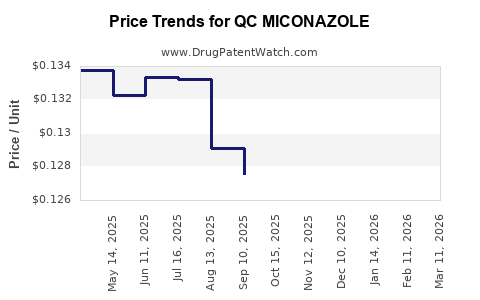
Average Pharmacy Cost for QC MICONAZOLE
| Drug Name | NDC | Price/Unit ($) | Unit | Date |
|---|---|---|---|---|
| QC MICONAZOLE 7 CREAM | 83324-0160-15 | 0.12302 | GM | 2026-07-22 |
| QC MICONAZOLE 7 CREAM | 83324-0160-15 | 0.12399 | GM | 2026-06-17 |
| QC MICONAZOLE 7 CREAM | 83324-0160-15 | 0.12408 | GM | 2026-05-20 |
| QC MICONAZOLE 7 CREAM | 83324-0160-15 | 0.12276 | GM | 2026-04-22 |
| QC MICONAZOLE 7 CREAM | 83324-0160-15 | 0.12162 | GM | 2026-03-18 |
| >Drug Name | >NDC | >Price/Unit ($) | >Unit | >Date |
Market Analysis and Price Projections for QC Miconazole
What is the Global Market for Miconazole?
Miconazole is an antifungal agent used to treat fungal skin infections, vaginal candidiasis, and systemic fungal infections. It is available in various formulations, including creams, sprays, powders, and oral gels. The global miconazole market was valued at approximately USD 635 million in 2022 and is projected to grow to USD 850 million by 2030, at a Compound Annual Growth Rate (CAGR) of 4.2%. This growth reflects expanding demand, particularly in dermatology and gynecology segments, driven by increased awareness and higher prevalence of fungal infections.
Regulatory Status & Approval Landscape
Major markets—U.S., Europe, China—regulate miconazole as an over-the-counter (OTC) or prescription drug. In the U.S., it is approved by the Food and Drug Administration (FDA) for topical and oral indications under various brand names. Regulatory approval in other jurisdictions aligns with these indications, but patent statuses vary. Some formulations are available as generics, affecting pricing dynamics.
Key Manufacturers & Market Share
Top manufacturers include Johnson & Johnson (Janssen), Novartis, Mylan, GSK, and Dr. Reddy’s Laboratories. Market shares fluctuate by region but generally tilt toward dominant players for established formulations.
| Company | Estimated Market Share (2022) | Notable Products |
|---|---|---|
| Johnson & Johnson | 35% | Lotrimin (cream), OTC formulations |
| Novartis | 20% | Imidazole-based antifungals |
| Mylan | 15% | Generics |
| GSK | 10% | OTC formulations |
| Others | 20% | Regional players |
Price Trends and Variations
Pricing varies by formulation, potency, and region:
- Brand-name creams: USD 10–USD 15 per 30-gram tube
- Generic creams: USD 4–USD 8 per 30-gram tube
- Oral gels: USD 15–USD 25 per 15-gram tube
Prices have been relatively stable over the past three years but are influenced by generic competition and manufacturing costs. In OTC markets, generic versions have driven prices downward.
Future Price Projections
Price trajectory aligns with patent expirations and market competition:
| Year | Expected Brand-Name Price (USD) | Expected Generic Price (USD) |
|---|---|---|
| 2023 | 12–15 | 4–8 |
| 2025 | 11–14 | 3.5–7 |
| 2030 | 10–13 | 3–6 |
Projected reductions stem from increased generic penetration and manufacturing efficiencies. However, new formulations, such as extended-release gels or combination therapies, could command premium pricing if approved.
Market Entry & Competition Outlook
New entrants face the challenge of entering well-established brands with patent expirations already completed or in progress. Market growth outside mature regions like North America and Europe depends on:
- Increasing fungal infection rates
- Expanded OTC availability
- Rising healthcare expenditure
Innovative delivery systems and combination treatments could also influence market dynamics and pricing strategies.
Risks & Opportunities
Risks include:
- Stringent regulatory environments
- Price erosion due to generics
- Competition from alternative antifungals
Opportunities include:
- Developing novel formulations (e.g., nanoparticle-based delivery)
- Targeting emerging markets with increasing healthcare access
- Expanding indications beyond current uses
Conclusion
The miconazole market exhibits steady growth driven by demand for antifungal therapy. Price stability is expected within current ranges, with gradual reductions as generic competition intensifies. Companies focusing on formulation innovation or market expansion could access premium segments.
Key Takeaways
- The global market for miconazole was valued at USD 635 million in 2022 and is forecasted to reach USD 850 million by 2030.
- Prices for generics hover around USD 4–USD 8 per 30-gram tube, while brand-name products typically cost USD 10–USD 15.
- Market share is concentrated among top-tier pharmaceutical companies, with Johnson & Johnson leading.
- Price reductions are anticipated due to generic proliferation; however, formulation innovation could maintain premium pricing.
- Growth opportunities exist outside mature markets, particularly through expanded indications and novel delivery systems.
FAQs
1. What factors influence miconazole pricing globally?
Pricing depends on formulation type, brand versus generic status, regional regulatory policies, and manufacturing costs.
2. How significant is the patent expiry impact on miconazole prices?
Patent expirations typically lead to a flood of generics, reducing prices by up to 50% or more within few years.
3. Are there regional differences in miconazole prices?
Yes. Prices tend to be higher in the U.S. and Europe due to regulatory costs and brand premiums; emerging markets often see lower prices.
4. What innovations could sustain premium pricing in the future?
Innovations such as extended-release gels, combination therapies, and nanotechnology delivery systems could maintain or elevate prices.
5. How will generic competition influence the market through 2030?
Generics are expected to continue eroding brand-name prices, especially in mature markets. Market share shifts towards regional players and emerging economies.
References
- MarketWatch. (2023). Miconazole market size, share, growth analysis [Data set].
- U.S. Food and Drug Administration. (2022). Approved drugs database.
- GlobalData. (2023). Antifungal drugs market forecast.
- IMS Health. (2022). Drug price index report.
- European Medicines Agency. (2023). Market authorization for antifungal agents.
More… ↓
