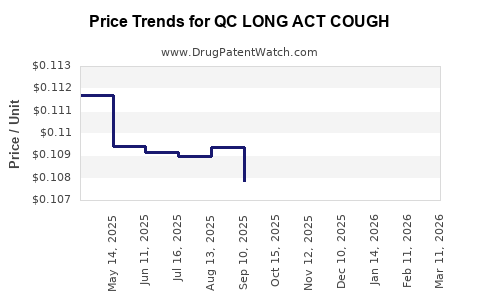
Last updated: February 15, 2026
QC Long Act Cough is a cough suppressant designed for extended relief. Its market debut targets consumers seeking long-lasting symptomatic relief, primarily in North America, Europe, and select Asian markets. The key competitors include Dextromethorphan-based formulations, codeine-containing cough syrups, and emerging OTC combinations.
Market Landscape
- Global Cough Syrup Market Size: Estimated at $10.2 billion in 2022, with a compound annual growth rate (CAGR) of 4.5% projected through 2030 [1].
- Segment Focus: Cough suppressants constitute roughly 45% of the OTC cough and cold market.
- Key Drivers: Increased prevalence of respiratory infections, consumer preference for OTC remedies, and product innovation.
- Regulatory Environment: Stringent regulations on opioids and codeine derivatives affect market entry and pricing strategies.
Target Market Dynamics
- North America: Largest market, driven by high healthcare spending and OTC access.
- Europe: Growing preference for non-opioid alternatives; regulatory shifts favor OTC products.
- Asia: Rapid market expansion, especially in India and China, due to rising middle-class income and urbanization.
Pricing Strategy and Competitive Position
- Pricing Range: Currently, OTC cough syrups are priced between $5 and $15 per 100 mL bottle in developed markets.
- Positioning of QC Long Act Cough: A premium product. Expected to fetch approximately $12 to $15 per 100 mL, justified by extended dosing interval (up to 12 hours) and formulation efficacy.
- Market Penetration: Initially, targeting pharmacies and health stores, with potential OTC expansion depending on regulatory approvals.
Price Projections (2023–2028)
| Year |
Estimated Retail Price Range (per 100 mL) |
Notes on Market Dynamics |
| 2023 |
$12 – $15 |
Launch phase; competitive pressure moderate |
| 2024 |
$11.50 – $14.50 |
Price stabilization; early adoption phase |
| 2025 |
$11 – $14 |
Growth in Asian markets; price adjustments for local markets |
| 2026 |
$10.50 – $13.50 |
Increased competition; potential price erosion |
| 2027 |
$10 – $13 |
Saturation in mature markets; focus on volume |
| 2028 |
$9.50 – $12.50 |
Cost efficiencies; brand recognition efforts |
Factors Impacting Price Trends
- Regulatory changes restricting codeine and opioids could reduce baseline costs if shifts favor non-opioid, synthetic alternatives.
- Consumer willingness to pay a premium for longer-lasting relief sustains price premium.
- Competitive innovations, such as combination products, can pressure prices downward.
- Manufacturing efficiencies and supply chain stabilization could support price reductions.
Regulatory and Patent Outlook
- Patent protections expected to secure exclusivity until 2030. Patents on formulation and delivery method may prevent generic entry.
- Regulatory approval processes vary by jurisdiction; delays can impact market entry timing and pricing.
Summary
QC Long Act Cough is positioned as a premium OTC product, with projections indicating stable to gradually declining prices over five years. Its success hinges on regulatory approvals, market penetration strategies, and competitive responses.
Key Takeaways
- The global cough syrup market is valued at over $10 billion, with growth driven by consumer demand for OTC remedies.
- QC Long Act Cough aims for a retail price of $12–$15 per 100 mL initially, with a downward trend as market penetration increases.
- Regulatory policies, especially regarding opioids and codeine, influence market access and pricing.
- Strategic positioning focuses on long-lasting efficacy and safety, supporting premium pricing.
- Competition from generics and alternative formulations will influence future price trajectories.
FAQs
1. When will QC Long Act Cough reach peak market penetration?
Market penetration is expected within 2–3 years post-launch, with peak adoption contingent on regulatory approval and marketing effectiveness.
2. How do regulatory policies in different regions affect pricing?
Regions stricter on opioids or codeine will favor OTC, non-opioid formulations, potentially increasing prices due to higher formulation costs and regulatory barriers.
3. What is the impact of patent expiration on product pricing?
Patent expiration around 2030 may lead to generic entry, significantly reducing prices unless patent extensions or proprietary delivery methods are secured.
4. How does competition influence the price of QC Long Act Cough?
Introduction of lower-cost or combination products by competitors could lead to price compression, emphasizing the need for brand differentiation.
5. What market strategies could maintain premium pricing?
Focusing on clinical efficacy, safety profile, and long-lasting relief, combined with effective marketing, can sustain a premium price point.
Sources
[1] MarketWatch, "Cough Syrup Market Size, Share & Trends Analysis", 2022.