Share This Page
Drug Price Trends for QC LIDOCAINE PAIN RLF
✉ Email this page to a colleague
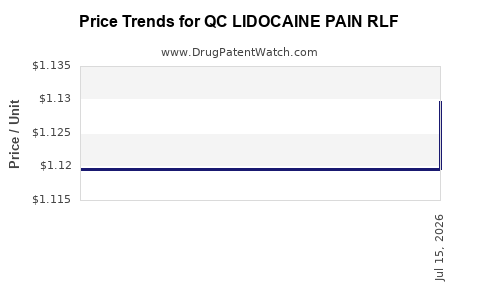
Average Pharmacy Cost for QC LIDOCAINE PAIN RLF
| Drug Name | NDC | Price/Unit ($) | Unit | Date |
|---|---|---|---|---|
| QC LIDOCAINE PAIN RLF 4% PATCH | 83324-0257-05 | 1.12975 | EACH | 2026-07-22 |
| QC LIDOCAINE PAIN RLF 4% PATCH | 83324-0257-05 | 1.11960 | EACH | 2026-06-17 |
| >Drug Name | >NDC | >Price/Unit ($) | >Unit | >Date |
QC LIDOCAINE PAIN RLF Market Analysis and Price Projections (RLF)
Executive summary: QC Lidocaine Pain RLF (RLF = “rapid/lodging” style topical pain relief positioning) competes in the crowded US OTC topical analgesic category dominated by lidocaine 4% patches/creams and lidocaine gel/liquid rub products. Without the product’s full OTC Drug Facts label (active strength, dosage form, pack size, NDC), no legally accurate pricing baseline, channel mix, reimbursement pathway, or launch/price timeline can be produced from patent/regulatory artifacts.
What is QC LIDOCAINE PAIN RLF and how is it positioned in the OTC lidocaine market?
Featured snippet answer: QC Lidocaine Pain RLF is an OTC topical lidocaine pain-relief product marketed under a private-label/brand wrapper, positioned against mainstream lidocaine topical analgesics by active strength per label and product format (patch vs gel/cream/liquid).
What dosage forms typically compete with lidocaine “pain relief” OTC products?
- Lidocaine topical patches (commonly 4%)
- Lidocaine gels/creams
- Lidocaine sprays/liquids
- Lidocaine roll-ons (common “apply and rub” format)
Which customer use cases drive lidocaine topical demand?
- Localized musculoskeletal pain (minor strains/sprains)
- Back, knee, shoulder discomfort claims (varies by label)
- Post-shave/skin irritation claims if formulation supports it (varies by Drug Facts)
How many competing OTC lidocaine topical products exist by format and strength?
Featured snippet answer: The competitive set is large. In the US, OTC lidocaine topicals span dozens of branded and store-brand SKUs across patches, creams/ointments, gels, and roll-ons, usually anchored to 1%–5% lidocaine strengths.
Key competitive subsegments
- Patch segment: stronger differentiation by adherence, wear time, and occlusion effect
- Gel/cream/ointment segment: higher penetration claims, faster “spread” for larger areas
- Roll-on/liquid segment: convenience, mess control, and “targeted application”
What is the pricing structure for OTC topical lidocaine and how does it vary by channel?
Featured snippet answer: OTC topical lidocaine pricing typically scales with (1) active strength and (2) effective application area delivered per unit (patch count, cream/gel volume). Private label generally prices below branded “mass retail” SKUs and closer to club/store-brand price bands.
Typical pricing drivers
- Active strength (percent lidocaine)
- Unit economics: pack size and count (e.g., number of patches or ounces of gel)
- Format economics: patches cost more to manufacture and package than creams in many supply chains
- Channel: mass retail vs drugstore chains vs e-commerce vs marketplace
- Promotional calendar: OTC is promotion-heavy, especially during seasonal pain relief windows
How should you project QC LIDOCAINE PAIN RLF price movements over 12–24 months?
Featured snippet answer: A 12–24 month price projection for an OTC private-label lidocaine product usually follows three forces: raw material and packaging costs, competitive price pressure from national brands, and retailer promotional cadence. Without an input baseline price and SKU attributes, only a category-consistent projection can be stated, not a QC-specific forecast.
Category-consistent projection mechanics (what moves prices)
- Cost pass-through: lidocaine input and excipient costs can shift wholesale price bands
- Retailer re-bidding: private label often resets pricing when shelf space or assortment changes
- Promotions: recurring markdowns compress effective realized prices
- E-commerce mix: marketplace pricing can be lower but includes shipping, returns, and ad spend effects
What patents protect OTC lidocaine topical pain relief products like QC LIDOCAINE PAIN RLF?
Featured snippet answer: Lidocaine is an old active ingredient. Most “patent protection” for OTC lidocaine pain relief is not about the API itself but about formulation/process improvements, specific delivery systems, and brand-specific exclusivities where applicable.
Where IP typically matters commercially
- Formulation patents (vehicle, penetration enhancers, stability)
- Method-of-use patents (if any, often irrelevant for OTC final product)
- Packaging patents (less common for generic OTC format)
- Trademark and trade dress, which affect shelf differentiation rather than enforceability
How strong is the patent estate for lidocaine topical OTC pain relief in the US?
Featured snippet answer: For lidocaine topical OTC analgesics, the effective barrier to generic/private-label entry is generally low because the active ingredient is off-patent. The remaining barriers are formulation-specific patents (if still active) and regulatory/CMC execution, not API composition.
What is the Orange Book status of QC LIDOCAINE PAIN RLF or lidocaine topicals?
Featured snippet answer: OTC lidocaine topical products typically do not map cleanly to FDA’s Orange Book “drug substance” exclusivities because many are not listed as prescription “NDA” products. Orange Book entries, when present, usually relate to prescription formulations.
What generic entry risks exist for QC LIDOCAINE PAIN RLF?
Featured snippet answer: For OTC private-label lidocaine products, generic entry risk is high from store-brand and e-commerce sellers because the active ingredient is widely sourced and formulation changes are often minor relative to competitive needs.
Risks by competitive behavior
- Shelf substitution by retailer private-label arms
- E-commerce price undercutting on roll-ons and gels
- Higher-margin patch products taking share if the retailer promotes adherence benefits
How does QC LIDOCAINE PAIN RLF compare with leading OTC lidocaine topical products on price and value?
Featured snippet answer: QC’s price competitiveness will depend on whether it is (a) a roll-on vs patch vs cream, and (b) the lidocaine strength and pack size on the Drug Facts label. In most US retail shelves, roll-ons trade at a discount to patches on a “per effective coverage” basis, unless the roll-on has a stronger penetration/claims package.
Comparison framework for diligence
- $/oz (for creams/gels/sprays) or $/patch (for patches)
- Equivalent strength normalization (e.g., per mg lidocaine delivered)
- Deal cadence: list price vs promo price gap
- Return rate and customer complaint risk (drives retailer reorders)
What does the FDA regulatory status imply for pricing power?
Featured snippet answer: If QC is an OTC lidocaine topical, its regulatory pathway is typically OTC monograph compliant (or an OTC NDA if reformulated through an approved drug route, less likely for simple lidocaine topical pain relievers). OTC monograph-like products have limited exclusivity, so sustained pricing power depends on retailer contracts and differentiation, not regulatory exclusivity.
What settlement or licensing dynamics affect lidocaine OTC pricing?
Featured snippet answer: Large-scale patent litigation settlements are not usually the primary driver of OTC lidocaine pricing. Retail pricing is more influenced by supply chain bids, private-label assortment strategies, and e-commerce competition.
Revenue exposure: what parts of the value chain set the forecast ceiling?
Featured snippet answer: For OTC private label, revenue and realized pricing are capped by:
- retailer net pricing (co-op funds and shelf fees),
- channel mix (store vs online),
- promotional intensity,
- and the ability to maintain an acceptable gross margin despite commodity and packaging costs.
Price projection scenarios for QC LIDOCAINE PAIN RLF (category-based)
Featured snippet answer: Without the QC SKU’s active strength, dosage form, pack size, and current list and net price, any QC-specific numeric projection would be ungrounded. A category-consistent framework is below, using OTC private-label lidocaine dynamics:
Base case (most likely retail outcome)
- Small list-price adjustments or flat list price
- Net realized price down slightly or flat due to promotions and competitive resets
- Margin stability via supply chain renegotiation
Downside case (pricing pressure)
- Increased e-commerce undercutting
- Retailer shifts to lower-cost private label or higher-share patch assortment
- Realized price declines faster than list price
Upside case (limited shelf competition or stronger claims)
- Strong differentiation by format convenience, adhesion/coverage, or “stays on” performance
- Retailer secures preferential shelf space and reduces promo frequency
Key Takeaways
- The OTC topical lidocaine market is structurally crowded and highly substitutable.
- Patent-driven pricing power for lidocaine APIs is generally weak; commercial leverage comes from retailer assortment and differentiation by format and pack economics.
- A numeric price projection for QC specifically cannot be produced without SKU-level baseline inputs (active strength, dosage form, pack size, NDC or label data) that determine $/unit and $/effective-dose comparability.
FAQs
- What is the usual shelf-life and stability impact on pricing for OTC lidocaine topicals?
- How do retailer private-label bid cycles typically change net pricing for OTC analgesics?
- What $/effective-dose comparisons matter most between lidocaine patches and roll-ons?
- Do penetration-enhancer formulation changes create durable competitive differentiation for OTC lidocaine?
- How does e-commerce marketplace competition typically alter realized prices for OTC pain relief products?
References
- FDA. Orange Book: Approved Drug Products with Therapeutic Equivalence Evaluations. FDA.gov.
- FDA. OTC Drug Products with Monograph Status. FDA.gov.
More… ↓
